
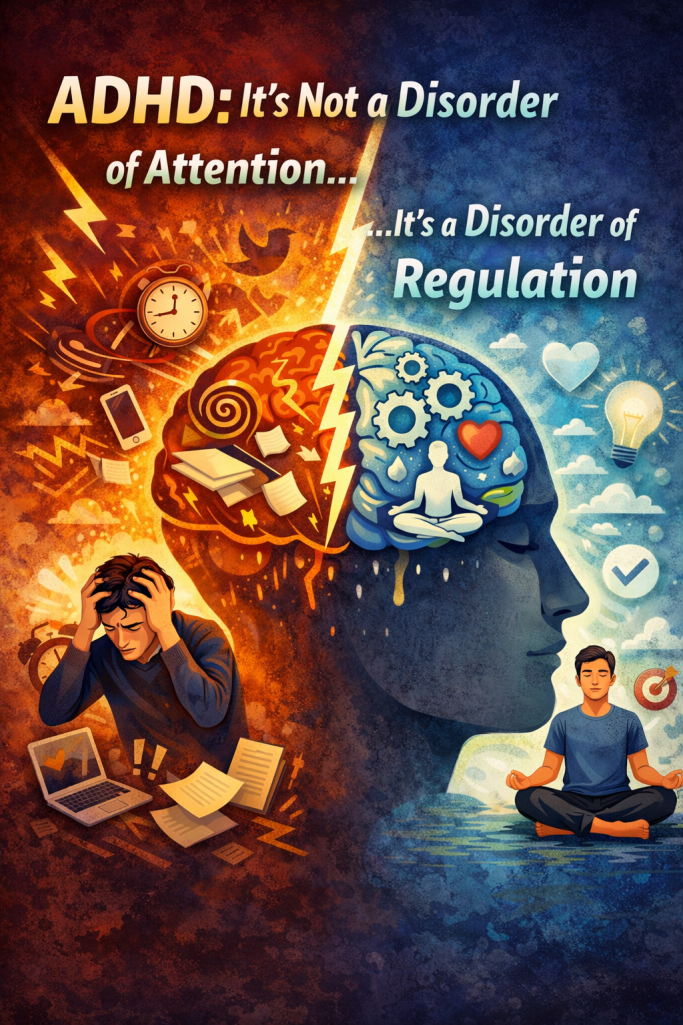
ADHD Is Not a Disorder of Attention…
It’s a Disorder of Regulation
By Neal Glendenning
For as long as ADHD has been publicly discussed, it has been described as a problem of attention.
You can’t focus.
You’re easily distracted.
You struggle to concentrate on what matters.
This explanation is so familiar that it often goes unquestioned. It appears in diagnostic criteria, school reports, workplace feedback, and casual conversation. It has shaped how people with ADHD are treated… and how they come to understand themselves.
And yet, for many people who live with ADHD, this explanation has always felt… incomplete.
Because they know something that doesn’t fit the story.
They know what it’s like to focus intensely… sometimes for hours at a time. To disappear into a task, an idea, a system, a problem. To hold complexity, notice patterns, think deeply and creatively while the world fades into the background.
They also know what it’s like to sit in front of something important and feel utterly unable to begin. To reread the same sentence repeatedly. To feel their mind fragment under pressure. To be told… again… that if they just tried harder, this wouldn’t be happening.
These two realities cannot coexist under a simple attention-deficit model.
If attention were broken, it would be absent all the time.
If focus were impaired, it would not appear so powerfully under the right conditions.
But attention in ADHD does not disappear randomly.
It fluctuates.
And fluctuation tells us something crucial.
If attention can be present, absent, collapse, or surge depending on context, then attention itself cannot be the primary problem.
Attention is not missing.
It is unstable.
And instability is not an attention issue.
It is a regulation issue.
This distinction matters more than it might initially seem, because once you stop treating attention as the root problem, the entire picture of ADHD begins to reorganise itself.
Suddenly, the contradictions make sense.
Why interest restores focus.
Why pressure destroys it.
Why “trying harder” backfires.
Why emotional overwhelm precedes cognitive collapse.
Why sensory environments matter more than motivation.
Why burnout appears not as tiredness, but as shutdown.
Attention problems are not the cause.
They are the signal.
The idea of ADHD as an attention disorder did not arise because it was the most accurate explanation of lived experience. It arose because attention was the most visible thing to measure.
Classrooms noticed children who struggled to sit still, follow instructions, or remain focused on tasks that required sustained, externally directed attention. Workplaces later noticed adults who procrastinated, missed deadlines, or seemed unable to focus on routine administrative work.
Attention was what disrupted systems designed around stillness, compliance, and linear productivity. So attention became the headline.
What this framing quietly did was shift responsibility inward.
If the problem is attention, the solution is effort, discipline, strategies, or correction. The environment remains unquestioned. The nervous system is ignored.
But visibility is not causality.
When a nervous system is overwhelmed, threatened, overstimulated, or emotionally flooded, attention is one of the first things to collapse. Not because the person doesn’t care… but because the system is reallocating resources away from exploration and toward survival.
This is not a defect.
It is biology.
To understand ADHD properly, we have to understand what regulation actually is… and what it isn’t.
Regulation is not calmness.
It is not obedience.
It is not emotional suppression or behavioural control.
Regulation is the nervous system’s ability to stay within a tolerable range of activation while responding flexibly to the world.
A regulated nervous system can:
- shift attention intentionally
- integrate emotion without flooding
- recover after stress
- modulate energy and arousal
- respond rather than react
Importantly, regulation does not mean low intensity.
A regulated nervous system can be excited, focused, driven, curious, or deeply engaged.
What matters is flexibility.
ADHD is characterised not by a lack of attention, but by difficulty maintaining regulatory flexibility across contexts.
That difficulty shows up everywhere… not just in focus.
Once regulation becomes the lens, a pattern emerges.
Emotions arrive quickly and intensely.
Sensory input accumulates rather than fades.
Cognitive load tips systems over faster.
Energy spikes and crashes unpredictably.
Time feels slippery, elastic, or unreal.
Attention sits downstream of all of this.
When regulation holds, attention is often extraordinary.
When regulation collapses, attention follows.
This is why telling someone with ADHD to “just focus” is like telling someone in a burning building to concentrate on a spreadsheet.
The problem is not willingness.
It is state.
Consider emotional regulation.
For many people with ADHD, emotion does not arrive gently. It arrives with speed and force, carrying full sensory and cognitive detail. There is often less buffering time between stimulus and response.
This does not mean emotions are inappropriate or exaggerated.
It means they are less filtered.
Small moments accumulate: a change in tone, an unexpected demand, a background noise, a feeling of being watched or evaluated. Each one adds load.
Eventually, the nervous system crosses a threshold.
At that point, attention does not drift.
It drops out.
From the outside, this looks like distraction, avoidance, or disengagement. From the inside, it feels like overload.
Again: attention is not the cause.
It is the casualty.
The same pattern appears with sensory regulation.
Many ADHD nervous systems do not automatically filter sensory input. Sound, light, movement, texture, emotional atmosphere… all remain “on”.
Individually, these inputs are manageable.
Cumulatively, they are exhausting.
By the time attention collapses, the system has often been processing at high volume for hours or days.
This is why open-plan offices drain capacity.
Why classrooms exhaust children before learning begins.
Why meetings with layered social expectations are so depleting.
Attention doesn’t fail unpredictably.
It fails predictably, once regulatory capacity is exceeded.
If attention were the problem, effort would fix it.
But effort is one of the fastest ways to destabilise a dysregulated nervous system.
Pressure activates threat.
Threat narrows attention.
Narrowed attention reduces flexibility.
This is why “trying harder” so often produces the opposite of what is intended.
The nervous system cannot be bullied into regulation.
It can only be supported into it.
At this point, the attention-deficit model is no longer holding.
It cannot explain:
- hyperfocus
- context-dependent performance
- emotional flooding
- sensory overload
- burnout
- shutdown
- the collapse that follows sustained effort
A regulation-based model can.
And once you see that, the question shifts.
The question is no longer:
Why can’t I focus?
It becomes:
What is dysregulating my nervous system… and why am I being asked to function there anyway?
Once regulation becomes the lens, another misunderstanding comes into focus.
For years, emotional dysregulation in ADHD was treated as a side issue… a secondary feature, a comorbidity, or a personality complication layered on top of the “real” problem of attention.
But emotional dysregulation is not peripheral.
It is structural.
It is the load-bearing wall.
Emotion is not separate from cognition. It is not something that occasionally interferes with thinking. Emotion is one of the primary ways the nervous system evaluates safety, relevance, and urgency.
For many people with ADHD, emotional signals arrive with high resolution and minimal delay. There is less buffering between stimulus and response, and less dampening of intensity once the signal is detected.
This does not mean emotions are irrational or excessive.
It means they are unfiltered.
The nervous system is receiving more data, more quickly, and with fewer brakes.
Under those conditions, attention does not wander. It follows the strongest signal available.
Interest captures it.
Threat hijacks it.
Meaning locks it in place.
Neutral, low-salience tasks struggle to compete… not because the person doesn’t care, but because the nervous system is not registering them as alive.
This is why boredom is not mild discomfort in ADHD.
It is dysregulation.
Boredom is often framed as a motivational failure. In reality, it is a state in which the nervous system cannot generate sufficient arousal to remain engaged.
The body goes flat.
The mind fogs.
Initiation disappears.
Under-stimulation is as dysregulating as overload.
And again, attention is not the primary issue.
It is responding appropriately to a system that is not providing the level of engagement required to stay online.
This is why novelty, challenge, urgency, or meaning can restore function almost instantly. Not because dopamine has been “added”, but because the nervous system has been brought back into a workable range of activation.
This reframing exposes one of the most damaging myths about ADHD: that motivation is a matter of discipline.
In reality, ADHD motivation is state-dependent.
People with ADHD do not lack motivation. They lack consistent access to motivational states.
When the nervous system is regulated and engaged, motivation can be immense. When it is dysregulated… either overstimulated or under-stimulated… motivation collapses.
Shame does not restore motivation.
Pressure does not create sustainability.
Punishment does not produce regulation.
They increase threat.
And threat collapses access.
Time perception follows the same pattern.
Time blindness is often framed as poor planning or lack of foresight. But time, like attention, is not experienced abstractly by the nervous system.
Time becomes real through emotional engagement.
Deadlines that carry meaning register early.
Deadlines that feel arbitrary remain abstract until they become urgent.
This is not irresponsibility.
It is experiential time.
When the nervous system is disengaged, future consequences do not generate sufficient signal to guide present action. When urgency arrives, the signal finally crosses threshold… often at the cost of anxiety.
This is why many people with ADHD rely on panic to function.
Not because they enjoy it.
Because it is the only reliable way their system has learned to come online.
Impulse control, too, shifts meaning under a regulation model.
Impulsivity is not the absence of inhibition. It is action occurring before regulatory processing has caught up.
When emotional or sensory signals move quickly, behaviour can follow before cognitive modulation has time to intervene.
This is not carelessness.
It is speed.
And speed without regulation produces outcomes that are later judged harshly… by others and by the person themselves.
Again, attention is not broken.
Regulation is unstable.
Once we understand ADHD as a regulation difference rather than an attention deficit, another long-standing harm becomes visible.
Most support systems are built backwards.
They attempt to improve attention through:
- pressure
- structure imposed without safety
- rewards and consequences
- behavioural correction
These strategies assume regulation will follow compliance.
In practice, they often do the opposite.
They increase load.
They increase threat.
They increase masking.
Which temporarily improves appearance while eroding capacity underneath.
This is why so many people with ADHD describe a lifetime of trying harder… and burning out anyway.
They were never supported to regulate.
They were trained to override.
A regulation-first model changes the entire direction of support.
Instead of asking:
- How do we get this person to focus?
We ask:
- What would help this nervous system stay within a workable range?
That question leads to different answers.
Answers like:
- reducing sensory load
- increasing predictability
- building in recovery
- anchoring time externally
- supporting emotional processing
- designing environments that generate engagement rather than demand it
When regulation is supported, attention follows.
Not perfectly. Not constantly.
But reliably enough to sustain a life.
This reframing also explains why ADHD is so often mischaracterised as a childhood condition that should be outgrown.
Children are regulated externally.
Adults are expected to self-regulate constantly.
As demands increase and support decreases, regulatory instability becomes more visible.
ADHD doesn’t suddenly appear in adulthood.
The scaffolding disappears.
By now, the original question has been fully overturned.
ADHD is not a disorder of attention.
Attention is the most visible point of collapse… not the source.
ADHD is a condition in which regulation across emotional, sensory, cognitive, temporal, and energetic domains is more fragile, more effortful, and more context-dependent.
That fragility is not a flaw.
It is a signal.
A signal that environments matter.
That safety matters.
That design matters.
And that asking people to function indefinitely in dysregulating systems will always produce collapse — no matter how capable they are.
If you have spent your life oscillating between intense focus and complete shutdown, this is not evidence that something is wrong with you.
It is evidence that your nervous system responds accurately to conditions.
When those conditions support regulation, you can do remarkable things.
When they don’t, attention disappears… not as a failure, but as protection.
That is not an attention disorder.
That is a nervous system doing its job.
And once we understand that, the task is no longer to fix people.
It is to change the conditions under which they are asked to live, learn, and work.