
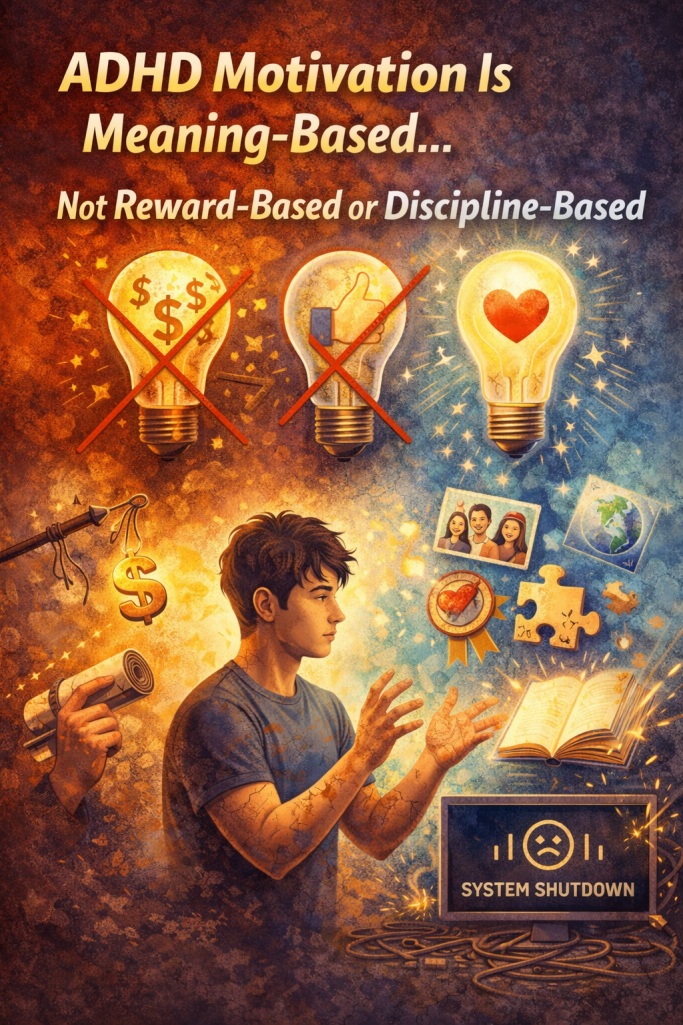
ADHD Motivation Is Meaning-Based…
Not Reward-Based or Discipline-Based
By Neal Glendenning
There is a sentence that follows people with ADHD everywhere.
You just need more discipline.
It appears in childhood, in school reports and classroom interventions. It resurfaces in adulthood, in workplaces, self-help books, productivity systems, and internal self-talk. It is offered as advice, criticism, encouragement, and diagnosis all at once.
If you cared more, you’d do it.
If you tried harder, you’d follow through.
If the consequences mattered enough, you’d be motivated.
This sentence sounds reasonable… until you compare it to lived reality.
Because people with ADHD are not unmotivated in general.
They are often intensely motivated… just not consistently, and not by the things they are told should motivate them.
They can work for hours without noticing hunger or time.
They can pursue complex goals with astonishing persistence.
They can tolerate effort, difficulty, and uncertainty when something feels alive.
And yet, they can sit paralysed in front of tasks they genuinely want to complete. They can care deeply about outcomes and still be unable to begin. They can understand the consequences perfectly and feel no internal movement toward action.
Under a discipline-based model, this makes no sense.
If motivation were a function of willpower, importance, or consequences, then knowing something mattered would be enough to act.
It isn’t.
Which tells us something crucial.
The problem is not that motivation is absent.
It is that motivation is context-dependent.
And the context that drives ADHD motivation is not the one most systems are built around.
Traditional motivation models assume a simple sequence:
Task → Importance → Effort → Action → Reward
If a task is important enough, you apply effort. If you apply enough effort, you act. If you act, you are rewarded. Discipline bridges the gap.
This model works reasonably well for nervous systems that experience importance and future reward as emotionally present.
ADHD nervous systems often do not.
Importance alone does not generate movement.
Consequences remain abstract.
Future rewards fail to activate present energy.
This is not because the person doesn’t understand them.
It is because understanding is not the same as activation.
Motivation, at a nervous-system level, is not a moral resource.
It is an activation state.
Action becomes possible when the nervous system registers enough signal to mobilise energy. That signal can come from many sources: threat, interest, novelty, connection, urgency, meaning.
ADHD motivation is not deficient.
It is selective.
And the selector is not discipline.
It is emotional salience.
This is why ADHD motivation is so often misunderstood.
From the outside, it looks inconsistent.
From the inside, it feels precise.
Tasks that carry emotional meaning… curiosity, relevance, identity, connection, challenge… generate momentum almost automatically.
Tasks that feel neutral, imposed, or disconnected do not.
This is not laziness.
It is nervous-system logic.
For many people with ADHD, the first time this becomes visible is through what is often called hyperfocus.
Hyperfocus is usually framed as a quirk… a strange excess of attention that appears unpredictably. But hyperfocus is not excess.
It is regulated engagement.
When interest, meaning, and challenge align, the nervous system enters a state where energy, attention, and persistence synchronise. Effort does not feel effortful. Time collapses. Distraction fades.
Under a discipline model, hyperfocus is an anomaly.
Under a regulation-and-meaning model, it is the clearest evidence we have that motivation in ADHD is not broken… it is misunderstood.
The real contradiction emerges when we look at what fails to motivate.
Punishment rarely works.
Shame reliably backfires.
Pressure produces short-term action at long-term cost.
People with ADHD often report that consequences only “work” when they become urgent enough to trigger anxiety.
This is not motivation.
It is threat.
And threat is a terrible long-term regulator.
When urgency becomes the primary way action happens, the nervous system learns that safety and productivity are incompatible.
Calm equals inertia.
Panic equals movement.
This is why so many people with ADHD describe a life organised around last-minute crises. Not because they enjoy chaos, but because it is the only state in which their system has learned to come online reliably.
The cost of this pattern is enormous.
Chronic anxiety.
Burnout.
Loss of trust in one’s own rhythms.
Deep shame around “only working under pressure”.
Again, discipline is not missing.
Safety is.
Shame deserves special attention here, because it is so often mistaken for a motivational tool.
Many people with ADHD have been shamed into short bursts of productivity for most of their lives. They have learned to associate self-criticism with action, and self-compassion with collapse.
This creates a deeply damaging internal economy.
If I’m kind to myself, I stop.
If I’m harsh enough, I move.
But shame does not generate sustainable motivation.
It generates threat-based compliance.
Over time, it erodes access to curiosity, play, and meaning… the very states that actually drive ADHD motivation.
Once we step back, a different picture emerges.
ADHD motivation is not reward-based in the traditional sense. External rewards often fail to activate sustained engagement unless they carry emotional weight.
It is not discipline-based. Willpower cannot reliably override a nervous system that is disengaged or dysregulated.
ADHD motivation is meaning-based.
Meaning is not an abstract idea.
It is a felt sense of relevance, aliveness, and connection.
When a task connects to:
- identity
- curiosity
- values
- relationships
- impact
- challenge
the nervous system responds.
Energy becomes available.
Attention stabilises.
Initiation becomes possible.
Not because the person suddenly became disciplined… but because their system has been given a reason to move.
At this point, the old question… “Why can’t I make myself do this?”… starts to lose its power.
A better question begins to form:
“What about this task is failing to engage my nervous system… and what would make it meaningful enough to activate?”
That question leads somewhere entirely different.
To understand why meaning matters so much for ADHD motivation, we have to be precise about what meaning actually does at a nervous-system level.
Meaning is not inspiration.
It is not positivity.
It is not liking something.
Meaning is signal strength.
When something matters emotionally… when it connects to identity, curiosity, values, or relationship… the nervous system registers it as relevant enough to allocate energy.
This is why external rewards so often fail.
Rewards sit after the task.
Meaning sits inside it.
A reward promised in the future has very little impact on a nervous system that is struggling to feel the present as alive. The signal is too distant, too abstract, too thin to mobilise action.
This is why incentive systems that work well for some people leave others unmoved… or actively demoralised.
They assume motivation flows forward from consequence.
For many ADHD nervous systems, motivation flows from engagement backward into action.
This is also why advice like “just break it into smaller steps” so often misses the mark.
Breaking a task into steps reduces cognitive load.
It does not increase emotional signal.
You can make a task smaller and still find it impossible to begin if the nervous system remains disengaged.
Initiation does not fail because the steps are too large.
It fails because nothing in the task is pulling the system toward it.
When people with ADHD say “I know what to do, I just can’t do it,” this is not defiance or confusion.
It is an access problem.
The capacity exists.
The signal does not.
This distinction explains one of the most painful experiences people with ADHD report: caring deeply and still being unable to act.
Under a discipline-based model, this is read as hypocrisy or lack of integrity.
Under a regulation-and-meaning model, it is entirely coherent.
Caring is cognitive and emotional.
Acting requires activation.
Without sufficient signal, care remains inert.
This is why people with ADHD often experience intense guilt around motivation. They do care. They care a great deal. But caring alone does not reliably move their nervous system into action.
Meaning has to be felt, not just understood.
When meaning is present, something remarkable happens.
The nervous system stops conserving energy and starts releasing it.
Attention stabilises.
Effort feels lighter.
Persistence increases.
Distraction fades.
This is not because the person is finally being responsible.
It is because their system has entered a state of regulated engagement.
Hyperfocus, in this context, stops being mysterious.
It is not excess motivation.
It is not obsession.
It is what motivation looks like when:
- threat is low
- engagement is high
- meaning is present
The tragedy is not that hyperfocus exists.
The tragedy is that so many people with ADHD only experience this state under conditions that are unsustainable… urgency, crisis, or extreme novelty.
When meaning is replaced by threat, engagement becomes fragile.
This brings us to a crucial turning point in the argument.
If motivation in ADHD is meaning-based, then systems that rely on pressure, shame, or arbitrary reward are not just ineffective… they are actively dysregulating.
Pressure increases threat.
Threat narrows attention.
Narrowed attention reduces flexibility.
Short-term compliance may appear.
Long-term capacity erodes.
This is why people with ADHD often report cycles of productivity followed by collapse. They are not cycling between motivation and laziness.
They are cycling between threat-driven activation and nervous-system depletion.
Meaning-based motivation is sustainable.
Threat-based activation is not.
Once this is understood, the idea of “discipline” needs to be reframed.
Discipline is often imagined as force… the ability to override internal resistance.
But force is not what sustains action in ADHD.
Structure can help.
Support can help.
External scaffolding can help.
But discipline alone cannot generate motivation where meaning is absent.
And when discipline is enforced through shame, it does real harm.
Shame teaches the nervous system that failure equals danger. It may temporarily increase urgency, but it destroys trust… both in the environment and in the self.
Over time, shame disconnects people from curiosity, play, and experimentation.
The very things that make meaning possible.
Designing for meaning, then, becomes the real task.
This does not mean every task must be fun.
It does not mean life can be organised entirely around interest.
It means that meaning has to be intentionally woven into engagement, especially when tasks are dull, repetitive, or externally imposed.
This can look like:
- connecting tasks to values or identity
- embedding choice and autonomy where possible
- working in relational contexts rather than isolation
- anchoring tasks to visible impact
- creating novelty in process, even when content is fixed
Meaning is not something you wait to feel.
It is something you design for.
This reframing also restores dignity.
When motivation is treated as a moral issue, people internalise failure.
When it is treated as a nervous-system issue, responsibility shifts.
The question stops being:
- Why can’t I make myself do this?
And becomes:
- What would help my system engage with this meaningfully?
That question invites creativity instead of self-punishment.
It also opens the door to environments that work with neurodivergent motivation rather than against it.
By the end of this chapter, one conclusion should be unavoidable.
ADHD motivation is not broken.
It is not lazy.
It is not undisciplined.
It is responsive.
Responsive to meaning.
Responsive to engagement.
Responsive to safety and regulation.
When those conditions are present, motivation appears… often in abundance.
When they are absent, no amount of discipline will reliably substitute.
If you have spent years believing that your inability to “just do things” meant something was wrong with your character, this reframing matters.
You were not failing at discipline.
You were responding accurately to a system that did not give your nervous system a reason to move.
Motivation was never the problem.
Meaning was.