
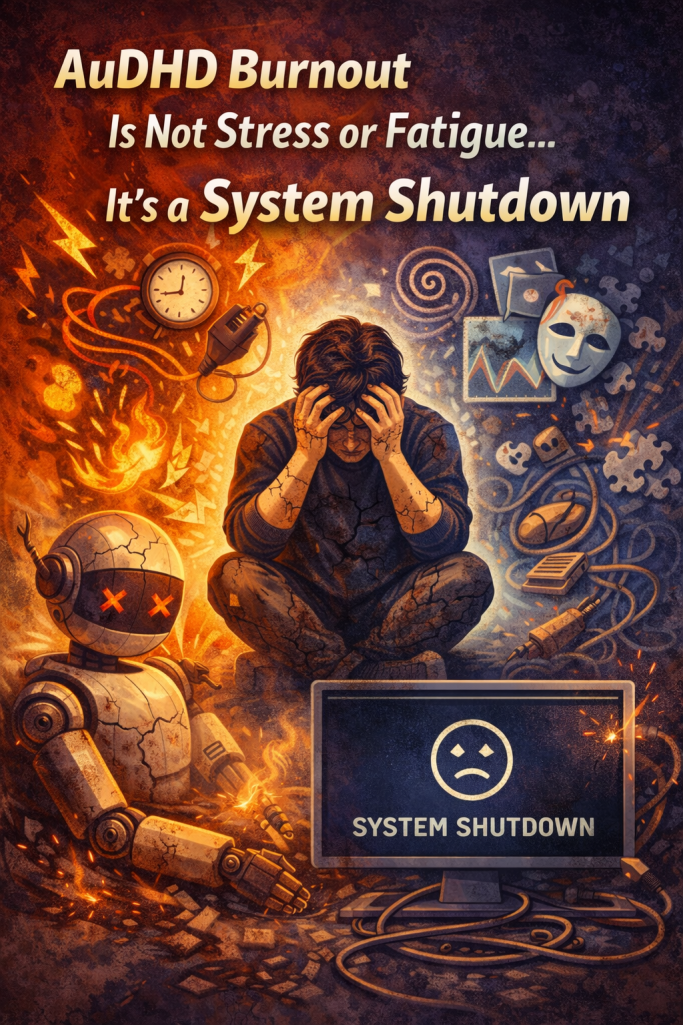
AuDHD Burnout Is Not Stress or Fatigue…
It’s a System Shutdown
By Neal Glendenning
There is a particular moment that many AuDHD people can identify with uncomfortable precision.
It is the moment when everything stops working.
Not gradually.
Not gently.
Not in a way that feels like ordinary tiredness.
One day you are functioning… perhaps struggling, perhaps stretched, but still moving… and then suddenly you are not.
Words become difficult to find.
Decisions feel impossible.
Sensory input becomes unbearable.
Emotions flatten or overwhelm without warning.
Tasks you have done for years feel unreachable.
From the outside, this moment is often described as burnout.
From the inside, it feels more like shutdown.
And that difference matters.
Because what AuDHD people experience is not well explained by existing models of stress, fatigue, or workplace burnout. Those models assume depletion that can be reversed with rest, time off, or reduced demands.
AuDHD burnout does not work that way.
Rest alone rarely fixes it.
Time off often helps only partially.
Returning to the same environment frequently triggers relapse.
This tells us something important.
What AuDHD people experience is not simple exhaustion.
It is nervous system collapse.
AuDHD burnout is frequently misunderstood because it does not follow the expected rules.
It does not arrive only after obvious overwork.
It does not respond predictably to rest.
It does not affect only motivation or mood.
It affects everything.
Cognition slows or fragments.
Speech becomes effortful.
Emotional range narrows or becomes volatile.
Sensory tolerance drops sharply.
Social interaction feels impossible.
This is not what stress looks like.
This is what a system does when it can no longer maintain regulation.
To understand AuDHD burnout, we have to step away from productivity language and look instead at what has been asked of the nervous system… and for how long.
AuDHD nervous systems are managing multiple layers of load simultaneously.
ADHD brings variability in attention, arousal, time perception, and emotional intensity.
Autistic traits add sensory sensitivity, pattern processing, social decoding, and the need for predictability.
Together, they create a nervous system that:
- processes more input
- filters less automatically
- relies heavily on conscious regulation
- requires stability to remain functional
When environments fail to provide that stability, the nervous system compensates.
For a while.
The key word here is cumulative.
AuDHD burnout does not come from a single stressor.
It comes from the accumulation of many manageable things over time.
Small sensory intrusions.
Unclear expectations.
Social monitoring.
Masking autistic traits.
Suppressing ADHD variability.
Constant self-correction.
Sustained urgency.
Inconsistent feedback.
None of these alone are catastrophic.
Together, they create a continuous demand for self-regulation.
And self-regulation is finite.
Masking plays a central role here.
AuDHD people often become exceptionally skilled at appearing functional.
They learn to:
- suppress sensory distress
- hide confusion or overload
- force eye contact or appropriate affect
- regulate emotion internally
- maintain output despite dysregulation
This is often praised as resilience.
In reality, it is energy conversion.
Masking converts internal distress into external performance.
The system sees success.
The nervous system absorbs the cost.
This is why AuDHD burnout so often surprises others.
From the outside, the person was coping.
From the inside, the nervous system was operating at the edge of capacity.
There is rarely a dramatic warning.
Instead, there is a slow narrowing:
- less tolerance for noise
- less flexibility around change
- longer recovery after interaction
- increased reliance on routines
- emotional flattening or volatility
These signs are often missed… or misinterpreted as attitude or disengagement.
By the time collapse occurs, the system has been overloaded for a long time.
At the point of burnout, the nervous system does something intelligent.
It shuts down.
This is not failure.
It is protection.
When regulation can no longer be sustained, the system reduces input, output, and engagement in order to prevent further damage.
Shutdown is not laziness.
It is not avoidance.
It is not loss of character.
It is the nervous system pulling the emergency brake.
This is why AuDHD burnout feels qualitatively different from ordinary burnout.
Ordinary burnout often involves exhaustion paired with restlessness.
AuDHD burnout often involves exhaustion paired with inaccessibility.
You may want to act and find that you cannot.
You may care deeply and feel nothing.
You may know what to do and be unable to begin.
This is not motivational collapse.
It is access collapse.
Traditional advice fails here because it misunderstands the nature of the problem.
“Just rest” assumes fatigue.
“Take a break” assumes temporary depletion.
“Reduce workload” assumes the system itself is neutral.
For AuDHD burnout, none of these are sufficient on their own.
Because the issue is not how much you did.
It is how long your nervous system was asked to function without safety.
At this stage in the chapter, one conclusion is already forming.
If AuDHD burnout were simply about stress, it would resolve with rest.
If it were about workload, it would track hours or output.
If it were about motivation, desire would return first.
It does not.
What resolves AuDHD burnout… when it resolves… is restoration of safety.
And safety is not just the absence of demands.
It is the presence of:
- predictability
- sensory containment
- relational stability
- permission to unmask
- reduced evaluative pressure
Without these, recovery stalls.
This brings us to the core reframing.
AuDHD burnout is not an individual crisis.
It is a system-level outcome.
It occurs when environments require sustained masking, chronic self-regulation, and adaptation without adequate support… and then interpret collapse as weakness.
The nervous system did not fail.
It reached its limit.
By the time AuDHD burnout is visible to others, the nervous system has already been signalling distress for a long time.
The tragedy is that these signals are rarely recognised for what they are.
They are mistaken for mood changes, attitude problems, disengagement, or lack of effort. They are often interpreted through behavioural or motivational lenses rather than regulatory ones. And because many AuDHD people have spent years masking distress, even they may not recognise the early warning signs in themselves.
But the signs are there… quietly at first, then unmistakably.
Long before collapse, regulation becomes brittle.
Recovery takes longer after ordinary demands.
Sensory input that was once tolerable becomes irritating, then painful.
Small changes feel disproportionately destabilising.
Social interaction requires increasing effort.
Emotional range narrows or becomes volatile.
People often describe feeling “thinner,” “raw,” or “closer to the edge,” without being able to explain why.
This is not emotional weakness.
It is the nervous system operating with reduced margin.
When margin disappears, flexibility disappears with it.
One of the most dangerous misunderstandings about burnout… especially for AuDHD people… is the belief that pushing through is neutral or even necessary.
In many systems, persistence under strain is rewarded. People are praised for endurance, for “keeping going,” for not letting things slip. The implicit message is that stopping would be failure.
For an AuDHD nervous system already near capacity, pushing through does not build resilience.
It accelerates damage.
Every time the system is forced to override sensory pain, emotional overload, or cognitive fatigue, the cost increases. Recovery becomes slower. Signals become louder. Eventually, override is no longer possible.
This is why AuDHD burnout often appears sudden.
From the outside, it looks like someone functioning… until they aren’t.
From the inside, it feels like a long descent followed by a final drop.
Once shutdown occurs, the experience is often frightening.
People describe:
- losing access to language
- struggling to process information
- feeling detached from emotion or overwhelmed by it
- being unable to initiate even simple tasks
- experiencing intense sensory sensitivity
This can be deeply confusing, especially for people who have previously been highly articulate, capable, and independent.
It is common for people to fear they are “regressing” or permanently damaged.
This fear is understandable… and misplaced.
Shutdown is not regression.
It is a protective state.
The nervous system shuts down when continued engagement would cause further harm. It reduces input, output, and interaction in order to preserve what remains of regulatory capacity.
In evolutionary terms, this makes perfect sense.
When fight and flight are no longer viable, freeze emerges.
AuDHD burnout sits squarely in this territory.
Understanding this matters, because it changes how recovery must be approached.
You cannot force a nervous system out of shutdown.
You cannot reason it back online.
You cannot shame it into functioning.
You can only restore safety gradually enough for regulation to return.
This is where conventional burnout advice becomes actively harmful.
Advice focused on:
- productivity hacks
- positive thinking
- gradual reintroduction of demands without environmental change
- pressure to “get back to normal”
often re-triggers shutdown.
Not because the person is resistant, but because the conditions that caused collapse are still present.
Returning to the same environment, with the same sensory load, expectations, and masking requirements, tells the nervous system that danger has not passed.
Relapse is not surprising.
It is inevitable.
True recovery from AuDHD burnout is slow, relational, and context-dependent.
It requires more than rest.
It requires:
- removal from chronic evaluative pressure
- reduction of sensory and cognitive load
- predictability and routine without rigidity
- permission to unmask without consequence
- support that does not demand performance
Most importantly, it requires time without threat.
Time in which the nervous system can relearn that engagement does not automatically lead to harm.
This is why recovery often feels nonlinear.
Progress appears, then disappears. Capacity returns in small pockets. Setbacks occur without obvious cause.
This is not failure.
It is regulation rebuilding itself.
One of the hardest parts of AuDHD burnout is the identity impact.
People who were once competent, articulate, and productive may find themselves unable to access those traits. They may begin to doubt whether they were ever real.
This is one of the cruellest effects of unsafe systems.
They don’t just exhaust the body.
They erode self-trust.
When collapse is framed as personal failure, people internalise blame for a response that was never voluntary.
Understanding burnout as system shutdown allows a different story to emerge.
A story in which:
- endurance is not confused with health
- collapse is not proof of weakness
- recovery is not measured by speed
Instead, recovery becomes about rebuilding access, not proving worth.
At this point, the central argument of this chapter becomes unavoidable.
If AuDHD burnout were about stress, rest would fix it.
If it were about workload, reduction would resolve it.
If it were about motivation, desire would return first.
It is none of these.
AuDHD burnout is the result of prolonged nervous-system overload in environments that require masking and offer insufficient safety.
It is not a personal crisis.
It is a system revealing its limits.
Once this is understood, responsibility shifts.
The question is no longer:
- Why couldn’t this person cope?
It becomes:
- Why was this nervous system required to operate beyond sustainable limits for so long?
And that question points not to individual treatment plans alone, but to systemic redesign.
Because as long as environments continue to demand constant self-regulation without support, AuDHD burnout will continue to occur… no matter how capable, motivated, or committed someone is.
If you have lived through AuDHD burnout, what happened to you was not a failure of character.
It was your nervous system protecting you when nothing else would.
Recovery is not about becoming who you were before.
It is about learning to live… and work… in conditions that do not require you to disappear in order to function.
That is not indulgence.
It is necessity.