
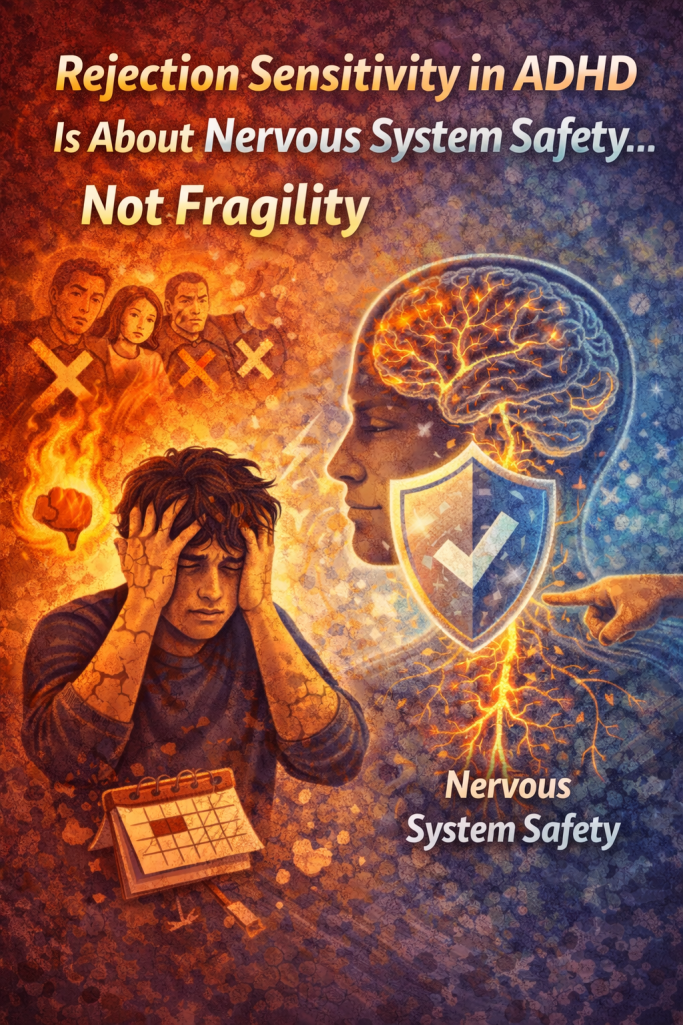
Rejection Sensitivity in ADHD Is About Nervous System Safety… Not Fragility
By Neal Glendenning
There is a particular speed to the reaction that people with ADHD often describe.
It happens before thought.
Before interpretation.
Before intention.
A look changes.
A tone shifts.
A message lands slightly differently than expected.
And the body reacts.
Heart rate jumps.
The stomach drops.
Heat floods the chest or face.
Thoughts scatter, loop, or go blank.
Only afterwards does the mind arrive with explanations.
They didn’t mean it.
I’m being too sensitive.
This is fine.
But the reaction has already happened.
And the gap between how fast the body responds and how slow logic follows is where shame is born.
Because from the outside, this reaction is often described as emotional fragility.
As overreaction.
As hypersensitivity.
As a personality issue.
And from the inside, it feels like something far more serious has been touched… something to do with safety, belonging, and survival.
That gap matters.
Because what we call rejection sensitivity in ADHD has been consistently misunderstood at the most fundamental level.
The dominant story goes something like this:
People with ADHD take things too personally.
They misread neutral cues as negative.
They react emotionally where others stay composed.
The implied solution is simple:
toughen up,
don’t take things so seriously,
develop thicker skin.
But this story does not survive contact with lived experience.
If rejection sensitivity were about thin skin, reassurance would work.
If it were about misinterpretation, explanation would calm it.
If it were about emotional immaturity, it would reduce with age.
For many people with ADHD, none of these things reliably happen.
The reaction is fast.
It is physical.
And it often occurs even when the person intellectually understands that no rejection was intended.
Which tells us something crucial.
This is not primarily a cognitive problem.
It is a nervous system problem.
To understand what is actually happening, we have to stop asking,
“Why do you react like that?”
and start asking,
“What is your nervous system responding to?”
Because nervous systems do not react to words alone.
They react to patterns.
Tone.
Timing.
Facial expression.
Power dynamics.
History.
Long before conscious thought gets involved, the nervous system is scanning for threat.
And for many people with ADHD, that scan is tuned very finely to relational danger.
Not because they are fragile.
But because they have learned, repeatedly, that relational rupture carries real consequences.
Most people with ADHD grow up in environments where they are corrected more often than their peers.
Not necessarily harshly.
Not always traumatically.
But frequently.
And consistently.
They are corrected for:
interrupting,
forgetting,
being late,
missing instructions,
being “too much,”
being “not enough.”
Often the correction is subtle.
A sigh.
A look.
A change in tone.
A withdrawal of warmth.
These moments rarely register as trauma in isolation.
But nervous systems do not learn from isolated events.
They learn from repetition.
Over time, a pattern forms.
Visibility leads to correction.
Difference leads to disapproval.
Mistakes lead to shame.
This learning does not sit in explicit memory.
It embeds in the body.
So when feedback arrives later in life… especially from someone with power… the nervous system does not evaluate intent.
It evaluates risk.
This is why rejection sensitivity in ADHD is so fast.
The nervous system is not responding to this comment.
It is responding to the accumulated history of what comments have meant before.
A neutral sentence carries the weight of previous outcomes.
A small tone shift activates a whole archive of past experiences.
A pause feels loaded because pauses have so often preceded correction or withdrawal.
This is not imagination.
It is pattern recognition.
And pattern recognition is one of the things ADHD nervous systems are exceptionally good at.
Another reason rejection sensitivity is so badly misunderstood is that it is often framed as emotional excess.
Too much feeling.
Too much reaction.
Too much intensity.
But intensity is not the same as fragility.
In fact, what we often see in ADHD is the opposite of fragility.
People with ADHD frequently tolerate enormous amounts of discomfort quietly.
They mask reactions.
They swallow emotion.
They override internal signals in order to stay acceptable.
The reaction we call rejection sensitivity is not constant.
It appears at the point where regulation fails.
It is not evidence of weakness.
It is evidence of a system that has been holding a great deal already.
Context makes this even clearer.
Rejection sensitivity is rarely uniform.
Many people with ADHD notice that they are far less reactive:
with people they deeply trust,
in environments where mistakes are safe,
when feedback is collaborative rather than evaluative.
The same words, delivered by a different person or in a different relational context, land completely differently.
If rejection sensitivity were a personality trait, context would not matter this much.
But context matters enormously.
Because context determines nervous system safety.
Power plays a central role here.
Rejection sensitivity tends to spike around:
teachers,
managers,
authority figures,
partners whose approval feels essential.
This is not coincidence.
When someone has the power to withdraw safety, resources, or belonging, the nervous system pays closer attention.
That is not pathology.
That is intelligence.
The nervous system is doing exactly what it evolved to do:
detect relational threat quickly when the cost of exclusion is high.
Over time, many people with ADHD adapt to this sensitivity by becoming hyper-vigilant.
They rehearse conversations.
They monitor tone.
They over-explain.
They apologise pre-emptively.
They suppress visible emotional reactions.
This is often described as social anxiety or people-pleasing.
At a nervous-system level, it is protective adaptation.
Masking reduces immediate risk.
It also keeps the nervous system in a constant state of alert.
Alertness is expensive.
And the longer it continues, the harder it becomes to stay regulated when feedback does arrive.
Once we understand rejection sensitivity as a learned nervous-system response, the next assumption that collapses is the idea that exposure builds tolerance.
This belief is deeply embedded in how feedback, discipline, and “character building” are justified.
If someone reacts strongly to criticism, the thinking goes, they simply need more of it. They need to get used to it. They need to learn that it’s not dangerous.
But this logic confuses two very different processes.
Habituation occurs when a nervous system repeatedly encounters a stimulus without harm.
Sensitisation occurs when a nervous system repeatedly encounters a stimulus with harm.
Most people with ADHD have not been repeatedly exposed to safe correction.
They have been repeatedly exposed to uncontained correction.
And the nervous system learns exactly what it is taught.
When feedback is delivered with shame, ambiguity, emotional charge, or power imbalance, the nervous system does not learn resilience.
It learns vigilance.
Each encounter sharpens threat detection.
Each experience lowers the threshold for activation.
Each moment reinforces the association: this is dangerous.
This is why rejection sensitivity often intensifies over time rather than diminishing.
Not because the person is failing to mature.
But because their nervous system has been trained to respond quickly in order to protect them.
Shame plays a particularly destructive role here.
Shame is not feedback.
It is a threat to belonging.
When shame is present, the nervous system does not stay open to information. It shifts into defence.
Attention narrows.
Memory fragments.
Emotional regulation collapses.
The body prepares for withdrawal or appeasement.
Whatever lesson was intended is lost.
What remains is a bodily imprint:
I am at risk.
For people with ADHD, whose nervous systems often activate quickly and intensely, shame doesn’t correct behaviour.
It locks it in.
This is why advice like “don’t take it personally” so often fails.
Personalisation is not the issue.
The nervous system is not deciding whether to feel hurt.
It is detecting a potential loss of safety.
And safety is not optional.
You cannot logic your way out of a threat response.
You cannot think your way back into regulation.
You cannot shame yourself into calm.
The response happens first.
Understanding comes later.
At this point, we need to introduce a concept that fundamentally changes how rejection sensitivity should be approached.
That concept is containment.
Containment is not kindness.
It is not softness.
And it is not avoidance of difficult truths.
Containment is the nervous system’s experience that a situation has limits.
That the relationship will hold.
That the feedback is specific.
That the person is not being evaluated as a whole.
That belonging is not at stake.
Contained feedback tells the nervous system:
This matters… but you are safe.
Uncontained feedback tells the nervous system:
Anything could happen.
And nervous systems respond accordingly.
Contained feedback has certain qualities that are remarkably consistent across contexts.
It is predictable rather than sudden.
It is specific rather than global.
It is delivered without emotional volatility.
It separates behaviour from identity.
It includes explicit signals that the relationship remains intact.
None of this lowers standards.
It lowers threat.
And threat reduction is what allows learning to occur.
This is why so many people with ADHD say they can handle feedback “if it’s delivered properly.”
They are not asking to be protected from truth.
They are asking to be protected from relational rupture.
They want to know:
Am I still safe?
Am I still valued?
Is this about growth, or about rejection?
When those questions are answered clearly, the nervous system can stay online.
When they are left ambiguous, it cannot.
The importance of containment becomes especially clear in environments with power differentials.
Managers, teachers, clinicians, and partners do not just offer information.
They control access to safety, approval, and resources.
When feedback comes from someone with power, the nervous system treats it differently.
Not emotionally.
Biologically.
This is why rejection sensitivity spikes in hierarchical environments.
And this is why attempts to individualise the problem… to locate it in “thin skin”… are so damaging.
They ignore the role of power entirely.
Over time, in the absence of containment, many people with ADHD develop elaborate strategies to manage perceived threat.
They pre-empt criticism by criticising themselves.
They over-explain to reduce misunderstanding.
They suppress emotion to avoid escalation.
They disengage to avoid exposure.
These strategies are often pathologised.
But they are not random.
They are survival adaptations.
They reduce risk in unsafe environments.
They just do so at enormous internal cost.
This brings us to a crucial and often overlooked truth.
You cannot heal rejection sensitivity in isolation.
You can understand it.
You can name it.
You can practice self-compassion.
All of these help.
But the nervous system does not learn safety alone.
It learns safety in relationship.
Through repeated experiences of being corrected without being shamed.
Of being disagreed with without being discarded.
Of being seen without being punished.
This is slow learning.
And it cannot be rushed.
If rejection sensitivity is not a flaw to be eliminated, then the goal was never to develop thicker skin.
Thicker skin implies numbness.
Distance.
Reduced perception.
But people with ADHD are not suffering because they feel too much.
They are suffering because they are asked to remain perceptive in environments that punish perception.
The task is not to blunt sensitivity.
It is to restore safety so sensitivity no longer has to defend itself.
When a nervous system repeatedly experiences containment, something subtle but profound begins to shift.
Threat detection slows.
Not because the system has been forced into silence.
But because it has learned… through repetition… that not every cue predicts harm.
This learning does not happen through insight.
It does not happen through affirmations.
And it does not happen through willpower.
It happens through pattern violation.
A moment where feedback arrives and belonging remains intact.
A disagreement that does not escalate.
A correction that does not carry shame.
A boundary that does not lead to abandonment.
Each of these moments teaches the nervous system something new.
Not cognitively.
Physiologically.
This is why healing rejection sensitivity often feels frustratingly slow.
The nervous system is not responding to what you know.
It is responding to what it has lived.
Years of conditional acceptance cannot be undone by understanding alone.
But they can be softened by consistent experience.
This is also why attempts to “manage” rejection sensitivity purely through self-regulation strategies often plateau.
Breathing techniques help.
Grounding helps.
Reframing helps.
But none of these address the root issue if the environment remains unsafe.
You cannot self-soothe your way out of a system that keeps signalling threat.
At best, you can survive it.
At this point, responsibility needs to shift.
If rejection sensitivity is shaped in relationship, then responsibility does not lie solely with the individual experiencing it.
It lies with:
- the cultures that normalise shame as motivation
- the workplaces that deliver feedback without containment
- the schools that correct difference without context
- the relationships that make belonging conditional
These systems often claim neutrality.
They are not neutral.
They privilege nervous systems that tolerate ambiguity, emotional suppression, and relational threat with minimal signalling.
Neurodivergent nervous systems simply refuse to disappear quietly.
And for that, they are often labelled difficult.
A regulation-informed understanding reframes this entirely.
What has been called “oversensitivity” is actually early warning.
It is the nervous system detecting relational instability before it becomes explicit.
In healthy systems, early warning is valuable.
In unhealthy systems, it is inconvenient.
So it is pathologised.
This reframing has practical consequences.
For individuals, it replaces self-blame with self-trust.
The question stops being:
“What is wrong with me?”
And becomes:
“What has my nervous system learned… and what would help it relearn safety?”
For relationships, it shifts the focus from managing reactions to improving containment.
For organisations, it exposes a simple truth:
If feedback regularly destabilises people, the issue is not sensitivity.
It is delivery.
None of this means avoiding truth.
It means delivering truth without threat.
High standards and nervous-system safety are not opposites.
They are allies.
People learn best when they are regulated.
They grow fastest when they feel secure.
They engage most deeply when they are not defending themselves.
This is not indulgence.
It is how humans work.
If you have lived with rejection sensitivity, it is likely you have spent years trying to fix yourself.
To be less reactive.
To care less.
To harden.
That work was never going to succeed… because it misunderstood the problem.
Your nervous system was not failing you.
It was responding intelligently to a world that repeatedly made belonging conditional.
Sensitivity was never the enemy.
Unsafety was.
When safety increases, something important happens.
Reactions slow.
Emotions become more navigable.
Feedback becomes information instead of threat.
Not because you became tougher.
But because you no longer needed armour.
The final truth of rejection sensitivity in ADHD is this:
What looks like fragility is often vigilance.
What looks like overreaction is often history.
What looks like a personal flaw is often a relational wound.
And wounds do not heal through discipline.
They heal through consistent safety over time.
Once that safety exists, sensitivity does not disappear.
It becomes what it was always meant to be:
Information.
Attunement.
Connection.