
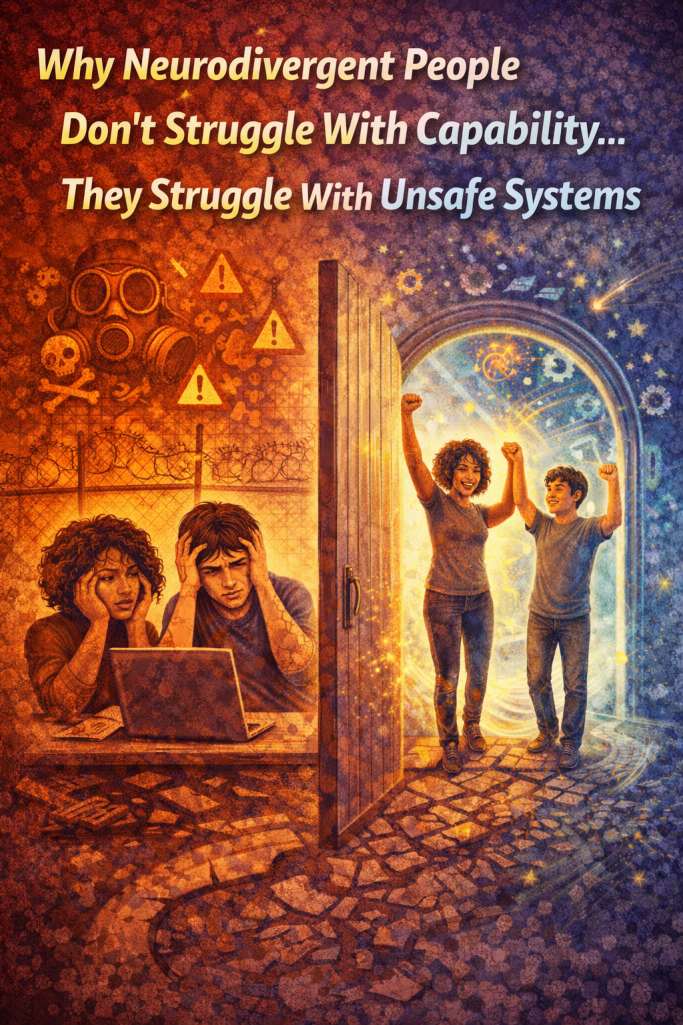
Why Neurodivergent People Don’t Struggle With Capability… They Struggle With Unsafe Systems
By Neal Glendenning
There is a contradiction that sits at the centre of almost every neurodivergent life.
On the one hand, neurodivergent people... particularly those with ADHD and AuDHD... are demonstrably capable. Often exceptionally so. They show flashes of depth, creativity, problem-solving, and insight that are unmistakable. They can work at extraordinary intensity when conditions are right. They can think laterally, relationally, systemically. They can carry complexity that others struggle to hold.
On the other hand, these same people repeatedly burn out, disengage, collapse, or are labelled as inconsistent, unreliable, or underperforming. They leave roles they were more than capable of doing. They exit education despite obvious intelligence. They withdraw from systems that insist they “just couldn’t cope.”
Both of these things are observed.
Both are documented.
Both are treated as facts.
What is rarely questioned is whether they can both be explained by the same story.
Because under an individual-deficit model, they cannot.
If capability were the issue, performance would be consistently low.
If intelligence were the issue, insight would be absent.
If motivation were the issue, interest would not restore function.
If resilience were the issue, rest would repair burnout.
But that is not what we see.
What we see instead is variability... not random variability, but patterned, context-dependent change. Capability appears in some environments and vanishes in others. The same person thrives under one set of conditions and collapses under another.
That pattern should immediately disqualify any explanation that locates the problem solely inside the individual.
And yet, that is exactly what most systems continue to do.
The individual-deficit explanation is seductive because it is simple. It allows systems to remain static. If the problem is the person, the solution is motivation, discipline, resilience training, or removal. No redesign required.
But simplicity is not accuracy.
When neurodivergent people “fail,” they are almost always told a version of the same thing: You have the ability, but you can’t apply it consistently. This framing sounds generous. It acknowledges potential. It also quietly blames the person for not accessing it.
What it never asks is why access disappears.
Capability is treated as a fixed internal resource... something you either bring with you or you don’t. If you fail to demonstrate it reliably, the assumption is that it was never really there, or that you lack the character to sustain it.
This assumption is not supported by neuroscience, lived experience, or basic pattern recognition.
Human capability is not static. It is state-dependent.
And states are shaped by nervous systems interacting with environments.
If we take seriously the idea that the nervous system governs access to cognitive and emotional resources, then inconsistency stops looking like a moral problem and starts looking like a regulatory signal.
Attention, working memory, emotional regulation, initiation, persistence... these are not switches you flip through willpower. They are functions that come online when the nervous system is within a tolerable range of activation.
When safety is present, capacity expands.
When threat accumulates, capacity contracts.
This is true for all humans. Neurodivergent people simply have narrower margins and higher costs for sustained self-regulation.
Which means they reveal the failure of unsafe systems sooner.
The question, then, is not why can’t neurodivergent people cope?
The question is what are they being asked to cope with... and at what cost?
Modern systems ask a great deal of the nervous system while pretending they are neutral.
They demand sustained attention regardless of interest or fatigue.
They require rapid task-switching without recovery.
They expect emotional suppression and social performance on demand.
They rely on urgency as a default motivator.
They impose ambiguity while penalising mistakes.
They monitor output, time, tone, and responsiveness.
All of this is framed as normal functioning.
None of it is neutral.
Every one of these demands requires active self-regulation. And self-regulation is not infinite.
For neurodivergent nervous systems, the cost of meeting these demands is often much higher. Sensory input is processed more intensely. Emotional information arrives faster and with less filtering. Cognitive switching carries a heavier load. Social monitoring is more effortful. Recovery takes longer.
The system does not account for this. It simply keeps demanding.
So neurodivergent people adapt.
They mask.
They suppress.
They push.
They override internal signals in order to remain acceptable.
And for a time, this works.
This is the part of the story that confuses observers most.
If the system is so unsafe, why do neurodivergent people often appear to function well... sometimes brilliantly... for long stretches?
The answer is not that the system is safe.
It is that masking converts harm into output.
Masking is not a social quirk. It is a neurological strategy. It allows a person to remain in an environment that exceeds their regulatory capacity by diverting enormous internal resources toward self-monitoring, suppression, and control.
Externally, the system sees competence.
Internally, the nervous system is burning through reserves.
This is why “functioning” is such a misleading metric.
A person can function while being injured.
A system that relies on that kind of functioning will look successful right up until the point it suddenly loses the person entirely.
Burnout, in this context, is not a mysterious collapse. It is the moment when the nervous system can no longer sustain the cost of continued override.
The system experiences this as sudden failure.
The nervous system experiences it as relief through shutdown.
If we follow this logic honestly, the narrative begins to invert.
Neurodivergent people are not failing because they lack capability.
They are failing because capability is being extracted under conditions that block regulation and punish authenticity.
The more capable someone is, the longer they may be able to mask.
And paradoxically, the deeper the eventual collapse can be.
This is why burnout so often strikes people who were seen as high-performing.
Not because they were weak.
But because they were enduring more than was visible.
At this point, an obvious question arises: if capability is context-dependent, what happens when the context changes?
The answer is uncomfortable for systems invested in the deficit story.
When neurodivergent people leave unsafe environments, many regain function.
Not immediately. Often after a period of exhaustion, grief, and recovery. But eventually, the same capacities that were said to be missing begin to reappear.
Attention stabilises.
Initiation returns.
Creativity resurfaces.
Energy becomes available again.
Same person.
Different system.
Different outcome.
This is not anecdotal. It is a pattern repeated across education, employment, and healthcare.
And it tells us something we cannot ignore.
If capability can disappear in one environment and re-emerge in another, then capability was never the limiting factor.
What we are seeing, again and again, is not individual failure but systemic incompatibility.
Systems designed around constant self-regulation, surveillance, urgency, and ambiguity will always select for those who can tolerate that harm longest... not those who are most capable.
Neurodivergent people are not less capable in these systems.
They are simply less able... or less willing... to pay the neurological price indefinitely.
And their collapse is not a personal tragedy.
It is the system revealing its design limits.
If we accept that capability is not a fixed trait but an accessible state, then the story systems tell about neurodivergent people begins to unravel.
The language of “coping” is a good place to see this most clearly.
Coping is treated as a virtue. The ability to tolerate pressure, override internal signals, and continue producing output under strain is praised as resilience. Those who cannot sustain that tolerance are framed as lacking grit or robustness. But this framing quietly reverses cause and effect.
Endurance is not health.
Silence is not regulation.
Compliance is not capacity.
A nervous system that continues functioning while absorbing harm is not demonstrating superior capability. It is deferring collapse.
This matters, because the systems most invested in individual resilience narratives are also the systems least willing to examine their own design. If people are failing, they must be insufficient. If they burn out, they must be fragile. If they leave, they must not have wanted it badly enough.
What never enters the frame is whether the environment itself is compatible with human nervous systems... particularly those that are more sensitive to load, threat, and ambiguity.
Unsafe systems externalise their costs.
They demand output without accounting for regulation.
They extract performance while ignoring recovery.
They reward those who mask most effectively and penalise those who surface limits.
When collapse finally occurs, the cost is carried by the individual: lost confidence, lost income, lost identity, lost trust in their own capacity. The system remains intact, having learned nothing.
This is why burnout is so often treated as a personal crisis rather than a structural signal. Naming it as systemic would require redesign. Pathologising it allows business as usual.
Neurodivergent people are disproportionately harmed by this dynamic not because they are weaker, but because their nervous systems make the cost visible sooner. Where others may numb or dissociate for years, neurodivergent nervous systems tend to signal overload earlier and more dramatically.
They are not breaking the system.
They are revealing it.
The inevitability of collapse under unsafe conditions forces a hard question: if the goal is sustained capability, why are systems built in ways that reliably destroy it?
Part of the answer lies in what is rewarded.
Modern systems tend to value:
- speed over accuracy
- urgency over pacing
- visibility over depth
- compliance over insight
- endurance over sustainability
These values are not neutral. They privilege certain nervous-system profiles and disadvantage others. They also create a narrow definition of success that excludes many forms of intelligence, creativity, and contribution.
Neurodivergent people often excel in environments that value:
- autonomy
- meaning
- depth
- pattern recognition
- relational attunement
When those qualities are sidelined in favour of constant output and performative busyness, capability is not lost... it is rendered unusable.
This is why leaving an unsafe system can feel both devastating and strangely clarifying.
In the immediate aftermath, many neurodivergent people experience profound depletion. The nervous system, finally released from constant threat, drops into exhaustion. There is grief... for lost time, lost identity, lost belief in one’s own competence.
But over time, something else often emerges.
Without constant surveillance, attention begins to stabilise.
Without perpetual urgency, energy becomes more predictable.
Without conditional belonging, creativity resurfaces.
The same capacities that were said to be absent slowly return.
Not because the person was fixed.
But because the environment stopped blocking access.
This is the part of the story that systems find hardest to accept.
Because it demonstrates, unequivocally, that the limiting factor was never the individual.
Once this becomes visible, responsibility shifts.
If capability is contextual, then it cannot be demanded in isolation from environment. If performance depends on regulation, then regulation must be supported, not assumed. If burnout is predictable under certain conditions, then those conditions are not accidental... they are design flaws.
This reframing is uncomfortable because it removes the moral high ground from systems that pride themselves on toughness. It challenges the idea that pressure is inherently productive and that those who fail under it are simply not strong enough.
It asks a different question altogether:
What would it take to design systems that allow human nervous systems to remain online?
Not occasionally.
Not only for the most compliant.
But sustainably.
A regulation-first approach does not mean lowering standards or avoiding challenge. It means recognising that challenge without safety narrows capacity rather than expanding it. It means understanding that clarity, predictability, and autonomy are not indulgences... they are prerequisites for consistent performance.
In regulation-supportive environments:
- expectations are explicit rather than implied
- feedback is contained rather than shaming
- pacing is intentional rather than crisis-driven
- autonomy replaces micromanagement
- recovery is built in rather than earned through collapse
Under these conditions, neurodivergent capability does not need to be coaxed or corrected.
It emerges.
This is why neuro-inclusive design is not about accommodation in the narrow sense. It is about redesigning systems around how nervous systems actually function, rather than how we wish they did.
The final inversion, once seen, cannot be unseen.
Neurodivergent people have not been failing systems.
Systems have been failing to account for neurodivergent nervous systems... and then blaming the fallout on the individuals who could not survive the mismatch indefinitely.
What has been labelled inconsistency is sensitivity to context.
What has been labelled fragility is early signalling of harm.
What has been labelled underperformance is blocked access to capacity.
Capability was never missing.
It was being asked to exist under conditions that made it impossible to sustain.
If you have spent your life moving between moments of brilliance and periods of collapse, this is not a personal contradiction. It is evidence. Evidence that your nervous system responds intelligently to its environment. Evidence that when safety, meaning, and regulation are present, you function. And when they are absent, you protect yourself.
The story you were told... that you were capable but flawed... was incomplete.
The fuller truth is simpler, and harder for systems to accept:
Human capability emerges in safety.
Remove safety, and even the most capable will eventually fall.
Restore it, and what was lost returns.
That is not a motivational slogan.
It is a biological fact.
And once systems are willing to design around it, neurodivergent people will no longer have to choose between functioning and surviving.