
By Neal Glendenning
Masking is usually described as pretending.
As hiding one’s “true self.”
As putting on a performance for the world.
As social camouflage.
This framing is understandable… but it is wrong in a way that matters.
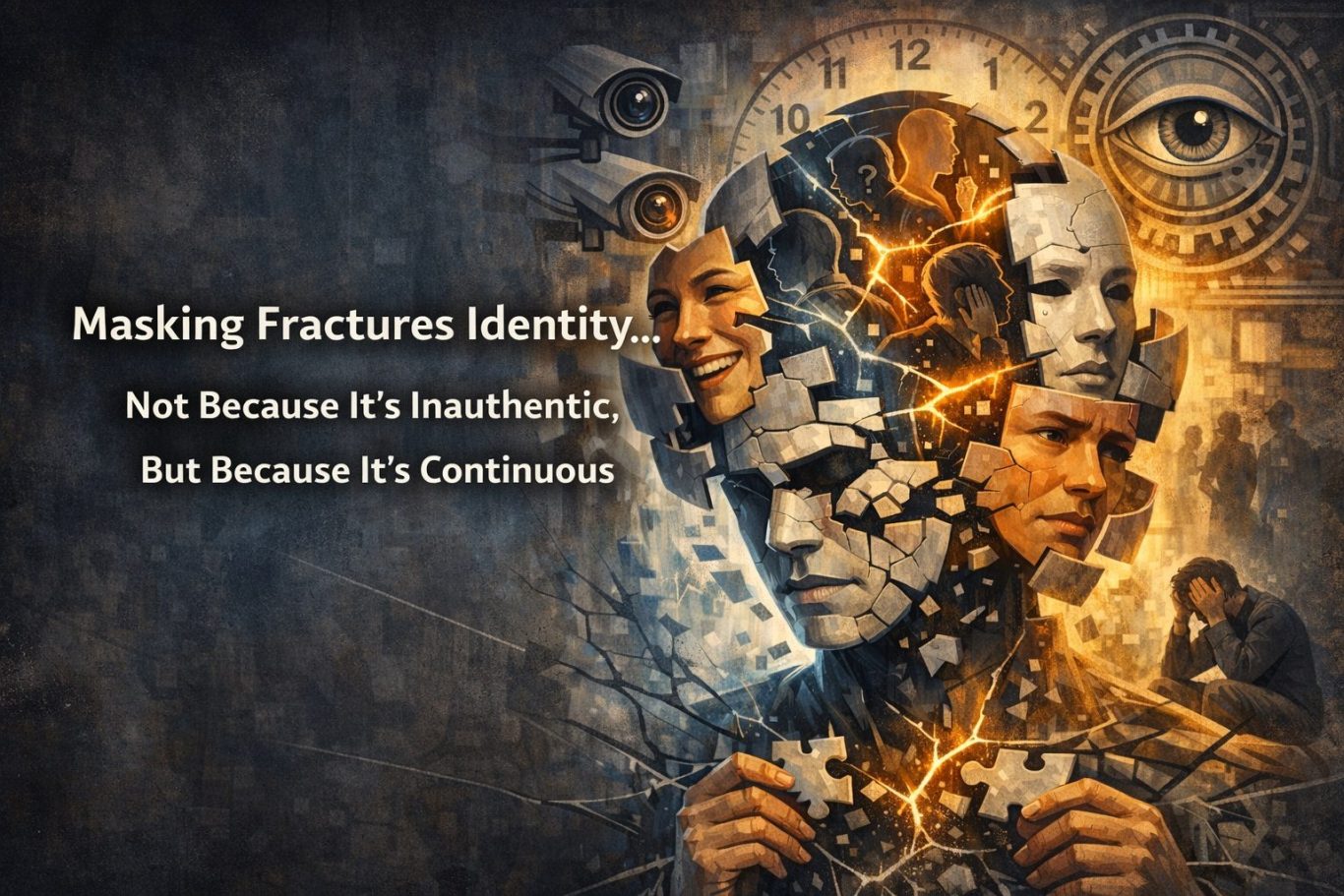
Masking does not fracture identity because it is fake.
It fractures identity because it is relentless.
It is not a single act.
It is not a conscious choice made now and then.
It is not a costume that can simply be removed at the end of the day.
Masking is a continuous process of self-interruption… one that runs in the background of everyday life, quietly fragmenting experience over time.
To understand its cost, we have to stop thinking about authenticity and start thinking about continuity.
Masking Is Not Performance… It Is Surveillance
Most neurodivergent people are not trying to deceive anyone.
They are trying to stay safe.
Masking is better understood as constant internal surveillance.
A person monitors:
- Their tone
- Their facial expression
- Their posture
- Their volume
- Their pace
- Their emotional display
- Their word choice
- Other people’s reactions
All at once.
All the time.
This monitoring happens while they are:
- Thinking
- Listening
- Feeling
- Problem-solving
- Making decisions
- Trying to connect
The nervous system is doing two jobs simultaneously:
- Engaging with the world
- Policing the self
This is not social skill.
It is cognitive load.
And it never fully switches off.
Identity Depends on Continuity, Not Honesty
We often assume that identity comes from honesty… from saying what you really think, feeling what you really feel, being who you really are.
But psychologically, identity is built on something more basic: continuity.
You experience yourself as “you” because:
- Your thoughts unfold without being cut off
- Your emotions are allowed to rise and resolve
- Your reactions follow a sequence that makes sense
- Your internal experience connects across moments
Continuity is what creates coherence.
Masking disrupts this.
Every time someone interrupts themselves to ask:
- Is this too intense?
- Is this appropriate?
- Am I being weird?
- How am I coming across?
The internal process is halted mid-stream.
Once or twice, this is manageable.
Dozens of times an hour, every day, for years… it becomes destabilising.
Chronic Self-Interruption and the Loss of “Me”
Many neurodivergent adults describe a haunting, persistent experience:
“I don’t know who I am anymore.”
This is often misinterpreted as:
- Low self-esteem
- Identity confusion
- Trauma response
- Lack of self-awareness
But very often, it has a simpler and more painful explanation.
The person has not been allowed to finish being themselves.
When thoughts are constantly edited before they complete,
when emotions are suppressed before they resolve,
when instincts are overridden before they land,
the internal narrative never gets to run its course.
Over time, the person loses access to the throughline of their own experience.
Not because the self was absent…
but because it was repeatedly interrupted.
Masking Is Metabolically Expensive
Masking is often framed as something neurodivergent people should simply learn to do better.
This ignores its biological cost.
Masking consumes:
- Executive function
- Working memory
- Attentional bandwidth
- Emotional regulation capacity
It requires sustained activation of brain systems involved in monitoring, inhibition, and error detection.
This is why masking feels tolerable in short bursts… meetings, interviews, social events… but unsustainable over time.
The exhaustion that follows is not social fatigue.
It is neurological depletion.
Why “High-Functioning” Is a Dangerous Label
People who mask effectively are often described as “high-functioning”.
They appear articulate.
Capable.
Competent.
Composed.
But what this label really means is: the cost is hidden.
High masking often correlates with:
- Burnout that appears “out of nowhere”
- Emotional numbness
- Anxiety without a clear trigger
- Shutdown or collapse in private
- Loss of joy, play, and spontaneity
From the outside, the person seems fine.
Inside, coherence is slowly eroding.
This is not resilience.
It is endurance.
Masking Disrupts Regulation, Not Just Expression
Masking is not only about social presentation.
It interferes directly with nervous system regulation.
Many neurodivergent people regulate themselves through:
- Movement
- Vocalisation
- Facial expression
- Sensory adjustment
- Emotional release
When these are suppressed to appear “appropriate”, the nervous system is forced to hold unprocessed activation internally.
Over time, this leads to:
- Increased irritability
- Emotional volatility
- Chronic fatigue
- Sensory overload
- Reduced stress tolerance
The person is not too sensitive.
They are over-contained.
Why Masking Becomes Invisible
One of the most dangerous aspects of masking is that it becomes automatic.
People stop noticing it.
They say:
- “I’m just tired.”
- “I’m just bad at coping.”
- “I don’t handle things like other people.”
They do not realise how much energy is being spent on self-monitoring, because they have never experienced sustained safety without it.
This is especially common in people diagnosed later in life, who have spent decades adapting without language for what they were doing.
By the time they recognise masking, it is no longer a strategy.
It is an identity scaffold… and removing it feels terrifying.
Masking Is Not a Trait… It Is a Response to Power
Masking is often framed as a personal characteristic.
It is not.
Masking is a contextual response.
People mask more when:
- Power is unpredictable
- Mistakes are punished
- Difference is shamed
- Belonging is conditional
- Repair is absent
They mask less when:
- Expectations are explicit
- Feedback is safe
- Difference is normalised
- Autonomy is respected
- Repair is real
This is why masking increases in workplaces, schools, healthcare systems, and institutions that claim inclusion… but lack structural safety.
The environment, not the individual, determines the masking load.
The Fragmentation That Follows
Chronic masking leads to fragmentation… not in a dramatic, clinical sense, but in a lived one.
People report:
- Feeling like different versions of themselves in different contexts
- Needing long periods alone to “come back” to themselves
- Losing access to desire, play, or motivation
- Feeling strangely empty despite constant effort
This fragmentation is not weakness.
It is the predictable outcome of long-term self-interruption.
Why Unmasking Is Not Instant or Easy
Unmasking is often romanticised as freedom.
In reality, it is slow, disorienting, and often frightening.
When someone begins to reduce masking:
- Thoughts feel louder
- Emotions feel unfamiliar
- Expression feels risky
- Boundaries feel unclear
This is not regression.
It is the nervous system relearning continuity.
After years of interruption, allowing internal processes to run uninterrupted can feel unsafe… even when the environment is supportive.
Unmasking is not about suddenly “being yourself”.
It is about allowing the self to re-form over time.
The Grief Beneath the Process
As masking loosens, many people encounter grief.
Grief for:
- The energy lost
- The identity fragments left behind
- The relationships built on performance
- The self that never got to stabilise
This grief is often misunderstood as deterioration.
In reality, it is integration.
Masking in Therapy and “Professional” Spaces
Even therapeutic and professional environments often reward masking.
Clients are praised for:
- Insightful language
- Emotional containment
- Polished narratives
But these are often signs of continued self-monitoring, not healing.
When therapy rewards articulation over regulation,
when professionalism rewards polish over coherence,
masking simply relocates… it does not resolve.
Systems That Depend on Masking Are Extractive
When systems rely on masking to function, they externalise harm.
They appear inclusive… because difference is invisible.
But invisibility is achieved through effort, not safety.
The cost is paid privately:
- In burnout
- In disengagement
- In mental health decline
- In loss of creativity and depth
A system that requires constant masking is not inclusive.
It is extractive.
What Changes When Masking Decreases
When environments reduce the need for masking, something profound happens.
People:
- Recover energy without forcing rest
- Regulate more easily
- Access creativity and intuition
- Develop clearer boundaries
- Feel more internally coherent
This is not because they are “more authentic”.
It is because they are less interrupted.
Designing for Coherence Instead of Compliance
True inclusion does not ask people to bring their “whole selves” to work.
It builds systems that stop fragmenting them.
This means:
- Reducing unnecessary self-monitoring
- Making expectations explicit
- Normalising difference without penalty
- Allowing regulation without punishment
- Valuing clarity over performance
When continuity is protected, identity stabilises naturally.
The Larger Implication
If we continue to build systems that reward compliance over coherence, we will continue to see:
- Burnout
- Disengagement
- Quiet quitting
- Mental health crises
Not because people are fragile…
but because they are constantly interrupted.
Closing Reflection
Masking does not fracture identity because people are being fake.
It fractures identity because people are being stopped…
again and again… from finishing their own experience.
The work ahead is not to teach people how to mask more effectively.
It is to build environments where self-continuity is safe.
Because when people are allowed to remain internally uninterrupted,
identity does not need to be discovered.
It stabilises on its own.