
By Neal Glendenning
We usually talk about neurodivergence as if it were a problem of space.
Attention wanders.
Thoughts scatter.
Focus drifts.
The metaphors themselves tell a story: something is moving away from where it is supposed to be. Something isn’t staying put. Something needs to be brought back into line.
But for many neurodivergent people, the real difference is not where attention goes.
It’s when.
Not time as measured by clocks, calendars, and schedules…
but time as it is experienced by the nervous system.
The pace at which information integrates.
The delay before energy mobilises.
The rhythm of emotion, recovery, insight, and action.
This dimension is almost entirely absent from how we design education, work, healthcare, therapy, and productivity systems. And because it is absent, the people whose lives are shaped most strongly by it are misunderstood from the outset.
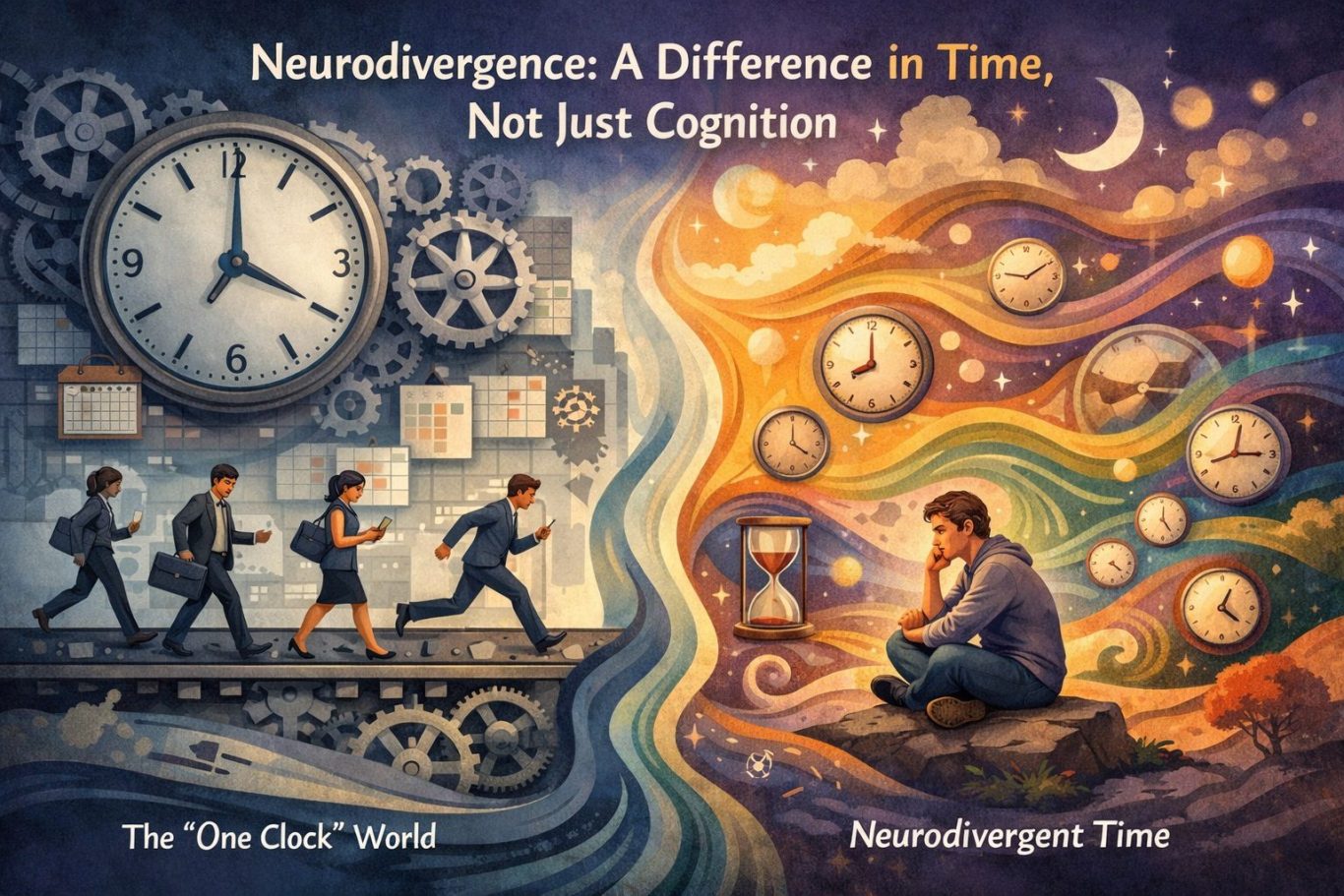
The World Is Built on One Clock
Modern life assumes a single, shared temporal reality.
There is a correct speed at which people should:
- Think
- Respond
- Learn
- Recover
- Decide
- Produce
That speed is linear, continuous, and externally regulated.
You are expected to make steady progress.
You are expected to be consistently available.
You are expected to respond quickly.
You are expected to recover rapidly.
You are expected to deliver on time.
These expectations are rarely spoken aloud. They are simply built into systems: school timetables, work hours, deadlines, performance reviews, meeting structures, therapy models, and productivity tools.
And because they are treated as neutral, they are rarely questioned.
But they are not neutral.
They are a design choice… one that privileges certain nervous systems and penalises others, not because of intelligence or effort, but because of tempo.
Neurodivergent Time Is Not Linear
Many neurodivergent nervous systems do not move smoothly forward in evenly spaced increments.
They move in pulses.
They require ramp-up.
They integrate information in the background.
They arrive at clarity suddenly, not gradually.
Energy may be unavailable for long periods… until it is suddenly abundant.
Focus may feel inaccessible… until it locks on completely.
Understanding may seem absent… until it coheres all at once.
This is not randomness.
It is nonlinear timing.
But when systems only recognise linear progress, nonlinear rhythms are misread as instability, unreliability, or failure.
When Timing Is Misread as Character
One of the most damaging labels applied to neurodivergent people is inconsistent.
It carries moral weight:
- You can’t be relied on
- You don’t apply yourself
- You lack discipline
- You can’t be trusted
But inconsistency is only visible when output is measured against a single, fixed clock.
A person who works in cycles will always look inconsistent in a system that demands constant output.
A nervous system that mobilises around meaning will always look unreliable in a system that demands constant availability.
A mind that integrates deeply will always look slow in a culture that prizes immediacy.
Seen through a temporal lens, what looks like inconsistency is often rhythm.
The problem is not the person.
It is the clock they are being judged by.
Latency: The Missing Concept
One of the most important… and most misunderstood… features of neurodivergent experience is latency.
Latency is the space between input and output.
Between stimulus and response.
Between demand and action.
In many neurodivergent nervous systems, latency is not empty time.
It is active processing.
This is where:
- Patterns are recognised
- Emotional information integrates
- Meaning consolidates
- Internal alignment forms
But latency is invisible. And what is invisible is treated as absence.
Silence is read as disengagement.
Pause is read as incompetence.
Delay is read as avoidance.
So people learn to override latency.
They speak before they are ready.
They decide before clarity arrives.
They act before integration completes.
And then they blame themselves when the outcome feels wrong.
The Cost of Acting Before Readiness
Repeatedly acting against one’s internal timing creates a specific kind of harm.
Not dramatic.
Not obvious.
But cumulative.
Each time someone is pushed to perform before readiness, they receive a quiet but powerful message:
Your internal signals cannot be trusted.
Over time, this erodes confidence… not because the person lacks ability, but because they are constantly required to betray their own timing.
They stop listening inwardly.
They outsource pacing to pressure.
They rely on urgency to mobilise action.
This is why so many ADHD adults say they “work best under pressure”.
Urgency collapses time.
It bypasses latency.
It forces action.
But it does so by borrowing energy from the future.
Pressure Is Not Alignment
Pressure can produce output.
It cannot produce sustainability.
When pressure becomes the primary mobilisation strategy, several things happen:
- Calm feels unproductive
- Space feels unsafe
- Only crisis unlocks action
- Recovery feels undeserved
This creates a cycle of sprint and collapse… often mistaken for poor self-regulation.
In reality, it is adaptation to a system that refuses to wait.
Why Rest Often Doesn’t Restore
Many neurodivergent people experience a confusing and distressing pattern.
They rest.
They take time off.
They reduce demands.
They sleep more.
And yet they do not recover.
This is often interpreted as depression, low motivation, or personal failure.
But very often, the issue is not energy.
It is temporal injury.
A lifetime of rushing integration, compressing recovery, interrupting natural rhythms, and overriding internal signals erodes trust in time itself.
The nervous system no longer believes it will be allowed to complete its own cycles.
Recovery requires more than stopping.
It requires returning to a pace where processes are allowed to finish.
Emotion Moves in Time Too
Emotions are not instantaneous events.
They unfold.
They rise.
They crest.
They resolve.
They integrate.
Many neurodivergent people experience delayed emotional processing… not because they are disconnected, but because their nervous system prioritises meaning before expression.
They may feel fine in the moment and impacted later.
They may only understand how something felt days after it happened.
They may need solitude before emotional clarity emerges.
This is not emotional avoidance.
It is emotional timing.
But environments often demand immediate emotional responses: How do you feel right now?
When this happens, people are forced to guess instead of listen.
Over time, emotional accuracy erodes. Self-trust weakens.
Decision-Making on a Different Timeline
Neurodivergent decision-making often follows a nonlinear arc.
It may involve:
- Broad pattern scanning
- Long-range consequence sensing
- Ethical and emotional integration
- Internal simulation over time
This can look slow from the outside.
But when allowed to complete, it often produces decisions that are:
- More durable
- More values-aligned
- Less reactive
- Less likely to require reversal
When rushed, the result is not efficiency.
It is regret.
Why Planning Often Fails
Traditional planning assumes:
- Stable energy
- Predictable motivation
- Uniform pacing
For many neurodivergent people, these assumptions simply do not hold.
Plans fail not because of poor intention, but because they ignore:
- Variable energy states
- Context-dependent focus
- Delayed motivation onset
- Recovery needs after intensity
When plans repeatedly fail, people internalise the failure.
But the real issue is that the plan was built on the wrong time model.
Late Blooming Is Not an Anomaly
Many neurodivergent adults describe themselves as late bloomers.
They struggled early.
They felt behind.
They took longer to “make sense”.
Then, at some point, things cohered.
This is not failure followed by success.
It is development on a non-standard timeline.
Some minds integrate depth before structure.
Vision before execution.
Meaning before momentum.
Linear systems reward early convergence.
Neurodivergent systems often converge later… and more holistically.
The Persistent Feeling of Being “Behind”
One of the most pervasive emotional experiences among neurodivergent adults is the feeling of being behind.
Behind peers.
Behind expectations.
Behind an invisible schedule everyone else seems to be following.
This feeling persists even in people who are capable, intelligent, and accomplished.
Because it is not about achievement.
It is about tempo mismatch.
When someone is constantly required to hurry processes that need time, they develop a chronic sense of lag… not because they are slow, but because they are always being asked to move before readiness.
Therapy, Coaching, and the Myth of Immediate Change
Many support models unconsciously reinforce temporal harm.
Insight is expected to lead quickly to action.
Skills are expected to generalise immediately.
Progress is expected to be visible session by session.
But for many neurodivergent people:
- Insight arrives early
- Change arrives late
- Integration happens quietly
When this is misunderstood, people are labelled resistant or unmotivated.
In reality, they are integrating on a timeline the model does not recognise.
What It Means to Honour Time
Honouring time does not mean removing structure.
It means aligning structure with biology.
It means:
- Allowing latency without penalty
- Separating readiness from responsiveness
- Designing margins for integration
- Measuring outcomes, not constant activity
- Treating rhythm as information
When time is honoured, something counterintuitive happens.
People become more reliable… not less.
Because action happens when it is ready to land.
Reclaiming Authority Over Pace
One of the most radical shifts a neurodivergent person can make is reclaiming authority over pace.
This does not mean moving slowly.
It means moving intentionally.
Trusting that readiness is real.
That latency is productive.
That recovery is necessary.
And that timing is not a moral issue.
The Broader Implication
If we continue to design systems that honour only one version of time, we will continue to misclassify depth as delay and rhythm as risk.
But if we begin designing for temporal diversity… allowing different paces, latencies, and cycles to coexist… we do more than include neurodivergent people.
We build systems that are:
- More adaptive
- More resilient
- More humane
- More future-ready
Closing Reflection
Neurodivergent people are not out of sync with reality.
They are out of sync with a narrow definition of time.
And when that definition expands, something profound changes.
What once looked like slowness reveals itself as precision.
What once looked like delay reveals itself as depth.
What once looked like inconsistency reveals itself as rhythm.
The future will not belong to the fastest systems.
It will belong to the ones that know when to wait.