
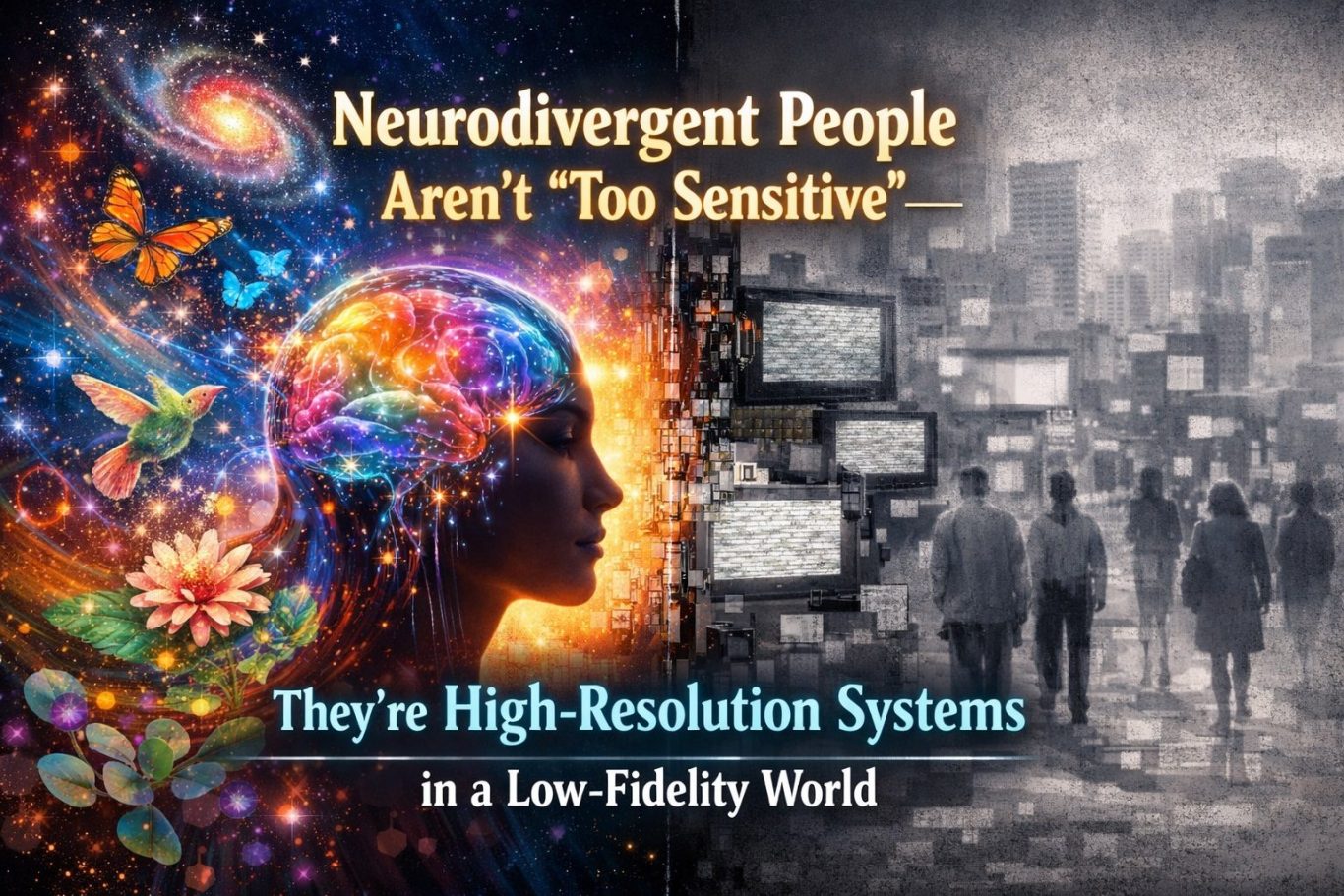
By Neal Glendenning
“Too sensitive.”
Few labels do as much quiet damage with so few words.
It is often said casually, even affectionately.
Sometimes with concern.
Sometimes with irritation.
Sometimes as an explanation that feels almost kind.
But underneath it sits a profound misunderstanding.
Neurodivergent people are not overwhelmed because they are weak, fragile, or unable to cope.
They are overwhelmed because they are operating as high-resolution systems in environments designed for low resolution… environments that compress, distort, and discard signal in the name of speed, efficiency, and manageability.
To understand this properly, we have to stop talking about sensitivity as a personality trait and start talking about information processing.
What “Sensitivity” Is Usually Taken to Mean
When people say someone is sensitive, they usually mean one of three things:
- They react strongly to emotional input
- They notice things others overlook
- They are affected deeply by tone, context, or atmosphere
In everyday language, these traits are framed as liabilities.
Sensitive people are told they need thicker skin.
They are encouraged to toughen up.
They are advised to lower expectations, care less, or detach.
The assumption underneath all of this is that the problem lies in intensity.
Too much feeling.
Too much noticing.
Too much reaction.
But this assumption is wrong.
The issue is not intensity.
It is resolution.
High-Resolution Systems Process More Data
A high-resolution system does not merely experience things “more strongly.”
It experiences more of them.
More nuance.
More micro-shifts.
More contextual information.
More inconsistencies.
More emotional data.
More sensory input.
This applies across multiple domains at once:
- Sensory: sound layers, lighting flicker, fabric texture, temperature changes
- Emotional: tone shifts, emotional incongruence, unspoken tension
- Relational: power dynamics, social hierarchies, subtle exclusion
- Cognitive: pattern mismatches, logical gaps, downstream implications
What looks like overreaction is often the nervous system responding accurately to information other systems never registered.
Why High Resolution Is Mistaken for Fragility
Low-resolution systems filter aggressively.
They discard subtle data to maintain speed and simplicity.
They prioritise coarse signals over fine ones.
They trade accuracy for efficiency.
This works well in environments built for throughput rather than truth.
But when a high-resolution system flags an issue early… noticing a misalignment, tension, or risk long before it becomes obvious… it can appear disproportionate.
Others say:
- “You’re reading too much into it.”
- “It’s not that deep.”
- “You’re overthinking.”
What they really mean is:
“My system didn’t pick that up, so it can’t be important.”
This is not objectivity.
It is resolution bias.
Early Detection Always Looks Like Overreaction
One of the defining features of high-resolution systems is early detection.
They sense problems upstream:
- Cultural fractures before breakdown
- Relationship issues before rupture
- Ethical drift before scandal
- Burnout before collapse
- Systemic failure before crisis
But early detection rarely looks dramatic or convincing.
At the early stages, signals are subtle.
Patterns are incomplete.
Evidence is intuitive rather than formalised.
So the person raising the concern appears emotional, alarmist, or reactive.
Only later… when the issue becomes obvious to everyone… does it become clear they were right.
By then, the cost is already higher.
Living With Constant Invalidated Perception
When someone repeatedly perceives real signals that are dismissed or minimised, something corrosive happens internally.
They begin to doubt their own perception.
They ask:
- “Am I imagining this?”
- “Am I being dramatic?”
- “Why does this bother me when it doesn’t bother others?”
Over time, this self-doubt becomes internalised.
Not because the perception was wrong…
but because it was unsupported.
This is one of the most under-recognised forms of psychological harm experienced by neurodivergent people: chronic perceptual invalidation.
The Nervous System Cost of Seeing Too Much
High-resolution perception is not free.
Processing more data requires more energy.
When environments are chaotic, contradictory, or poorly designed, high-resolution nervous systems work overtime trying to make sense of them.
This leads to:
- Faster overload
- Quicker depletion
- Reduced recovery capacity
- Heightened stress responses
Not because the system is defective…
but because it is being asked to operate continuously in noise.
Imagine running a high-definition camera in a low-bandwidth system.
The problem is not the camera.
It’s the infrastructure.
Why Suppression Doesn’t Work
Many neurodivergent people are taught… explicitly or implicitly… to suppress their sensitivity.
To ignore it.
To override it.
To “push through”.
But suppression does not reduce resolution.
It merely prevents expression.
The data is still being processed.
The nervous system still registers it.
The load still accumulates.
What changes is that the system has nowhere to discharge or integrate that information.
This is why suppression often leads to:
- Emotional volatility
- Sudden shutdown
- Burnout
- Physical symptoms
- Anxiety without a clear source
The system is saturated, not fragile.
Emotional Sensitivity as Information Accuracy
Emotional sensitivity is often framed as poor emotional regulation.
But in many cases, it is actually high emotional accuracy.
High-resolution emotional systems pick up:
- Emotional incongruence
- Unspoken resentment
- Performative positivity
- Power imbalance
- Lack of psychological safety
These cues are real.
They shape behaviour, outcomes, and trust… whether or not they are acknowledged.
When someone reacts emotionally to these cues, the reaction is often labelled excessive.
But excess is defined relative to what others perceive.
Not relative to what is actually present.
Why “Toughening Up” Makes Things Worse
Being told to toughen up usually means being told to lower resolution.
To ignore nuance.
To stop noticing.
To care less.
But resolution is not a dial you can simply turn down.
What people actually do instead is disconnect.
They dissociate slightly.
They numb emotionally.
They reduce engagement.
This can look like coping.
But it comes at a cost:
- Loss of intuition
- Reduced creativity
- Emotional blunting
- Ethical drift
- Loss of meaning
The person functions… but at lower fidelity.
High-Resolution Systems and Burnout
Burnout in neurodivergent people is often misunderstood as overwork.
In reality, it is frequently over-processing.
Too much input.
Too little coherence.
Too few outlets for integration.
High-resolution systems need:
- Clear structure
- Predictable patterns
- Psychological safety
- Meaningful feedback loops
Without these, the system never gets to stand down.
Burnout is not failure.
It is the nervous system saying:
“I cannot keep processing this much noise without support.”
The Social Cost of Being Accurate Too Early
High-resolution perception often comes with social risk.
Pointing out issues early can:
- Disrupt group harmony
- Challenge authority
- Create discomfort
- Expose inconvenient truths
As a result, high-resolution individuals are often subtly punished:
- Labelled difficult
- Excluded from influence
- Overlooked for leadership
- Told they are “not a good fit”
Over time, many learn to stay quiet.
Not because they stopped seeing…
but because speaking costs too much.
Why Neurodivergent People Are Often System Thinkers
Because high-resolution systems naturally track patterns, they often think systemically.
They don’t just see events.
They see:
- Feedback loops
- Downstream consequences
- Structural incentives
- Hidden costs
This makes them valuable in:
- Strategy
- Design
- Risk management
- Ethics
- Innovation
But only if their perception is trusted.
When it isn’t, organisations lose early warning systems… and pay for it later.
Sensitivity, Morality, and Integrity
High-resolution emotional systems are often deeply tied to integrity.
When you perceive inconsistency between stated values and actual behaviour, it creates internal friction.
That friction feels emotional… but it is ethical.
This is why many neurodivergent people struggle in environments where:
- Values are performative
- Decisions are arbitrary
- Power is misused
- Harm is minimised
They are not being dramatic.
They are responding accurately to moral dissonance.
What Regulation Looks Like for High-Resolution Systems
Regulation for high-resolution systems is not about numbing.
It is about:
- Reducing noise
- Increasing coherence
- Improving signal-to-noise ratio
- Creating predictable structure
- Allowing processing time
This might involve:
- Quiet rather than stimulation
- Fewer inputs rather than more coping
- Clear boundaries rather than flexibility
- Meaningful work rather than busywork
When this happens, something surprising occurs.
The person becomes calmer… not because they feel less, but because the system is no longer overloaded.
Why High-Resolution Systems Thrive in the Right Environments
In environments that value clarity, ethics, and long-term thinking, high-resolution systems become assets.
They:
- Catch problems early
- Strengthen culture
- Improve decision quality
- Increase resilience
- Protect against systemic failure
These environments are not “soft”.
They are intelligent.
The Cultural Mismatch at the Heart of the Problem
Modern culture rewards:
- Speed over depth
- Confidence over accuracy
- Simplicity over nuance
- Output over coherence
High-resolution systems do not naturally fit these values.
So they are labelled sensitive, intense, or difficult… not because they are wrong, but because they reveal the cost of the system itself.
Reframing Sensitivity Correctly
Sensitivity is not weakness.
It is bandwidth.
It is the capacity to register what others miss.
The problem is not that some people feel too much.
It is that our systems are built to tolerate too little truth.
Designing for High-Resolution Humans
If we designed systems that respected high-resolution processing, we would:
- Reduce unnecessary noise
- Clarify expectations
- Align values with behaviour
- Make power legible
- Build repair into structure
These systems would not only support neurodivergent people.
They would function better for everyone.
Closing Reflection
Neurodivergent people are not too sensitive.
They are high-resolution nervous systems operating in environments that prioritise speed over sense.
What overwhelms them is not reality…
it is distortion, noise, and misalignment.
The future will not be built by those who feel the least.
It will be built by those who can perceive the most…
and who are finally allowed to do so without punishment.