
By Neal Glendenning
Shame is usually treated as an accident.
An unfortunate emotional by-product.
A personal vulnerability.
A symptom of low self-esteem, trauma, or excessive self-criticism.
We are encouraged to work through it, rise above it, challenge it, or replace it with confidence and self-compassion. And while those responses can help at an individual level, they often miss something far more uncomfortable.
Shame is not merely an internal experience.
It is a structural one.
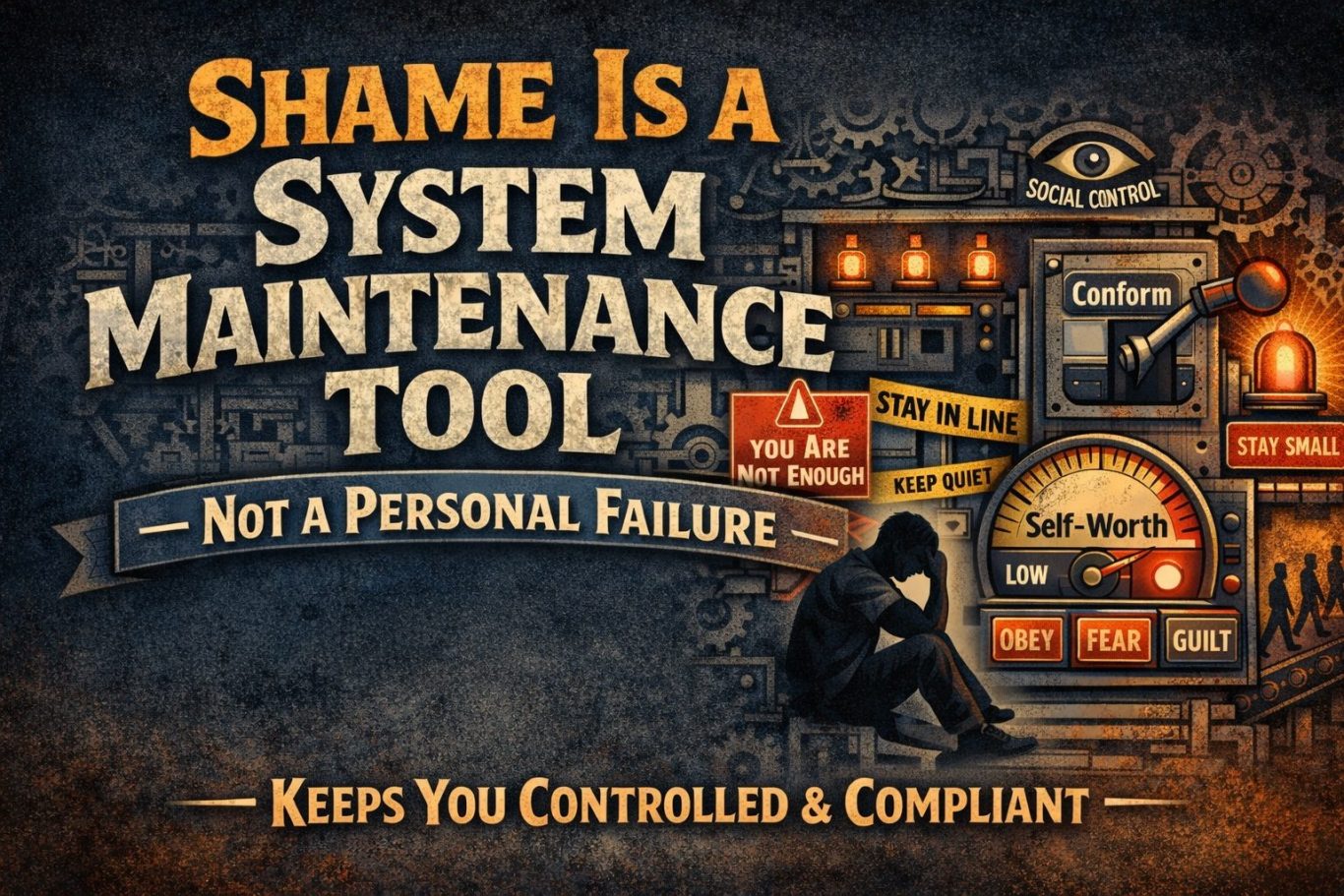
Shame persists not because people are weak, but because it is useful.
Not to the person experiencing it… but to the systems they are trying to survive within.
To understand why shame is so pervasive, especially for neurodivergent people, we have to stop asking why individuals feel so ashamed and start asking a more unsettling question:
Who benefits when people blame themselves?
Shame as a Regulator of Behaviour
At its core, shame is not an emotion about doing something wrong.
It is an emotion about being wrong.
Guilt says, “I made a mistake.”
Shame says, “I am the mistake.”
This distinction matters because shame doesn’t just correct behaviour. It reshapes identity. It teaches people not merely to avoid certain actions, but to doubt their own legitimacy.
From a systems perspective, this is extraordinarily efficient.
A person governed by shame:
- Self-monitors constantly
- Self-corrects pre-emptively
- Suppresses dissent
- Avoids risk
- Internalises failure
- Requires little external enforcement
Shame creates compliance from the inside.
And systems that rely on internal compliance are cheaper, quieter, and more stable than systems that rely on force.
Why Neurodivergent People Are Especially Vulnerable to Shame
Neurodivergent people grow up in environments where mismatch is constant.
Mismatch between:
- How they think and how thinking is rewarded
- How they regulate and how regulation is expected
- How they communicate and how communication is interpreted
- How they process time, emotion, and meaning… and how systems demand output
When mismatch is frequent and unexplained, the nervous system looks for a cause.
And because systems rarely acknowledge design failure, the explanation defaults inward.
It must be me.
This is the origin of chronic shame.
Not a single traumatic event… but thousands of small moments where difference is treated as deficiency and context is never named.
The Quiet Transfer of Responsibility
One of shame’s most powerful functions is responsibility transfer.
When systems fail to accommodate human variation, there are two possible explanations:
- The system is poorly designed
- The individual is inadequate
Shame ensures the second explanation wins.
If a student cannot learn in the way school is structured, shame says they are lazy.
If an employee burns out under unrealistic demands, shame says they are weak.
If a patient does not respond to treatment, shame says they are non-compliant.
In each case, the system remains intact and unquestioned.
Shame keeps failure personal, not structural.
Shame and the Myth of Resilience
Few concepts have done more to obscure systemic harm than “resilience”.
On the surface, resilience sounds positive.
It implies strength, adaptability, perseverance.
But in many contexts, resilience is simply shame in professional language.
It shifts the focus from:
- Why is this environment so damaging?
to - Why can’t you cope better?
Neurodivergent people are disproportionately subjected to resilience narratives because they are more visibly affected by poor design.
Instead of redesigning systems, we redesign people… through coaching, therapy, performance plans, medication, or “personal development”.
When these fail, shame fills the gap.
Shame as a Substitute for Repair
Healthy systems repair harm.
They acknowledge mistakes, adjust structure, and restore trust.
Unhealthy systems skip repair… and rely on shame instead.
Shame does what repair would do, but more cheaply:
- It silences complaint
- It discourages return to the issue
- It reframes harm as personal inadequacy
If a workplace says, “We’re sorry… this was poorly designed and we need to fix it,” it takes responsibility.
If instead it says, “You’re not meeting expectations,” shame does the work.
No redesign required.
The Nervous System Impact of Chronic Shame
Shame is not just a belief.
It is a state.
In the nervous system, shame activates threat responses:
- Collapse
- Freeze
- Submission
- Withdrawal
It narrows attention.
It suppresses curiosity.
It reduces agency.
Over time, chronic shame leads to:
- Learned helplessness
- Emotional numbing
- Perfectionism
- People-pleasing
- Hypervigilance
- Burnout
Not because the person is broken… but because their nervous system has learned that visibility is dangerous.
Why Shame Feels So Personal
Shame is internalised so early and so deeply that it feels like truth.
People say:
- “I’ve always been like this.”
- “I just don’t function properly.”
- “Something is wrong with me.”
These beliefs feel self-generated… but they are often the residue of repeated system-level failure.
When environments repeatedly communicate:
- You are too slow
- You are too much
- You are not enough
- You are the problem
The nervous system stops questioning the message.
Shame becomes identity.
Shame and Masking: A Closed Loop
Shame and masking reinforce each other.
Shame says:
If you show who you are, you will be rejected.
Masking says:
Hide who you are to stay safe.
When masking works… when rejection is avoided… shame is reinforced:
See? The real you would not have been acceptable.
Over time, the person becomes trapped:
- Masking increases exhaustion
- Exhaustion increases mistakes
- Mistakes increase shame
- Shame increases masking
The system does not need to intervene.
The loop sustains itself.
Why Confidence Training Doesn’t Work
Many interventions aimed at reducing shame focus on confidence, self-belief, or positive thinking.
But shame is not a lack of confidence.
It is a learned adaptation to unsafe systems.
Telling someone to believe in themselves while leaving them in the same environment is like telling someone to relax while keeping the threat present.
The nervous system does not respond to affirmation.
It responds to changed conditions.
Institutions and the Normalisation of Shame
Educational, corporate, and healthcare institutions often treat shame as incidental… but they quietly rely on it.
Grading systems.
Performance reviews.
Compliance metrics.
Professional hierarchies.
Diagnostic labels used without context.
All can become shame-delivery mechanisms when design ignores human variation.
When people feel perpetually behind, underperforming, or failing to meet vague expectations, shame fills the explanatory gap.
The institution remains legitimate.
The individual absorbs the cost.
Why Neurodivergent People Blame Themselves First
Neurodivergent people are often deeply conscientious.
They care about doing things well.
They care about impact.
They care about fairness and meaning.
This makes them particularly vulnerable to shame.
When something doesn’t work, they look inward:
What did I miss? What did I do wrong?
This introspection is often mistaken for fragility.
In reality, it is integrity colliding with poor design.
The Emotional Labour of Carrying System Failure
One of the least acknowledged burdens neurodivergent people carry is emotional labour on behalf of broken systems.
They absorb:
- Confusion that should prompt redesign
- Exhaustion that should prompt change
- Frustration that should prompt accountability
They hold these experiences internally, often without language to externalise them.
Shame becomes the container for unaddressed systemic harm.
What Happens When Shame Is Removed
When shame is genuinely reduced… not suppressed, not reframed, but structurally removed… something remarkable happens.
People do not become lazy.
They do not stop caring.
They do not lose standards.
They become:
- More honest
- More engaged
- More creative
- More responsible
- More willing to repair
Because responsibility can finally move back to where it belongs.
Designing Systems That Don’t Need Shame
A system that does not rely on shame looks very different.
It:
- Makes expectations explicit
- Accounts for human variation
- Builds in feedback loops
- Treats failure as information
- Repairs harm visibly
- Shares responsibility honestly
In such systems, people do not need to internalise failure to function.
They can stay intact.
The Political Nature of Shame
Shame is not just psychological.
It is political.
It determines who is allowed to question systems and who must adapt to them.
When marginalised groups internalise shame, power remains unchallenged.
Neurodivergent shame is not accidental.
It is a predictable outcome of systems that privilege narrow definitions of competence and success.
Healing Shame Requires Structural Truth
Individual healing from shame is possible… but it is incomplete without structural truth.
People do not fully heal shame until they can say, with clarity:
This wasn’t a personal failure. It was a design failure.
That recognition restores dignity.
It returns agency.
It allows the nervous system to stand down.
Why This Insight Matters Now
We are living through a period of widespread burnout, disengagement, and quiet collapse.
These are often framed as mental health crises.
But many are actually shame crises… the cumulative effect of people absorbing responsibility for systems that no longer work.
Neurodivergent people feel this first because their nervous systems are less able to ignore misalignment.
They are not breaking faster.
They are detecting earlier.
Reclaiming Responsibility Without Shame
Removing shame does not remove responsibility.
It relocates it.
People can take responsibility for their actions without being defined by failure.
Systems can take responsibility for design without being dismantled.
This is not about blame.
It is about accuracy.
Closing Reflection
Shame is not an unfortunate side effect of modern life.
It is a tool… one that keeps broken systems running by convincing people that the problem is them.
Neurodivergent people have carried this burden disproportionately, not because they are flawed, but because they are more affected by misaligned design.
The future of mental health, education, and work does not lie in teaching people to tolerate shame more gracefully.
It lies in building systems that no longer require it to function.
When shame loses its utility, something extraordinary becomes possible:
People stop shrinking themselves to fit broken systems…
and systems are finally forced to grow around real human beings.