By Neal Glendenning
Most of the systems we live inside were built on a hidden assumption:
that people should be broadly interchangeable.
If you design clear rules, standard procedures, fixed schedules, and consistent incentives, people will adapt. Differences will smooth out. Variation will shrink. The system will stabilise.
For a long time, this assumption seemed to work… not because it was true, but because the cost of enforcing it could be hidden.
Those costs were carried quietly:
- By people who masked
- By people who burned out
- By people who dropped out
- By people who blamed themselves
- By people whose capacity was slowly eroded
What we are witnessing now is not a sudden rise in fragility.
It is the point at which suppressed human variability has become impossible to ignore.
And this is where the future begins to diverge.
Variability Is Not a Flaw in Human Systems
In engineering, variability is expected.
Materials expand and contract.
Loads fluctuate.
Inputs are noisy.
Conditions change.
Robust systems are not built by eliminating variability.
They are built by absorbing it.
Human systems, however, have taken the opposite approach.
Instead of designing for variability, they have tried to discipline it out.
Education standardises pace.
Work standardises output.
Healthcare standardises presentation.
Bureaucracy standardises behaviour.
Anyone who does not conform becomes a “problem to manage”.
Neurodivergent people are simply the most visible edge of this failure.
Why Standardisation Looked Like Progress
Standardisation brought genuine gains.
It allowed:
- Mass education
- Scalable organisations
- Predictable processes
- Rapid industrial growth
But it also embedded a dangerous myth:
If something doesn’t fit, it must be defective.
As long as most people could adapt enough, this myth held.
But adaptation has a cost.
And costs that are externalised eventually accumulate.
The Hidden Cost Curve of Human Adaptation
When people are forced to adapt to systems not designed for them, three things happen over time:
- Short-term compliance increases
- Long-term capacity decreases
- System-level fragility grows
This pattern is visible everywhere.
Schools that push uniform pacing produce early compliance and later disengagement.
Workplaces that reward constant availability see short bursts of productivity followed by burnout.
Healthcare systems that standardise care miss complex cases until they become crises.
The system looks efficient… until it suddenly isn’t.
Neurodivergent People as Stress-Tests, Not Edge Cases
Neurodivergent people are often framed as exceptions.
Small percentages.
Special cases.
Outliers.
This framing is convenient… and deeply misleading.
In complex systems theory, outliers are not noise.
They are stress-tests.
They reveal where assumptions break under pressure.
Neurodivergent nervous systems expose:
- Rigid timing expectations
- Narrow definitions of productivity
- Fragile authority structures
- Low tolerance for uncertainty
- Poor feedback loops
When these systems fail neurodivergent people, they are not failing a minority.
They are failing future conditions.
Complexity Has Outgrown Control
Modern life is more complex than the systems designed to manage it.
Work is no longer linear.
Problems are no longer bounded.
Knowledge is no longer siloed.
Change is no longer incremental.
Rigid systems struggle in complexity.
They rely on:
- Predictability
- Uniform inputs
- Clear hierarchies
- Slow feedback
These conditions no longer exist.
Systems that survive complexity do something different.
They:
- Distribute authority
- Allow multiple rhythms
- Accept uncertainty
- Learn continuously
- Adapt locally
In other words, they tolerate variability.
Why Variability Looks Like Risk (But Isn’t)
To a rigid system, variability looks like danger.
Different working styles feel inefficient.
Different communication styles feel messy.
Different needs feel expensive.
Different paces feel disruptive.
So systems try to compress variation back into a narrow band.
This works in the short term.
In the long term, it creates brittleness.
Brittle systems fail catastrophically, not gradually.
The Difference Between Equality and Resilience
Many systems confuse equality with sameness.
Same hours.
Same metrics.
Same processes.
Same expectations.
But resilience does not come from sameness.
It comes from diversity of response.
In ecology, monocultures collapse.
In finance, uniform strategies amplify crashes.
In organisations, identical thinkers miss blind spots.
Human variability is not an inefficiency.
It is redundancy, creativity, and adaptability built into the species.
Neurodivergent Strengths Are Context-Dependent
Neurodivergent traits are often described in isolation:
- Hyperfocus
- Pattern recognition
- Creativity
- Intensity
- Sensitivity
But traits are not strengths or weaknesses in themselves.
They are amplifiers.
In the wrong environment, they overload.
In the right environment, they transform systems.
The same nervous system that burns out in a rigid workplace may thrive in a flexible, meaningful one.
The variable is not the person.
It is the design.
Why “Accommodation” Is the Wrong Frame
Accommodation implies deviation from the norm.
It suggests:
- An exception
- A favour
- A cost
This framing keeps the system central and the person peripheral.
Designing for variability flips this relationship.
Instead of asking:
How do we make room for this person?
The question becomes:
Why is our system so narrow that normal human variation breaks it?
This is not about kindness.
It is about viability.
Systems That Tolerate Variability Perform Better
Systems that tolerate variability:
- Retain talent longer
- Detect problems earlier
- Adapt faster
- Recover more quickly
- Sustain output over time
They may look less “efficient” on paper.
But they outperform in reality.
Because efficiency without adaptability is just delayed failure.
What Variability-Tolerant Design Looks Like
Variability-tolerant systems share common features:
1. Multiple Paces
They allow different rhythms of work, recovery, and engagement.
2. Clear Structure, Flexible Execution
Goals are explicit. Paths are negotiable.
3. Local Decision-Making
Authority sits closer to the work, not locked at the top.
4. Psychological Safety
People can signal problems without penalty.
5. Outcome-Based Metrics
Value is measured by impact, not constant activity.
These features support neurodivergent people… and everyone else.
Why Burnout Is a System Signal
Burnout is often treated as an individual health issue.
But at scale, burnout is a system diagnostic.
It indicates:
- Chronic mismatch
- Over-constrained environments
- Lack of recovery pathways
- Suppressed feedback
Neurodivergent burnout appears earlier because tolerance for mismatch is lower.
Again, this is not fragility.
It is sensitivity to design failure.
The Role of Leadership in Variability-Tolerant Systems
Leadership in variability-tolerant systems looks different.
It is less about control and more about:
- Sense-making
- Boundary-setting
- Signal amplification
- Repair
Leaders do not reduce complexity.
They hold it.
This style of leadership is often more accessible to neurodivergent thinkers… not despite their differences, but because of them.
Why the Old Model Is Breaking Now
Three forces are converging:
- Complexity has increased
- Human tolerance for suppression has decreased
- Feedback can no longer be hidden
Remote work, digital transparency, and cultural shifts have exposed how much adaptation was previously invisible.
The system did not suddenly become harsher.
People stopped absorbing its costs silently.
Neurodivergent People as Future Architects
Neurodivergent people are not just users of future systems.
They are often the ones who can design them.
Because they:
- Notice mismatches early
- Think in systems
- Question hidden assumptions
- Resist meaningless structure
- Value coherence over appearance
When allowed to shape systems rather than merely survive them, they bring architectures that are more humane… and more robust.
Designing for Variability Is Designing for Reality
The idea of a “standard human” was always a convenience.
Reality has always been messier.
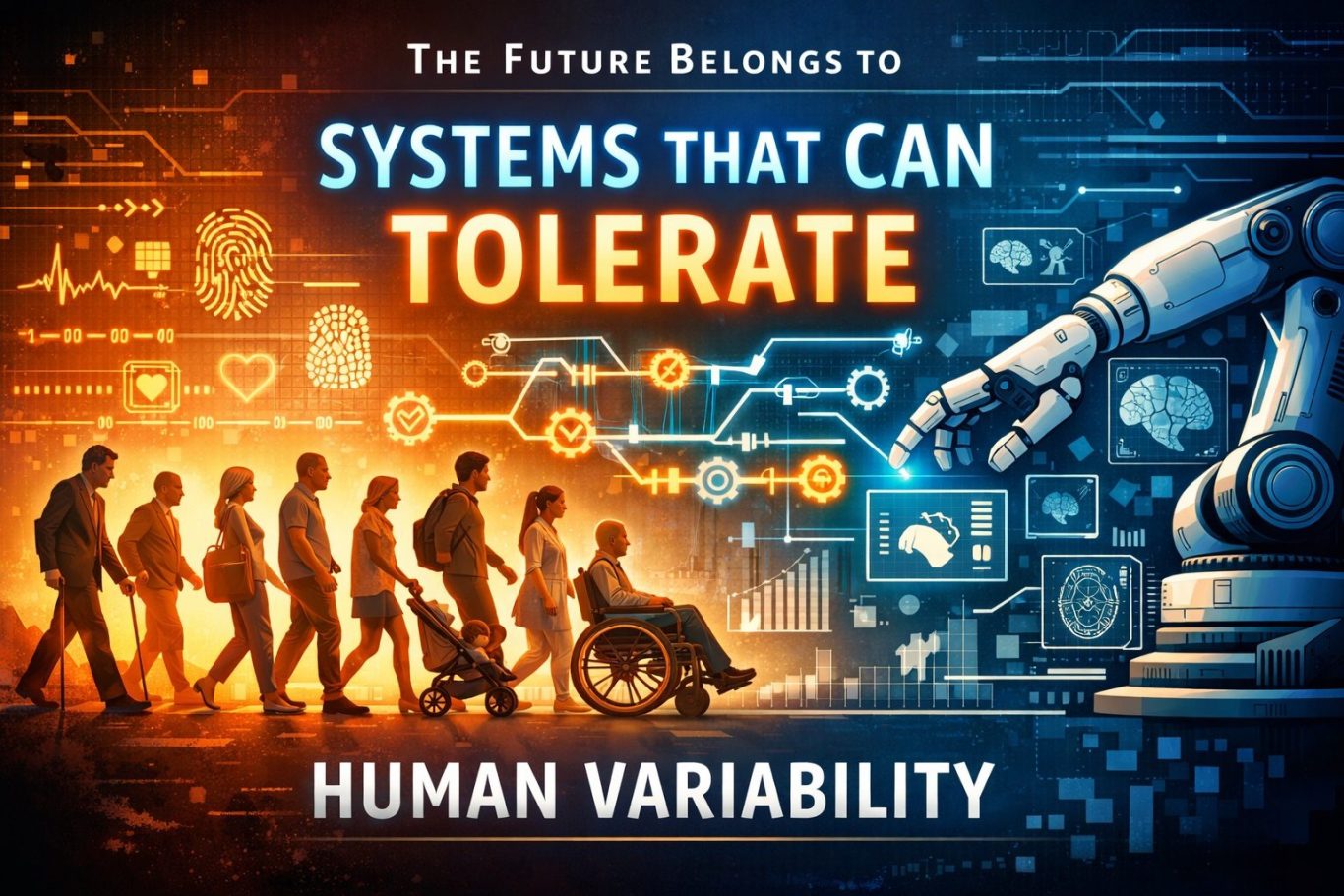
The future will belong to systems that stop fighting this fact.
Systems that accept:
- Different nervous systems
- Different time profiles
- Different communication styles
- Different energy curves
- Different paths to value
Not as problems to solve… but as conditions to design for.
What Happens When Variability Is Welcomed
When systems genuinely tolerate human variability:
- People stop masking
- Capacity stabilises
- Creativity resurfaces
- Trust increases
- Burnout declines
The system becomes quieter… not because people are suppressed, but because friction decreases.
A Warning, and an Invitation
Systems that cannot tolerate variability will not survive increasing complexity.
They will either:
- Become more coercive
- Or collapse under their own rigidity
Systems that adapt will not look like softened versions of the old model.
They will look fundamentally different.
More plural.
More flexible.
More human.
Closing Reflection
The future does not belong to the most disciplined systems.
It belongs to the most adaptive ones.
Human variability is not the problem modern systems must solve.
It is the resource they must finally learn to use.
Neurodivergent people have been living at the edge of this truth for decades… absorbing the cost of systems that could not bend.
As complexity accelerates, that edge becomes the centre.
The question is no longer whether systems should adapt to human variability.
It is whether they can afford not to.