
By Neal Glendenning
We tend to talk about trust as if it were a choice.
Something you decide.
Something you offer.
Something you extend when you feel confident, generous, or open enough.
We ask people to give trust.
We tell them to build trust.
We accuse them of withholding trust.
And when trust collapses, we often frame it as a failure of attitude, openness, or willingness.
But this framing misunderstands where trust actually lives.
Trust is not primarily a belief.
It is not a value.
It is not a moral stance.
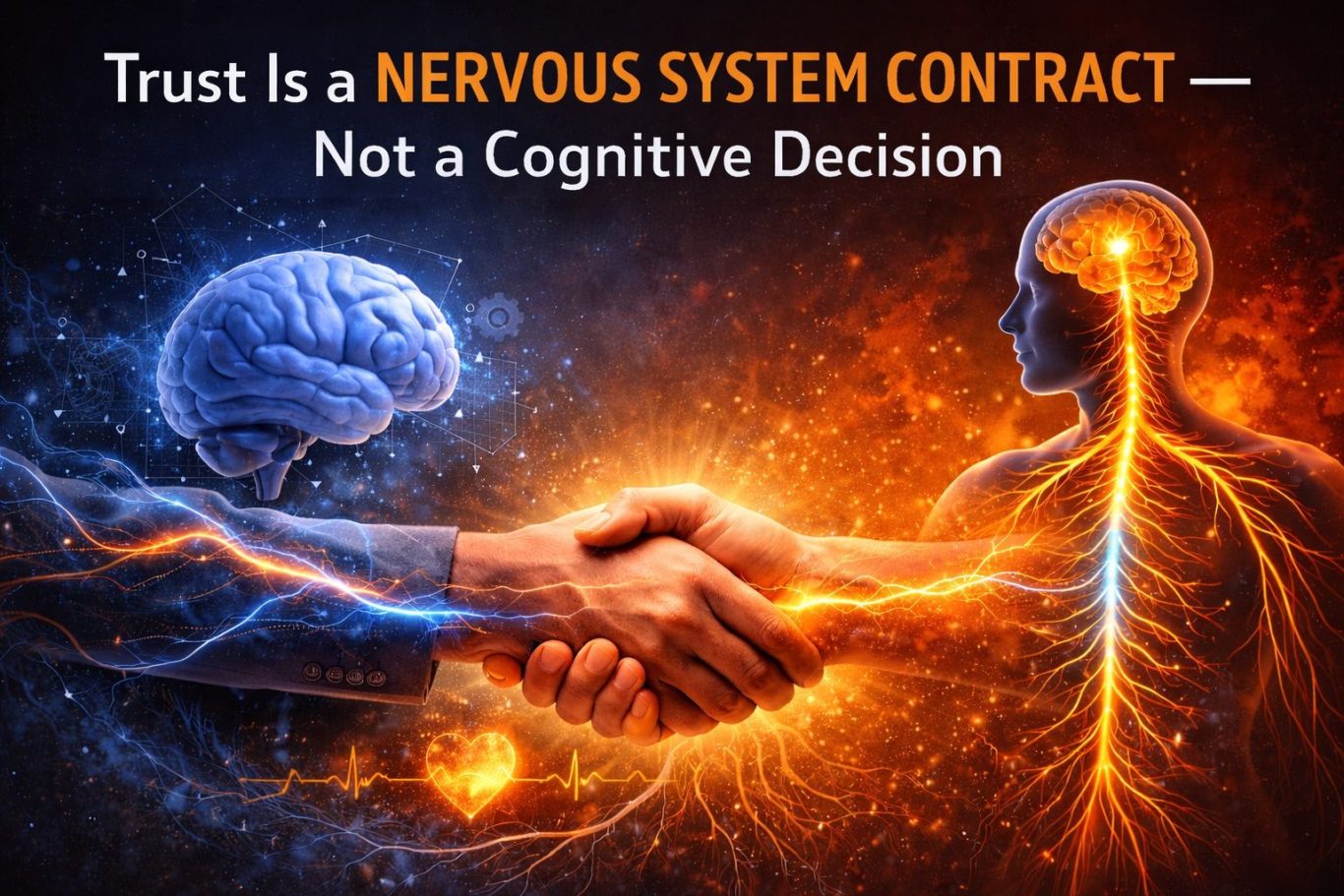
Trust is a nervous system state.
It emerges… or doesn’t… based on whether the nervous system learns that the world it is operating in is predictable, repairable, and safe enough to remain open.
You cannot talk a nervous system into trust.
You can only teach it, through repeated experience, whether trust is viable.
The Nervous System Is Always Making Predictions
Long before conscious thought enters the picture, the nervous system is doing one thing relentlessly: predicting what will happen next.
It tracks:
- Patterns of response
- Consistency of behaviour
- Predictability of power
- Consequences of mistakes
- Likelihood of repair after rupture
These predictions are not abstract. They are embodied.
They determine:
- Whether muscles stay relaxed or tense
- Whether breath remains steady or shallow
- Whether attention stays open or narrows
- Whether emotion can flow or must be contained
Trust, at this level, is not optimism.
It is confidence in predictability.
A nervous system trusts when it believes:
- Cause and effect make sense
- Signals are reliable
- Boundaries will be respected
- Repair will happen when harm occurs
Without these conditions, trust does not form… no matter how much someone wants it to.
Why Trust Cannot Be Demanded
Because trust is a physiological response, it cannot be coerced.
Yet many systems attempt exactly that.
They say:
- “You need to trust the process.”
- “You need to trust leadership.”
- “You need to trust the system.”
- “You need to trust your therapist.”
But when a nervous system has learned… through experience… that unpredictability, punishment, or abandonment follow openness, these demands land as threat.
Being told to trust in an unsafe context is not reassuring.
It is destabilising.
It communicates that the system values compliance over safety.
And once that message is received, trust moves further out of reach.
Trust and Neurodivergent Nervous Systems
For many neurodivergent people, trust is especially fragile… not because they are suspicious or oppositional, but because their nervous systems have often been shaped by repeated mismatch.
Mismatch between:
- What was said and what happened
- What was promised and what was delivered
- What was expected and what was possible
- What was punished and what was tolerated
Inconsistent environments train vigilance.
When rules shift without explanation, when feedback arrives late or arbitrarily, when expectations are implicit rather than explicit, the nervous system learns a painful lesson:
Staying open is risky.
This learning happens early and often.
Especially in schools, workplaces, healthcare settings, and families where difference is misunderstood or moralised.
Trust Is Not About Intent… It’s About Impact Over Time
One of the most common misunderstandings about trust is the emphasis on intent.
People say:
- “I didn’t mean it that way.”
- “That wasn’t my intention.”
- “You’re misinterpreting me.”
But nervous systems do not respond to intent.
They respond to patterns.
If someone is kind nine times and unpredictable on the tenth, the nervous system does not average those experiences. It prioritises the unpredictable one.
Not because it is pessimistic… but because unpredictability is dangerous.
Trust is not built by good intentions.
It is built by reliable outcomes.
The Difference Between Psychological Safety and Comfort
Trust is often confused with comfort.
But comfort is optional.
Safety is not.
A nervous system can tolerate discomfort… challenge, feedback, stretch, even conflict… if the environment is predictable and repairable.
What it cannot tolerate is arbitrary threat.
Threat includes:
- Inconsistent enforcement of rules
- Power without explanation
- Feedback without context
- Consequences without repair
- Silence after rupture
In these conditions, the nervous system does not relax.
It scans.
And scanning is incompatible with trust.
Why “Just Be Vulnerable” Often Backfires
Vulnerability is often presented as the path to trust.
But vulnerability is not the cause of trust.
It is a result of it.
When people are urged to be vulnerable in environments that have not proven safe, the nervous system experiences exposure without protection.
If vulnerability is met with:
- Minimisation
- Fixing
- Defensiveness
- Withdrawal
- Consequence
The nervous system updates its model.
Openness is dangerous.
Once that learning occurs, trust collapses further… and becomes harder to rebuild.
Trust and Power: The Unspoken Relationship
Trust cannot be understood without talking about power.
Where power is unequal, trust is asymmetric.
Those with less power must predict those with more power more carefully. The cost of being wrong is higher.
This is why trust is harder to establish:
- Upward in organisations
- In marginalised groups
- In healthcare systems
- In educational settings
- In therapy when authority is unexamined
When power is opaque or unaccountable, the nervous system stays alert.
Transparency does not guarantee trust… but opacity guarantees its absence.
Why Rupture Matters More Than Harmony
Many people assume trust is built by avoiding conflict.
In reality, trust is built through repair.
Rupture is inevitable in human systems. Misattunement happens. Mistakes happen. Harm happens.
The nervous system does not ask:
Will rupture occur?
It asks:
What happens next?
If rupture is followed by:
- Acknowledgement
- Accountability
- Repair
- Change
Trust strengthens.
If rupture is followed by:
- Denial
- Defensiveness
- Silence
- Blame
Trust erodes… even if the original rupture was small.
Repair teaches the nervous system that openness is survivable.
Avoidance teaches it that harm is unresolved.
Why Neurodivergent People Often “Test” Trust
Neurodivergent people are sometimes described as testing boundaries, pushing limits, or being difficult.
What is often missed is that this behaviour can be predictive testing.
The nervous system is asking:
- Will you stay consistent?
- Will you respond proportionately?
- Will you repair if this goes wrong?
This is not manipulation.
It is data gathering.
A system that responds with punishment, withdrawal, or shaming fails the test… and trust collapses.
A system that responds with clarity, repair, and proportion builds trust rapidly.
The Cost of Low-Trust Environments
When trust is absent, the nervous system shifts into protection.
Protection looks like:
- Hypervigilance
- Overthinking
- Masking
- Withdrawal
- Compliance without engagement
- Defensiveness
- Emotional shutdown
From the outside, this is often misread as disengagement, resistance, or lack of motivation.
From the inside, it is survival.
Low-trust environments are exhausting because vigilance is expensive.
And vigilance prevents:
- Creativity
- Learning
- Collaboration
- Emotional regulation
No amount of encouragement can override this.
Trust Cannot Be Repaired With Words Alone
When trust breaks, many people rush to explanation.
They clarify intent.
They provide rationale.
They offer reassurance.
But nervous systems do not heal through explanation.
They heal through changed experience.
Trust is restored when:
- Behaviour becomes consistent
- Boundaries become clear
- Repair becomes reliable
- Power becomes legible
Without these shifts, reassurance sounds like noise.
Therapy as a Case Study in Trust
Therapy is often framed as a space where trust is assumed.
But for many neurodivergent clients, trust is fragile here too.
Especially when:
- The therapist holds unquestioned authority
- Interpretation replaces curiosity
- Rupture is not acknowledged
- Pace is imposed rather than negotiated
In these contexts, clients may comply, intellectualise, or disengage… not because therapy isn’t helping, but because trust has not been established at the nervous system level.
Trust in therapy is not built through insight.
It is built through felt safety, pacing, and repair.
What Trust Looks Like When It Is Present
When a nervous system trusts, several things happen naturally:
- Attention broadens
- Breathing deepens
- Emotion flows more freely
- Curiosity increases
- Defensiveness decreases
- Learning accelerates
These are not choices.
They are states.
And they cannot be forced.
Designing for Trust Instead of Demanding It
If trust is a nervous system contract, then systems must earn it.
This means designing environments where:
- Expectations are explicit
- Consequences are proportionate
- Power is transparent
- Feedback is timely and contextual
- Repair is normalised
- Difference is not punished
In such systems, trust emerges without instruction.
People do not need to be told to trust.
Their nervous systems decide to.
The Larger Implication
Many modern institutions are experiencing a crisis of trust.
This is often framed as a cultural or generational problem.
But at its core, it is a design problem.
Systems have become unpredictable, extractive, and unrepairable.
And nervous systems are responding appropriately.
Closing Reflection
Trust is not something you ask for.
It is something the nervous system concludes.
It concludes it through pattern, consistency, repair, and safety.
Until we understand this, we will continue to mistake vigilance for resistance, withdrawal for disengagement, and caution for pathology.
The future does not belong to the systems that demand trust the loudest.
It belongs to the ones that make trust inevitable.