
By Neal Glendenning
Episode 1… Beyond the Labels: ADHD as a Nervous System Pattern
ADHD isn’t a failure of attention… It’s a pattern of regulation.
For decades, ADHD has been explained almost entirely through behaviour.
Inattention.
Impulsivity.
Disorganisation.
Emotional reactivity.
These words describe what others observe… but they tell us almost nothing about what is actually happening inside the person.
And so the story becomes dangerously simple:
“You’re capable… you just need to try harder.”
“You know what to do… why don’t you do it?”
“You can focus on the things you like… so this must be a choice.”
Episode one begins by dismantling that story.
Because ADHD is not best understood as a failure of effort, motivation, or discipline.
It is best understood as a nervous system that regulates differently.
Why the Behaviour Lens Fails
Behaviour is the end point of a much deeper process.
Before behaviour, there is:
- perception
- sensory load
- emotional signalling
- physiological arousal
- nervous system safety
Only after those layers are processed does cognition come online.
Traditional ADHD models start at the top… executive function… and work backwards.
A nervous system lens starts at the foundation.
It asks:
- What state was the body in?
- What level of arousal was present?
- Did the system feel safe enough to engage?
- Was there enough stimulation to activate focus?
- Was there too much threat to sustain it?
When we skip these questions, we mistake regulation differences for personal shortcomings.
The Nervous System Is Not Optional
Every human nervous system is constantly scanning the environment for cues of safety, threat, relevance, and demand.
This happens before conscious thought.
The nervous system decides:
- how much energy is available
- whether attention opens or closes
- whether emotion amplifies or dampens cognition
- whether learning is possible
- whether the body prepares to engage or withdraw
For many people with ADHD:
- baseline arousal is less stable
- regulation is more state-dependent
- attention is more sensitive to context
- emotional and sensory input has a stronger impact on access to cognition
This isn’t dysfunction.
It’s difference.
ADHD Is Not a Lack of Attention… It’s Conditional Access
One of the most damaging myths about ADHD is that attention is “missing”.
In reality, attention is highly available… but only under certain conditions.
People with ADHD can often focus:
- intensely
- creatively
- for long periods
- with exceptional depth
But only when the nervous system agrees.
That agreement depends on:
- arousal level
- emotional meaning
- perceived safety
- sensory load
- internal demand vs capacity
When those factors are misaligned, attention doesn’t gradually weaken.
It disappears.
Not because the person doesn’t care…
but because the nervous system has closed the gate.
From Deficit to Regulation Pattern
A nervous system lens reframes ADHD entirely.
Instead of asking:
“Why can’t you maintain consistent attention?”
We ask:
“What regulation rhythm does this system operate on?”
ADHD regulation tends to be:
- non-linear
- context-sensitive
- interest-activated
- emotionally driven
- energy-variable
This produces patterns such as:
- bursts of high output followed by depletion
- hyperfocus that cannot be summoned on demand
- shutdown after sustained pressure
- motivation that appears “inconsistent” from the outside
But these are not random.
They are predictable outcomes of a system constantly adjusting to stay within survivable limits.
Why Pressure Backfires
Many ADHD interventions rely on pressure:
- tighter deadlines
- higher stakes
- more accountability
- increased monitoring
Sometimes pressure appears to work… briefly.
That’s because urgency spikes arousal.
But pressure also increases threat.
And threat narrows cognition, exhausts the system, and accelerates burnout.
Over time, the nervous system learns:
“Engagement is dangerous.”
And so:
- procrastination increases
- avoidance grows
- emotional reactivity intensifies
- capacity collapses sooner
This is not a motivation problem.
It’s a nervous system protecting itself.
Emotional Intensity Is a Signal, Not a Flaw
ADHD is often described as involving “emotional dysregulation”.
But emotional intensity is not inherently dysregulated.
Emotion is one of the nervous system’s primary signalling tools.
In ADHD:
- emotion often carries information about relevance
- intensity reflects arousal shifts
- emotional responses move faster than cognitive processing
When emotional signals are ignored, suppressed, or shamed, regulation worsens.
When they are understood as data, regulation improves.
This is why:
- interest fuels focus
- rejection sensitivity reflects safety detection
- boredom feels painful
- meaning unlocks momentum
The nervous system is not being dramatic.
It is communicating.
Why the Deficit Model Causes Harm
When ADHD is framed as a deficit:
- people internalise shame
- effort becomes moralised
- systems demand consistency at all costs
- nervous systems remain in survival
This leads to:
- chronic stress
- identity erosion
- burnout cycles
- loss of self-trust
- secondary anxiety and depression
People don’t fail because they lack skills.
They fail because they are asked to perform in environments that ignore how their nervous system works.
A Different Starting Point
This series begins with a fundamental shift:
Stop asking people with ADHD to override their nervous system.
Start designing life, work, and care around how it actually regulates.
That means:
- physiology before productivity
- regulation before discipline
- safety before performance
- rhythm before routine
It means moving from:
- “What’s wrong with you?”
to - “What state is your system in right now?”
And from:
- “Why can’t you just do it?”
to - “What would help your nervous system access this?”
Why This Reframe Changes Everything
When ADHD is understood as a nervous system pattern:
- motivation stops being moralised
- inconsistency stops being personal
- rest stops being laziness
- support stops being indulgence
People begin to:
- anticipate their own cycles
- design around capacity
- regulate rather than force
- rebuild trust with their body
- engage sustainably, not heroically
This is not about lowering expectations.
It’s about aligning expectations with biology.
Setting the Foundation for the Series
Episode one is about orientation.
Before tools.
Before strategies.
Before techniques.
Because no intervention works if it asks the nervous system to fight itself.
In the next episode, we’ll explore arousal and attention… and why ADHD focus depends on nervous system state, not effort or intention.
Because attention isn’t something you command.
It’s something the nervous system allows.
Attention doesn’t disappear… It goes offline when arousal is wrong.
If Episode 1 reframed ADHD as a nervous system pattern, Episode 2 explains why attention feels so unreliable… and why effort so often makes things worse instead of better.
The short answer is this:
Attention is not a skill you summon.
It is a state the nervous system permits.
When arousal is misaligned, attention doesn’t weaken gradually.
It withdraws.
Not as defiance.
Not as laziness.
But as protection.
Why “Just Focus” Is the Wrong Instruction
Most advice aimed at people with ADHD assumes a stable baseline:
- stable energy
- stable arousal
- stable access to cognition
From that assumption comes advice like:
- “break it down”
- “use a planner”
- “remove distractions”
- “try harder”
- “be more disciplined”
But if attention were simply a cognitive skill, these would work consistently.
They don’t… because attention is downstream of physiology.
The nervous system decides:
- whether enough energy is available
- whether engagement is safe
- whether the task is worth mobilising for
- whether threat outweighs reward
If the answer to any of those is “no”, cognition never fully comes online.
Arousal Is the Gatekeeper of Attention
Arousal is the level of activation in the nervous system.
It is not the same as stress.
It is not the same as anxiety.
It is the amount of energy available for engagement.
Every nervous system operates along an arousal–performance curve:
- too little arousal → disengagement
- too much arousal → overwhelm
- a middle band → access, learning, focus
For many ADHD nervous systems:
- the “optimal band” is narrower
- transitions between states are faster
- regulation is more context-sensitive
- arousal shifts are more dramatic
This is not a weakness.
It is a highly responsive system.
Under-Arousal: When the Brain Can’t Switch On
Under-arousal is one of the most misunderstood ADHD states.
From the outside, it looks like:
- procrastination
- apathy
- avoidance
- zoning out
- “not trying”
From the inside, it feels like:
- mental fog
- heaviness
- restlessness without direction
- physical discomfort
- an inability to start
This is why staring at a simple task can feel painful.
Low stimulation means:
- insufficient dopamine
- insufficient arousal
- insufficient access to executive function
The nervous system reads this as:
“There isn’t enough energy here to engage.”
So it seeks stimulation… anywhere.
Scrolling.
Daydreaming.
Switching tasks.
Creating urgency.
Not because the person is unfocused…
but because the system is trying to regulate itself.
Over-Arousal: When Attention Collapses Under Pressure
Over-arousal is often mistaken for “anxiety” or “poor stress tolerance”.
But in ADHD, over-arousal frequently comes from:
- pressure
- evaluation
- time urgency
- emotional load
- sensory overload
At high arousal:
- attention narrows
- flexibility disappears
- working memory degrades
- emotion overrides cognition
This is why:
- pressure can temporarily create focus
- but then quickly leads to shutdown
- mistakes increase under scrutiny
- people “blank” in exams or meetings
The nervous system shifts from engagement to survival.
And survival is not a learning state.
Why ADHD Lives at the Extremes
ADHD nervous systems tend to oscillate between:
- under-arousal (bored, stuck, foggy)
- over-arousal (overwhelmed, flooded, panicked)
Hovering in the middle — where attention is accessible but sustainable… often requires external regulation support.
Without it, people rely on extremes:
- last-minute urgency
- emotional intensity
- novelty
- crisis
These work… briefly… because they spike arousal.
But they come at a cost.
Hyperfocus Is Not a Superpower
Hyperfocus is often framed as a gift.
But through a nervous system lens, hyperfocus is not magic.
It is alignment.
Hyperfocus occurs when:
- arousal rises into the optimal zone
- meaning is high
- stimulation matches capacity
- perceived threat is low
- the task “locks in”
In that moment:
- attention stabilises
- time perception collapses
- output becomes effortless
But hyperfocus:
- cannot be summoned on demand
- collapses when interrupted
- consumes enormous energy
- is often followed by depletion or shutdown
It is not evidence of limitless capacity.
It is evidence that conditions finally matched the system.
Why Boredom Feels So Bad
For ADHD nervous systems, boredom is not neutral.
Low stimulation equals:
- low arousal
- low dopamine
- reduced cognitive access
The body interprets this as:
- threat to agency
- threat to meaning
- threat to engagement
And responds with:
- agitation
- discomfort
- emotional distress
- stimulation-seeking
This is why “just push through” rarely works.
The nervous system is not resisting the task.
It is resisting a state that feels untenable.
Effort vs Access
This is one of the most important distinctions in ADHD.
Effort assumes access already exists.
ADHD struggles are often not about effort…
they are about access.
You cannot effort your way into focus
if the nervous system has closed the gate.
What restores access is not force, but regulation.
Regulating Arousal Changes the Entire Equation
When we stop trying to “fix focus”
and start working with arousal,
everything shifts.
Helpful approaches include:
- raising arousal when under-stimulated
(movement, music, novelty, interest, social engagement) - lowering arousal when overwhelmed
(grounding, sensory reduction, pacing, safety cues) - reducing threat before adding demand
- adding meaning before adding structure
This explains why:
- background music helps some people think
- standing desks help regulate attention
- flexible deadlines outperform rigid ones
- interest-based work unlocks capacity
- compassionate environments increase productivity
The goal is not constant focus.
The goal is reliable access.
Why Traditional Productivity Advice Fails ADHD
Most systems are built on:
- consistency
- linear output
- sustained attention
- delayed reward
ADHD nervous systems are built for:
- responsiveness
- intensity
- pattern recognition
- meaning-driven engagement
When the system is forced into the wrong arousal band:
- performance drops
- self-trust erodes
- shame increases
- burnout accelerates
This is not because the person is failing.
It’s because the environment is incompatible with their regulation needs.
The Reframe That Unlocks Compassion
ADHD attention is not broken.
It is conditional.
It asks:
- Is this stimulating enough?
- Is this emotionally relevant?
- Is this safe enough?
- Is this too much right now?
When the answers align, attention appears.
When they don’t, attention withdraws.
Not to sabotage.
But to protect.
What This Means Going Forward
Understanding arousal is the foundation of:
- sustainable productivity
- effective therapy
- humane education
- neuro-inclusive workplaces
It allows people to stop asking:
“Why can’t I just do this?”
And start asking:
“What state is my nervous system in… and what would help it shift?”
That single question changes everything.
What Comes Next
In Episode 3, we’ll go deeper into the autonomic nervous system:
- fight
- flight
- freeze
- shutdown
- social engagement
And how ADHD nervous systems move between these states… often invisibly… long before behaviour changes.
Because once you can name your state,
you stop blaming yourself for losing access.
You learn how to guide your system back.
ADHD isn’t about behaviour breaking down… It’s about state shifts going unseen.
By the time behaviour changes, the nervous system has already moved.
Episode 1 reframed ADHD as a nervous system pattern.
Episode 2 showed how arousal gates attention.
Episode 3 goes deeper… into the system that governs those shifts:
the autonomic nervous system (ANS).
Because most ADHD “symptoms” are not conscious choices.
They are state-dependent survival responses that activate long before logic or intention has a say.
What the Autonomic Nervous System Actually Does
The autonomic nervous system runs under conscious control.
It continuously asks:
- Am I safe?
- Is this too much?
- Do I need to mobilise?
- Do I need to shut down?
And then it adjusts:
- heart rate
- breathing
- muscle tone
- sensory sensitivity
- emotional intensity
- access to cognition
You do not decide these shifts.
They happen before thought.
Which is why telling someone to “calm down”, “focus”, or “push through” rarely works once the ANS has moved.
The Core ANS States (Simplified)
While the nervous system is far more complex than neat categories, most experiences fall into a few recognisable states:
1. Social Engagement / Regulated State
- nervous system feels safe enough
- thinking is flexible
- attention is available
- emotion is present but manageable
- connection and learning are possible
2. Fight / Flight (Mobilised States)
- energy spikes
- urgency, anxiety, irritability, or panic
- attention narrows
- emotion overrides reflection
- action feels compulsory
3. Freeze / Shutdown (Conservation States)
- energy drops
- numbness, fog, dissociation
- difficulty speaking or starting
- withdrawal and collapse
- minimal access to executive function
None of these are “bad”.
They are adaptive responses to perceived conditions.
Why ADHD Nervous Systems Shift Faster
ADHD nervous systems tend to be:
- more sensitive to input
- quicker to mobilise
- slower to downshift without support
- more reactive to emotional and sensory cues
This means:
- state changes happen rapidly
- early warning signs are subtle
- behaviour often looks “sudden” from the outside
In reality, the nervous system has been escalating… or collapsing… for some time.
But because society only notices behaviour, the internal transition is missed.
Fight and Flight in ADHD: Often Misread as Personality
In ADHD, fight and flight often show up as:
- irritability
- defensiveness
- urgency
- over-talking
- interrupting
- impulsive decisions
- emotional reactivity
These are frequently labelled as:
- “poor emotional control”
- “overreaction”
- “immaturity”
- “attitude”
But physiologically, the system is saying:
Something here feels too much, too fast, or too unsafe.
Once in fight/flight:
- attention narrows
- nuance disappears
- working memory drops
- time pressure feels intolerable
The person is not being difficult.
They are mobilised.
Freeze and Shutdown: The Most Misunderstood ADHD State
Freeze is often invisible… and devastatingly misunderstood.
In ADHD, freeze/shutdown can look like:
- procrastination
- avoidance
- silence
- withdrawal
- “not caring”
- inability to respond to messages
- inability to start even simple tasks
Internally, it feels like:
- heaviness
- paralysis
- fog
- numbness
- shame
- disconnection from time and urgency
This is not laziness.
It is the nervous system conserving energy because it believes engagement is unsafe or impossible.
Trying to push through freeze often deepens it.
Why ADHD Gets Stuck in Survival States
Several factors make ADHD nervous systems more likely to linger in fight/flight or freeze:
- chronic pressure to perform inconsistently
- repeated experiences of failure despite effort
- sensory overload
- emotional invalidation
- time urgency without support
- environments that reward only one regulation style
Over time, the nervous system learns:
Engagement costs too much.
And begins to protect by pre-emptively mobilising or shutting down.
This is how ADHD becomes associated with:
- burnout
- anxiety
- depression
- loss of confidence
- distrust of one’s own capacity
Not because ADHD causes these outcomes…
but because unsupported regulation does.
Why Insight Alone Isn’t Enough
Many people with ADHD understand themselves intellectually.
They know:
- what they should do
- what strategies exist
- what helps “in theory”
But insight lives in the cortex.
ANS states live below that.
Once the system shifts:
- logic is offline
- advice is inaccessible
- memory fragments
- skills disappear
This is why people say:
“I know what helps… I just can’t access it when I need it.”
That is not a failure of insight.
It is a state access problem.
Regulation Is About State Shifts, Not Self-Control
Traditional approaches often aim to:
- suppress emotion
- override reactions
- control impulses
A nervous system lens asks something different:
What state is the system in… and what would help it move?
Regulation means:
- recognising early state changes
- responding to physiology, not behaviour
- reducing threat before adding demand
- using the body as an entry point
This might include:
- movement to discharge fight/flight
- grounding to exit freeze
- sensory adjustments
- co-regulation through safe connection
- pacing and permission to pause
The goal is not to eliminate survival responses.
The goal is to return to access.
Why Naming the State Changes Everything
When people can recognise:
- “I’m mobilised”
- “I’m overloaded”
- “I’m shutting down”
They stop interpreting these states as:
- failure
- weakness
- regression
- lack of effort
And start responding with:
- adjustment
- compassion
- strategy
- timing
This alone reduces shame… which itself is a powerful nervous system stressor.
From Behaviour Management to State Awareness
ADHD support often focuses on managing behaviour.
But behaviour is the last domino.
State awareness moves the intervention upstream:
- before shutdown
- before burnout
- before rupture
- before self-attack
It allows people to say:
“This isn’t me being difficult.
This is my nervous system asking for support.”
That is a radical shift.
Why This Matters Clinically, Educationally, and Systemically
When systems ignore ANS states:
- productivity frameworks fail
- therapies plateau
- accommodations miss the point
- people blame themselves
When systems respond to states:
- engagement improves
- learning stabilises
- burnout decreases
- trust rebuilds
This is not about being “soft”.
It is about being biologically accurate.
What Comes Next
Episode 4 will explore sensory processing and nervous system load…
how sound, light, touch, pace, and environment directly influence ADHD regulation long before stress or emotion are named.
Because for many ADHD nervous systems,
dysregulation doesn’t start with thoughts.
It starts with sensory overwhelm.
For many ADHD nervous systems, dysregulation doesn’t start with thoughts… It starts with the senses.
Long before someone feels “stressed”, “overwhelmed”, or “emotionally dysregulated”, their nervous system has already been doing the maths.
Light.
Sound.
Movement.
Touch.
Visual complexity.
Social proximity.
Pace.
All of this is processed automatically, beneath awareness.
And for ADHD nervous systems, sensory input carries more weight, arrives faster, and costs more energy to process.
Episode 4 is about understanding sensory load… not as a preference issue, but as a core driver of regulation, attention, emotion, and shutdown.
Sensory Processing Is Nervous System Work
Every moment, your nervous system is filtering:
- what to amplify
- what to dampen
- what to ignore
- what signals threat
- what signals relevance
This filtering process is metabolically expensive.
For many ADHD nervous systems:
- sensory filtering is less efficient
- more input gets through
- background noise stays foreground
- irrelevant detail competes with priority information
This is not “being sensitive”.
It is processing more data with the same resources.
And that has consequences.
Why ADHD Is Often Both Hyper- and Hypo-Sensitive
One of the most confusing aspects of ADHD sensory profiles is that people can be:
- overwhelmed by noise
- yet seek loud music
- exhausted by touch
- yet crave pressure
- overstimulated visually
- yet bored without movement
This isn’t contradiction.
It’s regulation.
ADHD nervous systems often oscillate between:
- hypersensitivity (too much input)
- hyposensitivity (not enough input)
Both are attempts to stabilise arousal.
The system is constantly adjusting the dial.
Sensory Load Accumulates Invisibly
Sensory stress is cumulative.
It builds quietly through:
- background noise
- fluorescent lighting
- visual clutter
- social masking
- tight clothing
- constant notifications
- sitting still when the body needs movement
None of these may be intolerable on their own.
But together, they create load.
And unlike emotional stress, sensory load often:
- goes unnamed
- is minimised or dismissed
- is interpreted as “mood” or “attitude”
- is blamed on poor coping
By the time someone “suddenly” shuts down, the system has been overloaded for hours… sometimes days.
Why Sensory Overload Looks Like Emotional Dysregulation
When sensory load exceeds capacity, the nervous system shifts state.
This can look like:
- irritability
- emotional flooding
- tearfulness
- anger
- withdrawal
- shutdown
- loss of speech
- inability to make decisions
The emotion is real… but it is secondary.
The primary driver is physiological overwhelm.
If you try to fix this at the emotional level alone, it rarely works.
The body is still overloaded.
The Workplace and Classroom Problem
Modern environments are not designed for sensory diversity.
Open-plan offices.
Constant meetings.
Bright screens.
Noise.
Interruptions.
Social performance.
Time pressure.
For ADHD nervous systems, this creates a near-constant state of low-grade threat.
Which means:
- attention drops
- errors increase
- emotional tolerance shrinks
- exhaustion accelerates
- shutdown becomes more likely
This is why people can be brilliant in one environment and non-functional in another.
The difference isn’t capability.
It’s sensory load.
Why Sensory Needs Are Not “Nice to Have”
Sensory accommodations are often treated as optional extras.
Headphones.
Lighting adjustments.
Breaks.
Flexible seating.
But for ADHD nervous systems, these are not comfort preferences.
They are regulation supports.
Ignoring sensory needs is like asking someone to run on a broken ankle and blaming them for limping.
Sensory Seeking Is Also Regulation
Not all ADHD sensory behaviour is about avoidance.
Many people actively seek:
- movement
- texture
- pressure
- sound
- rhythm
- novelty
This is the nervous system trying to:
- raise arousal
- organise input
- stabilise attention
- feel embodied
Fidgeting.
Pacing.
Music.
Rocking.
Chewing.
Tapping.
These are not distractions.
They are self-regulation strategies.
When they are suppressed, regulation worsens.
Masking Increases Sensory Load
Masking isn’t just emotional labour.
It’s sensory labour.
Maintaining eye contact.
Monitoring tone.
Suppressing movement.
Filtering background input while performing socially.
This dramatically increases nervous system demand.
Which is why:
- social environments are exhausting
- shutdown often follows interaction
- people need isolation to recover
- burnout is common even without “doing much”
The system is not weak.
It is overworked.
Why Sensory Awareness Changes Everything
When people begin to track sensory load, several things happen:
They stop asking:
“Why am I like this?”
And start asking:
“What input tipped my system?”
They learn:
- that overwhelm has early signals
- that irritability often follows sensory build-up
- that shutdown is predictable, not random
- that recovery requires reducing input, not pushing through
This restores a sense of control… not through force, but through anticipation.
Regulating Sensory Load (Not Eliminating It)
The goal is not to remove all stimulation.
It is to balance input with capacity.
This might include:
- reducing background noise
- simplifying visual fields
- choosing softer or adjustable lighting
- building in movement
- using pressure or grounding input
- planning recovery time after high-load environments
- alternating stimulation and rest intentionally
Small adjustments, made early, prevent large collapses later.
Why Sensory Regulation Is a Foundation Skill
You cannot regulate emotion if the senses are overloaded.
You cannot access focus if the body is flooded.
You cannot use strategies if the system is in survival.
Sensory regulation is not a side topic.
It is foundational.
When it’s ignored:
- therapy plateaus
- productivity systems fail
- people blame themselves
- burnout repeats
When it’s addressed:
- attention stabilises
- emotional tolerance increases
- recovery speeds up
- self-trust returns
Reframing Sensory Needs
Sensory needs are not evidence of fragility.
They are evidence of accuracy.
An ADHD nervous system is often exquisitely attuned to its environment.
It notices what others filter out.
It processes more, faster.
That sensitivity can be a strength…
but only if it is supported.
What Comes Next
In Episode 5, we’ll explore emotional intensity… not as dysregulation, but as nervous system signalling.
Why feelings are fast.
Why they’re strong.
Why suppressing them backfires.
And how emotion, arousal, and meaning are inseparable in ADHD regulation.
Because emotion isn’t the enemy.
It’s information.
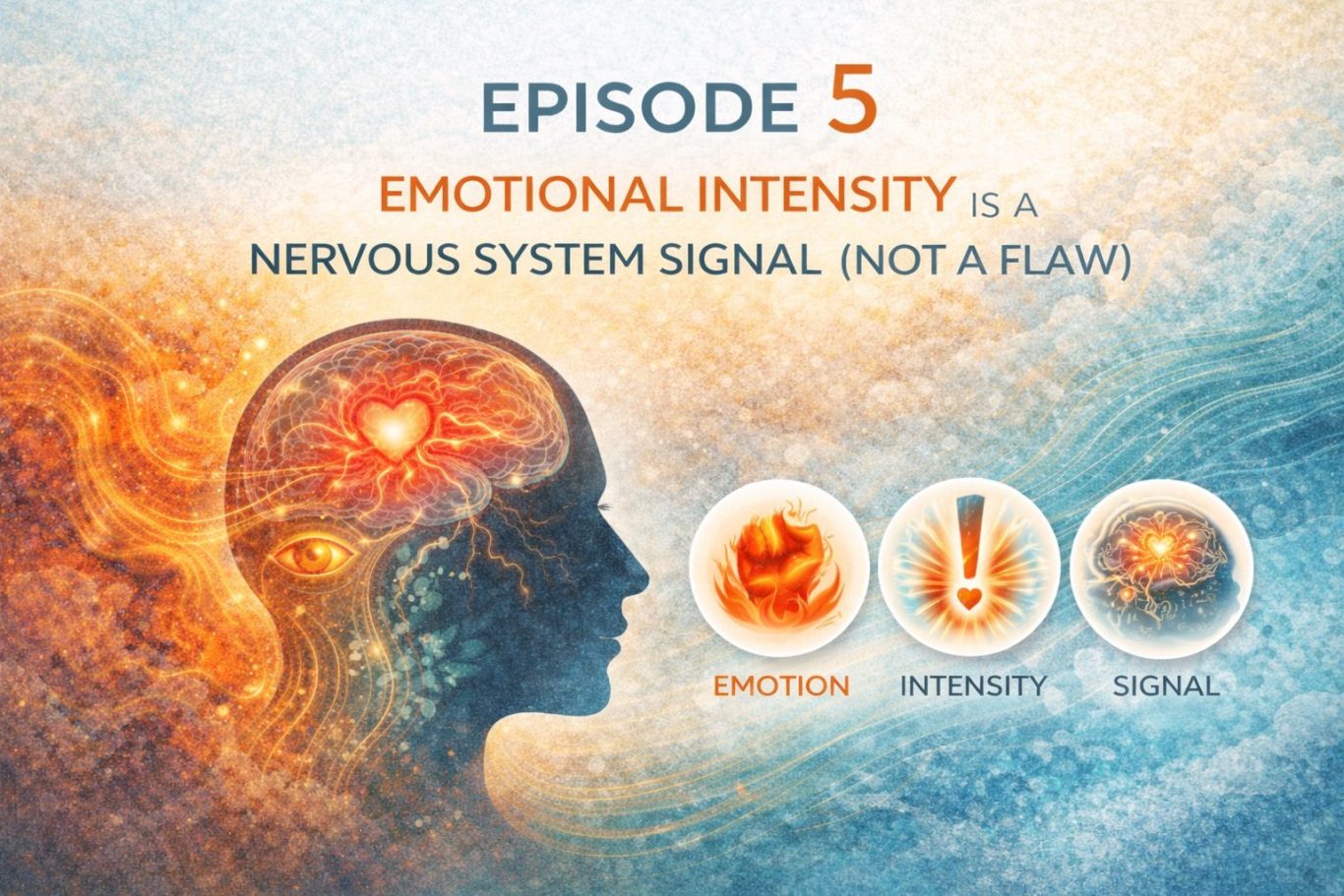
ADHD emotions aren’t “too much… They’re fast, informative, and physiologically driven.
By the time emotion shows up, the nervous system has already decided something matters.
Episode 5 reframes emotional intensity in ADHD… not as dysregulation, immaturity, or overreaction, but as a high-fidelity signalling system operating at speed.
If Episodes 1–4 established that:
- ADHD is a nervous system pattern
- attention depends on arousal
- state shifts drive behaviour
- sensory load primes regulation
Then Episode 5 addresses what is most often shamed:
feeling.
Why Emotion Gets Blamed
In ADHD, emotion is frequently treated as the problem:
- “too sensitive”
- “overreactive”
- “emotionally dysregulated”
- “can’t regulate feelings”
But emotion is not the cause of dysregulation.
Emotion is the messenger.
When systems focus on suppressing emotion instead of understanding its origin, regulation worsens… not improves.
Emotion Is a Nervous System Output
Emotion does not originate in logic.
It emerges from:
- sensory input
- arousal shifts
- perceived safety or threat
- relevance and meaning
By the time someone feels overwhelmed, rejected, angry, or flooded:
- the body has already mobilised
- arousal has already shifted
- attention has already narrowed
Trying to “calm emotions” without addressing physiology is like muting a fire alarm while the building is still burning.
Why ADHD Emotions Are Fast and Intense
ADHD nervous systems tend to process emotion:
- quickly (low latency)
- globally (whole-body activation)
- meaning-first (relevance before logic)
This creates emotional experiences that are:
- sudden
- powerful
- immersive
- hard to interrupt once underway
Not because regulation is poor…
but because signal transmission is strong.
This is why people often say:
“I feel it before I can think about it.”
That’s not a failure.
That’s how the system is wired.
Emotion as Information, Not Instability
Emotion in ADHD often signals:
- relevance (“this matters”)
- threat (“this feels unsafe”)
- overload (“this is too much”)
- misalignment (“this doesn’t fit”)
- urgency (“something needs attention now”)
When these signals are dismissed, minimised, or invalidated:
- the system escalates
- intensity increases
- shutdown or explosion becomes more likely
When they are acknowledged early:
- arousal stabilises
- cognition returns
- regulation improves
Emotion isn’t the problem.
Ignored emotion is.
Why Suppression Backfires
Many people with ADHD learn early to suppress emotion to survive:
- in school
- at work
- in relationships
- in therapy
They learn to:
- mask reactions
- intellectualise feelings
- minimise needs
- “hold it together”
But suppression doesn’t remove emotion.
It pushes it downstream.
Which often results in:
- delayed overwhelm
- sudden shutdown
- emotional explosions
- burnout
- somatic symptoms
The nervous system does not forget unprocessed signals.
It stores them.
Emotional Dysregulation vs Emotional Overload
What’s often called “emotional dysregulation” in ADHD is more accurately:
- emotional overload
- driven by cumulative arousal
- compounded by sensory input
- intensified by pressure and invalidation
The emotion itself isn’t dysregulated.
The system is overloaded.
Trying to teach “emotional control” without addressing load is ineffective… and often harmful.
Why Rejection Sensitivity Hits So Hard
Experiences of rejection, criticism, or exclusion often trigger intense emotional responses in ADHD.
This is not fragility.
It’s nervous system logic.
Social belonging is a safety signal.
For ADHD nervous systems:
- emotional meaning is amplified
- relational cues are processed rapidly
- past experiences of misunderstanding or failure sensitise detection
So when rejection is perceived:
- arousal spikes
- threat responses activate
- emotion floods
This happens before rational evaluation.
Shaming the reaction doesn’t help.
Understanding the signal does.
Emotion, Meaning, and Motivation Are Linked
In ADHD, emotion is not separate from motivation.
Emotion is often the engine of motivation.
This is why:
- interest unlocks focus
- passion fuels endurance
- boredom collapses capacity
- emotionally flat tasks feel impossible
Emotion tells the nervous system:
“This is worth energy.”
Remove emotion, and the system disengages.
This is why purely logical task framing often fails.
Emotional Awareness as a Regulation Skill
Regulation doesn’t mean “not feeling”.
It means:
- recognising emotional shifts early
- identifying what the emotion is responding to
- adjusting load, safety, or stimulation accordingly
This might look like:
- pausing before escalation
- naming the signal (“this feels like overload”)
- reducing sensory input
- lowering demand
- adding grounding or connection
The earlier emotion is recognised, the less intense it needs to become.
Why Naming Emotion Restores Control
When people can say:
- “I’m flooded”
- “This feels threatening”
- “I’m emotionally overloaded”
- “This matters more than I expected”
They stop interpreting emotion as:
- weakness
- failure
- immaturity
- overreaction
And start responding with:
- adjustment
- compassion
- strategy
- timing
This alone reduces secondary shame… which is itself a powerful dysregulator.
Emotion Is Not the Enemy of Logic
A common myth is that emotion interferes with thinking.
In reality:
- unacknowledged emotion blocks cognition
- acknowledged emotion restores it
When emotional signals are integrated:
- attention widens
- flexibility returns
- decision-making improves
- communication becomes clearer
Emotion and cognition are not opposites.
They are partners.
From Emotional Control to Emotional Translation
The shift this episode invites is simple… and profound:
From:
“How do I stop feeling this?”
To:
“What is my nervous system trying to tell me?”
That single question transforms emotion from something to fight
into something to listen to.
Why This Matters Clinically and Systemically
When emotional intensity is pathologised:
- people learn to mistrust themselves
- therapy becomes invalidating
- systems reward numbness over accuracy
When emotional signalling is respected:
- regulation improves
- trust rebuilds
- burnout decreases
- insight becomes usable
This is not indulgence.
It is biological realism.
What Comes Next
Episode 5 reframes emotion as signal.
Episode 6 will explore what happens when those signals are ignored repeatedly:
chronic stress, allostatic load, and burnout in ADHD nervous systems.
Why resilience fails.
Why recovery takes longer.
And why “just rest” is rarely enough.
Because burnout isn’t a motivation problem.
It’s a nervous system debt.
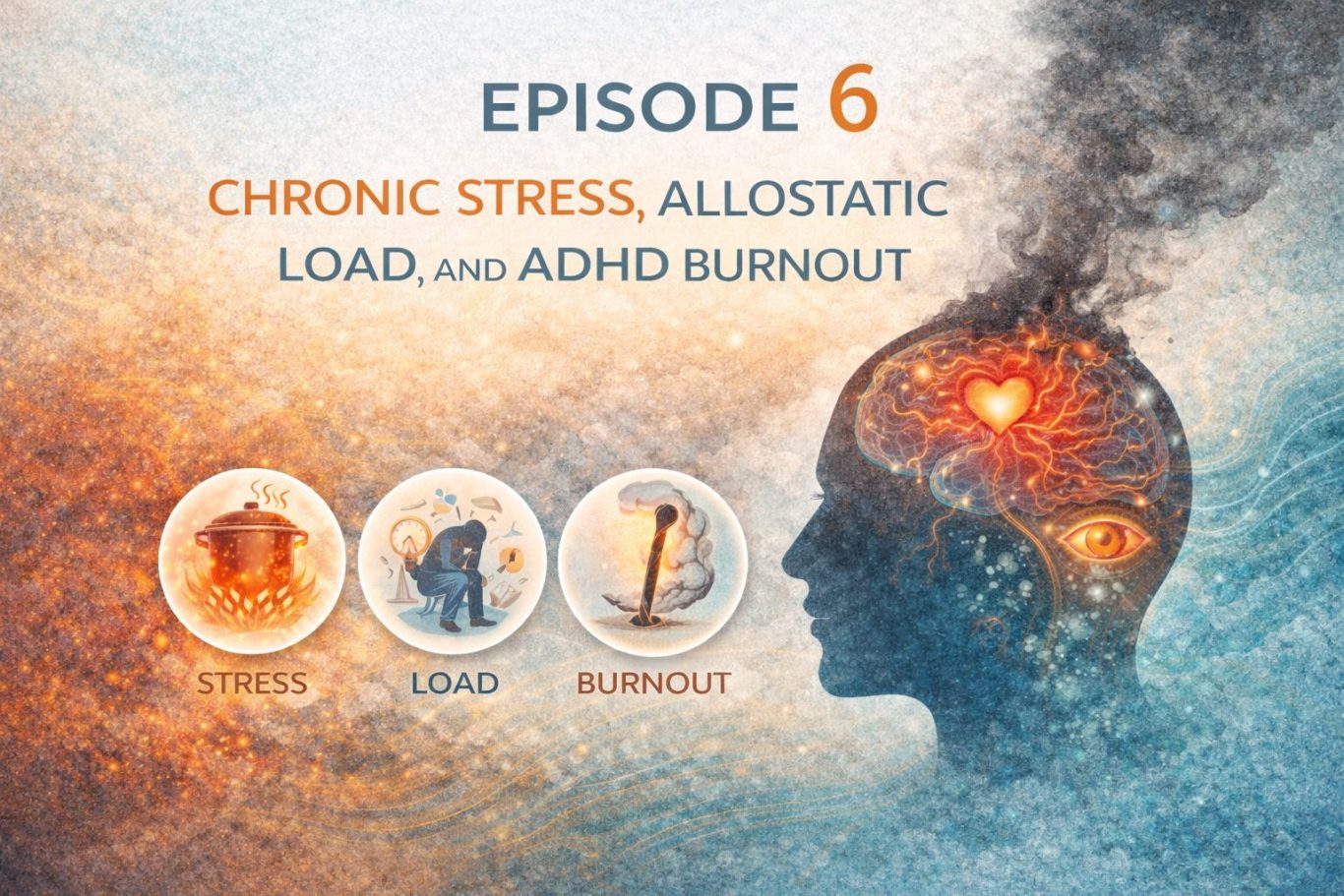
Burnout isn’t a motivation failure… It’s a nervous system debt coming due.
By Episode 6, a pattern should be clear.
ADHD isn’t explained by:
- poor effort
- weak resilience
- lack of skills
It’s explained by what happens when a highly responsive nervous system is asked to operate in environments that ignore how it works.
This episode looks at what happens over time… when arousal is repeatedly pushed, sensory load is rarely reduced, emotional signals are ignored, and recovery is postponed.
The result isn’t laziness.
It’s allostatic overload.
What Chronic Stress Actually Is
Stress is not the problem.
Stress is a normal, adaptive nervous system response.
The problem is unresolved stress.
Chronic stress occurs when:
- arousal is repeatedly activated
- threat signals remain present
- recovery is insufficient or delayed
- the nervous system never fully returns to baseline
For ADHD nervous systems… which already regulate with greater intensity and variability… this load accumulates faster.
And it costs more.
Allostasis vs Homeostasis (Why ADHD Pays a Higher Price)
Homeostasis assumes stability.
Allostasis recognises reality:
- the body constantly adjusts to meet demand
Allostatic load is the wear and tear that accumulates when those adjustments are made too often, too intensely, or for too long.
ADHD nervous systems often carry higher allostatic load because:
- arousal shifts are frequent
- emotional intensity is high
- sensory input is harder to filter
- social masking is constant
- performance expectations are rigid
- recovery is delayed by shame or pressure
The system is always compensating.
Eventually, it runs out of margin.
Why ADHD Burnout Looks “Sudden” (But Isn’t)
ADHD burnout is often described as coming out of nowhere.
In reality, it’s the end of a long sequence:
- repeated mobilisation without recovery
- reliance on urgency and pressure
- suppression of early warning signals
- cycles of hyperfocus and collapse
- self-blame replacing adjustment
By the time burnout is visible:
- the nervous system is exhausted
- access to motivation is gone
- cognition feels offline
- even meaningful tasks feel impossible
The collapse is not sudden.
It’s overdue.
Burnout Is a Nervous System State, Not a Mood
ADHD burnout is often misdiagnosed as:
- depression
- lack of motivation
- loss of ambition
- avoidance
But burnout is not primarily emotional.
It is physiological.
Common features include:
- extreme fatigue that rest doesn’t fix
- emotional numbness or flattening
- cognitive fog and memory problems
- reduced stress tolerance
- increased sensory sensitivity
- shutdown or withdrawal
- loss of interest even in previously meaningful work
This is the nervous system saying:
I cannot mobilise anymore.
Why “Just Rest” Rarely Works
Well-meaning advice often says:
- “take a break”
- “rest more”
- “have a holiday”
Rest helps… but it’s not sufficient on its own.
Because burnout isn’t caused by lack of rest.
It’s caused by:
- chronic overactivation
- lack of regulation
- constant self-suppression
- environmental mismatch
If the system returns to the same demands, same sensory load, same pressure, same expectations…
it re-enters survival immediately.
Recovery requires structural change, not just pauses.
The Role of Shame in Burnout
One of the most damaging contributors to ADHD burnout is shame.
Shame:
- increases threat
- keeps the nervous system activated
- prevents early adjustment
- delays recovery
- drives overcompensation
Many people push themselves not because they feel capable…
but because they don’t feel allowed to stop.
They internalise messages like:
- “Others manage this”
- “I shouldn’t need support”
- “If I rest, I’m failing”
- “I just need to try harder”
Shame turns stress into chronic stress.
Why Burnout Reduces Access to Skills
One of the most frightening aspects of ADHD burnout is skill loss.
People often say:
“I know what helps… I just can’t access it anymore.”
This isn’t regression.
It’s state-dependent shutdown.
In burnout:
- executive function is offline
- working memory is compromised
- emotional range is flattened
- motivation systems are depleted
Skills haven’t disappeared.
They’re temporarily inaccessible because the system lacks energy.
Why ADHD Burnout Lasts Longer
ADHD burnout often takes longer to recover from because:
- the nervous system was compensating for years
- identity is tied to overfunctioning
- rest feels unsafe or undeserved
- people return to pressure too quickly
- environments remain unchanged
Without addressing regulation patterns, people cycle:
push → crash → recover → push again
Each cycle deepens depletion.
Early Warning Signs (That Are Often Missed)
Burnout rarely begins with collapse.
Early signs include:
- increased irritability
- reduced tolerance for noise or interruption
- emotional flattening or volatility
- avoidance of low-demand tasks
- reliance on urgency to function
- longer recovery times after effort
- increased shutdown after social interaction
These are regulation warnings, not character flaws.
Responding early prevents collapse.
Recovery Is About Rebuilding Capacity… Slowly
Burnout recovery is not about returning to previous output.
It’s about:
- restoring baseline regulation
- reducing unnecessary load
- rebuilding trust with the nervous system
- reintroducing demand gradually
This often requires:
- reducing sensory input
- lowering performance pressure
- increasing predictability
- prioritising safety and rhythm
- decoupling worth from productivity
Recovery is not linear.
And forcing speed delays it.
Why Sustainable Functioning Requires a Different Model
ADHD nervous systems cannot be run on:
- constant urgency
- chronic pressure
- rigid schedules
- delayed reward
They function sustainably with:
- meaning-based engagement
- flexible pacing
- built-in recovery
- sensory awareness
- permission to adjust
This is not about doing less forever.
It’s about stopping the cycle of depletion.
Burnout as Information, Not Failure
Burnout is often experienced as personal collapse.
But through a nervous system lens, burnout is information.
It tells us:
- where capacity was exceeded
- which signals were ignored
- which environments were unsafe
- which expectations were misaligned
Listening to that information is the beginning of recovery.
Why Systems, Not Individuals, Must Change
No amount of resilience training fixes environments that:
- reward overwork
- punish inconsistency
- ignore sensory needs
- shame rest
- pathologise regulation differences
ADHD burnout is not an individual problem.
It is a system design problem.
The Reframe That Protects Futures
The most protective shift is this:
From:
“Why can’t I cope like others?”
To:
“What has my nervous system been carrying… and what does it need now?”
That question replaces self-attack with care.
And care restores capacity.
What Comes Next
Episode 6 explained what happens when regulation is ignored long-term.
Episode 7 will explore the opposite:
how rhythm, timing, and nervous system coherence support sustainable ADHD functioning.
Not rigid routines.
Not discipline.
But biological alignment.
Because ADHD nervous systems don’t need to be pushed harder.
They need to be timed better.
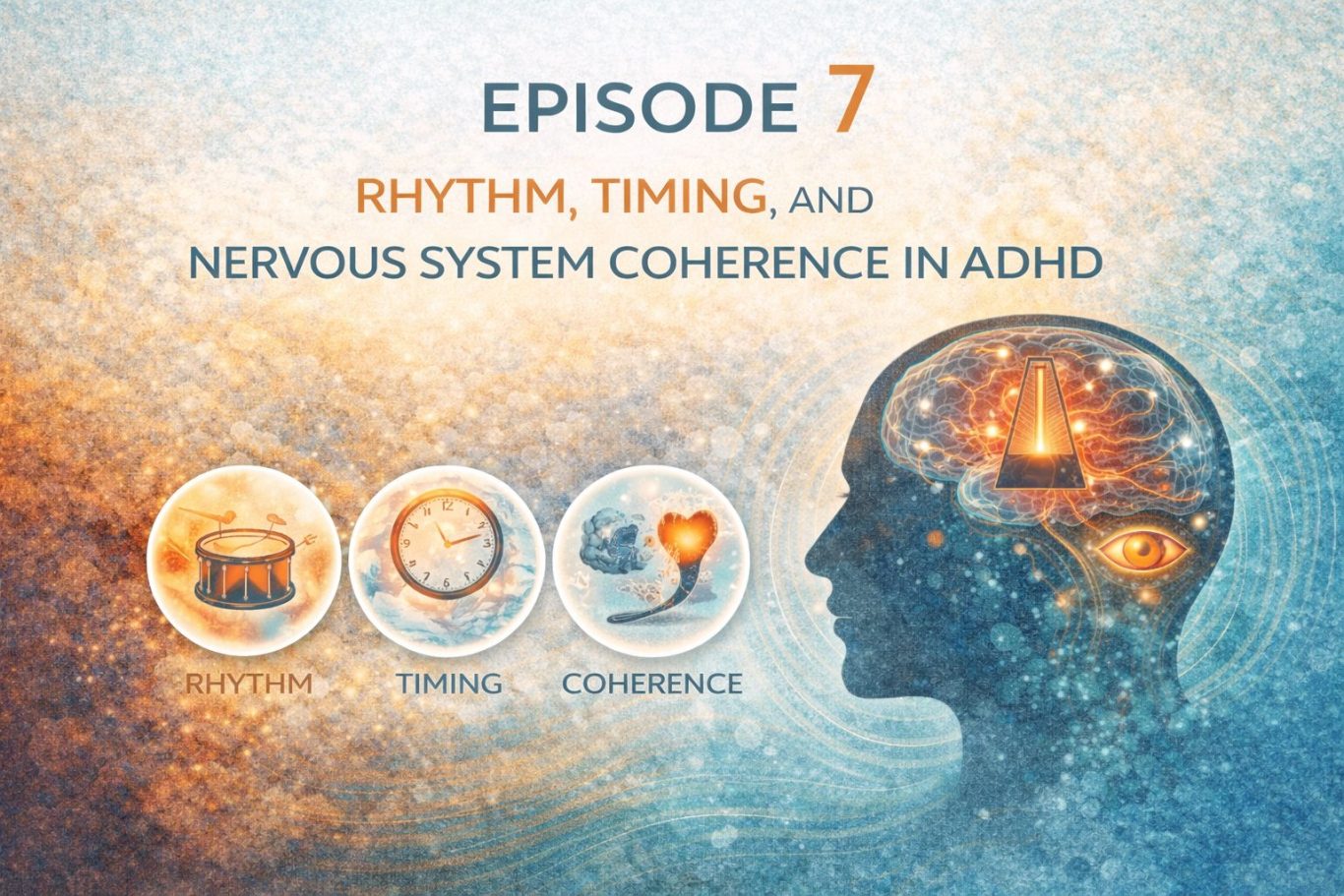
ADHD doesn’t struggle with routine… It struggles with rhythm mismatch.
By this point in the series, a clear picture has emerged.
ADHD nervous systems are:
- highly responsive
- state-dependent
- sensitive to load
- deeply affected by arousal, emotion, and environment
So Episode 7 asks a critical question:
If this is how the system works… why do we keep demanding rigid consistency?
This episode reframes “structure” entirely.
Not as discipline.
Not as routine.
But as biological timing and nervous system coherence.
Why Routines Fail ADHD Nervous Systems
Traditional routines assume:
- consistent energy
- predictable focus
- linear productivity
- identical capacity day to day
ADHD nervous systems don’t operate like that.
Capacity fluctuates because:
- arousal shifts
- sensory load varies
- emotional demand changes
- sleep and recovery differ
- stress accumulates unevenly
Rigid routines ignore this reality.
And when routines break… as they inevitably do… people blame themselves.
But the problem is not the person.
It’s the structure.
Rhythm vs Routine
Routine is about repetition.
Rhythm is about timing.
Rhythm asks:
- When does my energy rise?
- When does it fall?
- When is my nervous system open?
- When does it need protection or recovery?
ADHD nervous systems are far more responsive to when something happens than to what the plan says.
This is why:
- the same task feels easy one day and impossible the next
- productivity comes in waves
- forcing work at the wrong time backfires
- rest at the wrong time doesn’t restore
Rhythm is the missing layer.
Circadian Rhythm: The First Misalignment
Many ADHD nervous systems experience circadian differences:
- delayed sleep phase
- late energy peaks
- slow mornings, strong evenings
- difficulty “winding down”
When society demands peak performance early:
- arousal is forced
- stress hormones compensate
- recovery debt builds
Over time, this creates:
- chronic exhaustion
- reliance on urgency or stimulants
- mislabelled “poor sleep hygiene”
- burnout cycles
This isn’t poor discipline.
It’s chronobiology.
Ultradian Rhythms: Why Focus Comes in Bursts
Beyond daily rhythm, the nervous system operates in ultradian cycles:
- natural waves of energy and rest throughout the day
ADHD nervous systems often experience:
- shorter focus windows
- sharper peaks
- steeper drops
Trying to override these cycles leads to:
- cognitive fatigue
- irritability
- shutdown
- diminishing returns
Working with them allows:
- intense focus in short bursts
- intentional recovery
- sustained output across the day
This is why “work sprints” often succeed where endurance fails.
Why ADHD Productivity Is Pulse-Based
ADHD productivity is not steady.
It is pulse-based.
High output periods are followed by:
- depletion
- sensory sensitivity
- need for disengagement
When this is misunderstood:
- recovery is framed as laziness
- rest is delayed
- pulses become crashes
When it is respected:
- recovery is planned
- capacity stabilises
- burnout is avoided
The nervous system doesn’t want less productivity.
It wants paced productivity.
Nervous System Coherence: What Stability Actually Looks Like
Coherence doesn’t mean calm all the time.
It means:
- predictable oscillation
- safe transitions between states
- recovery built into effort
- fewer extremes
For ADHD nervous systems, coherence comes from:
- flexible timing
- permission to adjust
- environmental consistency
- sensory predictability
- emotional validation
This creates stability without rigidity.
Why “Habits” Are Hard (and Often Misunderstood)
Habit formation advice assumes:
- repetition equals automation
- consistency equals success
But ADHD habit disruption is rarely about forgetting.
It’s about:
- state mismatch
- energy depletion
- sensory interference
- emotional overload
A habit that works in one state may fail completely in another.
This doesn’t mean habits are impossible.
It means they must be:
- state-aware
- flexible
- responsive
- forgiving
Rigid habits collapse under real nervous system conditions.
Anchors, Not Schedules
One of the most effective ADHD supports is anchoring.
Anchors are:
- flexible reference points
- predictable cues
- repeatable transitions
Examples include:
- a morning grounding ritual (not a fixed time)
- a movement break between tasks
- a sensory reset after meetings
- a consistent “shutdown” signal at the end of work
Anchors support regulation without demanding sameness.
Why Timing Reduces Shame
When people learn their rhythms, they stop saying:
- “I’m inconsistent”
- “I can’t stick to anything”
- “I always mess this up”
And start saying:
- “This isn’t my window”
- “My system needs recovery”
- “This will work later”
That language shift reduces:
- self-attack
- panic-driven urgency
- overcompensation
And shame reduction is itself a powerful regulator.
Designing Life Around Rhythm (Not Fighting It)
When ADHD nervous systems are supported by rhythm:
- energy becomes more predictable
- focus becomes more accessible
- emotion stabilises
- recovery shortens
- self-trust rebuilds
This might mean:
- working later when possible
- front-loading meaningful tasks
- planning admin for low-arousal windows
- protecting recovery after intensity
- designing weeks, not days
This isn’t about doing less.
It’s about doing things at the right time.
Why Systems Resist Rhythm (and Why They Must Change)
Most systems are built for:
- uniformity
- predictability
- linear output
Rhythm threatens that illusion.
But forcing uniformity on nervous systems that don’t work that way:
- reduces performance
- increases burnout
- drives disengagement
Neuro-inclusive systems don’t remove standards.
They diversify timing.
From Discipline to Alignment
The biggest reframe in Episode 7 is this:
ADHD doesn’t need more discipline.
It needs better alignment.
Alignment between:
- demand and capacity
- effort and recovery
- stimulation and arousal
- expectation and biology
When alignment exists, discipline becomes unnecessary.
Engagement happens naturally.
Preparing for the Final Episode
Episode 7 focused on rhythm and coherence.
Episode 8 will bring the entire series together into a practical nervous system-informed self-regulation framework.
Not a list of hacks.
Not a productivity system.
But a way of living that works with ADHD nervous systems… not against them.
From surviving…
to tuning.
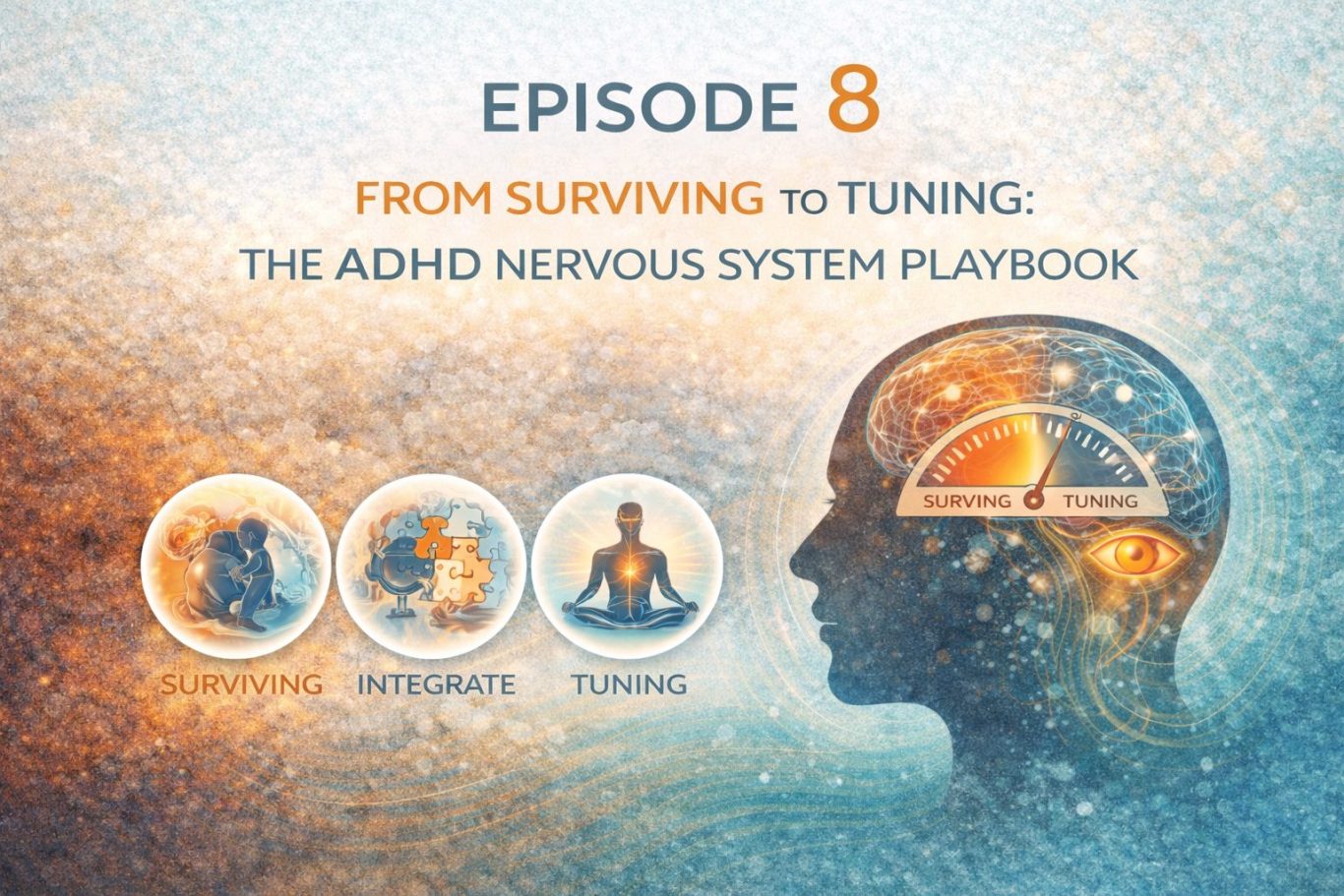
This was never about fixing yourself… It was about learning how your system works.
Across this series, one truth has repeated itself in different forms:
ADHD is not a failure of character, effort, or intelligence.
It is a nervous system that operates with different rules.
Episode 8 brings everything together… not as another strategy list, but as a way of orienting to yourself that makes regulation possible, sustainable, and humane.
This is not about optimisation.
It’s about tuning.
Why “Trying Harder” Never Worked
Most people with ADHD already try harder than anyone realises.
They try to:
- override arousal
- suppress emotion
- ignore sensory overload
- push through fatigue
- perform consistency
What this series has shown is that effort applied against the nervous system:
- increases stress
- narrows access
- accelerates burnout
- erodes self-trust
The playbook begins by dropping one assumption:
You cannot out-discipline physiology.
But you can learn to work with it.
The Core Shift: From Behaviour to State
Everything in this playbook rests on one foundational move:
Stop asking
“What should I be doing?”
Start asking
“What state is my nervous system in right now?”
Because:
- behaviour follows state
- skills depend on access
- access depends on regulation
When state is misread, every intervention misses.
The ADHD Nervous System Playbook (The Architecture)
Rather than tools, think in layers.
Each layer supports the next.
Layer 1: State Awareness (Before Strategy)
Nothing works without state awareness.
This means learning to recognise:
- under-arousal (fog, boredom, restlessness)
- over-arousal (anxiety, urgency, emotional flooding)
- freeze/shutdown (numbness, paralysis, withdrawal)
- regulated engagement (flexibility, curiosity, access)
This is not overthinking.
It is early detection.
The earlier state shifts are noticed, the less extreme they need to become.
Layer 2: Regulation Before Demand
Once state is recognised, the next rule applies:
Regulate first. Demand second.
This might mean:
- movement before focus
- grounding before decision-making
- reducing sensory load before emotional processing
- lowering stakes before problem-solving
This is where most systems fail ADHD.
They add demand to dysregulation and then blame the person when access collapses.
Layer 3: Sensory Load Is Foundational
If the senses are overloaded, nothing else matters.
The playbook assumes:
- sensory input is always affecting regulation
- overload is cumulative
- recovery requires reducing input, not pushing through
This means treating sensory supports as:
- regulation infrastructure
- not preferences
- not indulgences
- not optional extras
No sensory safety = no sustainable access.
Layer 4: Emotion as Signal, Not Obstacle
Emotion is not something to manage away.
It is something to translate.
Instead of:
- “Why am I reacting like this?”
The playbook asks:
- “What does this emotion tell me about load, safety, or meaning?”
Emotion often signals:
- misalignment
- overload
- threat
- importance
- exhaustion
When emotion is listened to early, it doesn’t need to escalate.
Layer 5: Rhythm Over Routine
This playbook replaces rigid routine with biological timing.
Key assumptions:
- capacity fluctuates
- energy moves in waves
- focus is pulse-based
- recovery must be planned
Instead of enforcing sameness, the playbook uses:
- anchors
- windows
- transitions
- flexible structures
This protects capacity rather than consuming it.
Layer 6: Access Over Consistency
Traditional success models reward consistency.
The nervous system playbook prioritises access.
It asks:
- Can I access focus when it matters?
- Can I return to regulation after disruption?
- Can I recover without collapse?
In ADHD, consistency emerges after regulation… not before it.
Layer 7: Shame Reduction Is Regulation
Shame is not emotional fluff.
It is a threat signal.
The playbook actively removes shame by:
- externalising regulation differences
- normalising fluctuation
- validating recovery needs
- reframing “failure” as state mismatch
Reduced shame = lower baseline arousal = greater access.
The Daily Application (What This Looks Like in Real Life)
This is not a checklist.
It’s a rhythm of questions:
- What state am I in?
- What input is affecting me right now?
- What would help my system shift?
- Is this a regulation issue or a capacity issue?
- What can wait until access returns?
These questions replace self-attack with curiosity.
And curiosity is regulating.
Why This Works Where Other Systems Fail
Most ADHD approaches focus on:
- behaviour modification
- cognitive strategies
- motivation hacks
Those have a place… after regulation.
This playbook works because it:
- starts upstream
- respects physiology
- prevents escalation
- builds sustainability
- restores self-trust
It doesn’t demand more from the nervous system.
It protects it.
From Surviving to Tuning
Survival looks like:
- urgency
- overfunctioning
- collapse
- recovery
- repeat
Tuning looks like:
- awareness
- adjustment
- engagement
- recovery
- continuity
The goal is not to eliminate dysregulation.
It is to:
- shorten it
- soften it
- recover faster
- reduce harm
That is sustainable functioning.
Why This Is Not “Lowering the Bar”
This playbook does not lower expectations.
It raises accuracy.
When expectations align with nervous system reality:
- performance improves
- burnout decreases
- creativity increases
- trust rebuilds
People do not thrive by being pushed harder.
They thrive by being supported precisely.
What This Means Beyond the Individual
This series was never only about individuals.
It applies to:
- therapy models
- education systems
- workplaces
- healthcare pathways
- policy design
Any system that ignores nervous system regulation will:
- misinterpret behaviour
- punish difference
- waste potential
- cause harm
Neuro-inclusive systems don’t ask people to adapt endlessly.
They adapt to humans.
The Final Reframe
If this series leaves you with one sentence, let it be this:
ADHD is not a disorder of effort.
It is a nervous system that requires attunement.
Nothing here is about becoming someone else.
It’s about becoming aligned.
Where This Series Ends (and Begins)
Episode 8 closes the series… but opens a new way of relating to ADHD.
Not as a problem to overcome.
Not as a flaw to mask.
But as a system to understand, support, and tune.
From surviving…
to tuning.