
By Neal Glendenning
The system doesn’t fail people at random. It fails them predictably.
There is a story that repeats across healthcare, education, workplaces, and public services with unsettling consistency.
Capable people enter systems with hope.
They engage.
They try.
They adapt.
Often, they try harder than those around them.
They learn the rules quickly.
They compensate for friction.
They mask difficulties.
They over-prepare.
They over-function.
And then, slowly or suddenly, something breaks.
They burn out.
They disengage.
They are labelled non-compliant, unreliable, or not the right fit.
They leave… or are quietly removed.
When this happens, the explanation offered is almost always individual.
They couldn’t cope.
They weren’t resilient enough.
They didn’t engage properly.
They didn’t take responsibility.
What is rarely asked… and almost never examined… is the most important question of all:
Why does this keep happening to the same people, in the same ways, across entirely different systems?
Because when outcomes repeat with this level of consistency, they are not personal.
They are patterned.
The myth of random failure
Most systems tell a comforting story about themselves.
They claim neutrality.
Fairness.
Equal opportunity.
They insist that the rules are the same for everyone… and therefore the outcomes must be fair.
If some people succeed and others don’t, the logic goes, that’s just life.
Not everyone will thrive everywhere.
Variation is inevitable.
But this explanation collapses under even the lightest scrutiny.
Because the people who “fail” are not randomly distributed.
Across sectors and institutions, those who struggle most are disproportionately:
- neurodivergent
- disabled
- traumatised
- chronically ill
- carers
- people without financial, social, or cultural capital
Different systems.
Different rules.
Same outcomes.
That is not randomness.
That is structural patterning.
When outcomes repeat, design is speaking
In any other domain, repeated failure would trigger investigation.
If a bridge collapsed every time it rained heavily, we wouldn’t blame drivers for crossing it incorrectly.
If a product injured the same group of users repeatedly, we wouldn’t accuse those users of incompetence.
We would examine the design.
We would ask:
- What assumptions were made?
- What loads were underestimated?
- Who was not considered in testing?
- What conditions were ignored?
Yet when human systems repeatedly disadvantage the same people, we reach for moral explanations instead.
Why?
Because questioning design is uncomfortable.
Design implicates power.
Design implicates leadership.
Design implicates the system itself.
Blaming individuals is safer.
Design always encodes values… whether we admit it or not
Every system carries assumptions about what a “normal” human looks like.
Not explicitly.
Not maliciously.
But structurally.
Assumptions about:
- how long someone can sustain focus
- how quickly they can respond
- how predictable their energy is
- how emotionally regulated they can remain under pressure
- how safe they feel asking for help
These assumptions get baked into:
- timelines
- thresholds
- escalation policies
- attendance rules
- communication norms
- definitions of “engagement”
Once embedded, they become invisible.
And once invisible, they stop being questioned.
This is how systems quietly sort people… not by merit, but by compatibility with an unspoken template.
Failure is data… but we treat it as a verdict
Every system produces feedback.
Some of it comes in spreadsheets and dashboards.
But much of it comes through human experience.
People dropping out.
People burning out.
People disengaging.
People labelled “difficult.”
People disappearing quietly.
These are not anomalies.
They are signals.
But most systems don’t treat them as such.
Instead of asking what these outcomes are telling us about load, safety, accessibility, and coherence, we reinterpret them as personal shortcomings.
Failure becomes a verdict on the individual… not information about the system.
And once failure is moralised, learning stops.
The difference between malfunction and misfit
There is a distinction most systems fail to make.
Malfunction implies something is broken.
Misfit implies something doesn’t belong in its current form.
When a neurodivergent person struggles in a rigid system, the system diagnoses malfunction:
- attention problem
- motivation problem
- compliance problem
- attitude problem
But very often, what’s actually happening is misfit.
The system is functioning exactly as designed.
The person simply does not match the design assumptions.
Treating misfit as malfunction creates unnecessary harm:
- unnecessary treatment
- unnecessary discipline
- unnecessary shame
- unnecessary loss of talent
And it obscures the simplest solution of all: redesign.
Why systems default to personal blame
There are deep structural reasons institutions resist recognising patterned failure.
1. Pattern recognition threatens legitimacy
If failure is systemic, responsibility shifts upward.
That introduces accountability.
Cost.
Change.
Disruption.
Personal blame preserves institutional innocence.
2. Moral explanations feel intuitive
We are culturally trained to interpret struggle through effort, attitude, and willpower.
This framing feels familiar.
It feels fair.
It feels earned.
Even when it is inaccurate.
3. Design bias is invisible to those it serves
Those who thrive within a system often become its designers.
Their nervous systems, cognitive styles, energy profiles, and life circumstances become the unspoken blueprint.
Difference is not maliciously excluded… it is simply unseen.
The quiet violence of misattribution
When systems misread patterned failure as individual weakness, something corrosive happens.
People internalise the explanation.
They don’t think:
“This system is not designed for my nervous system, cognition, or life constraints.”
They think:
“There must be something wrong with me.”
So they push harder.
They override signals.
They ignore limits.
They suppress needs.
They trade safety for approval.
Until their body or mind forces a stop.
And when collapse finally happens, the system responds with surprise:
“We had no idea they were struggling.”
Of course it didn’t.
The system trained them not to show it.
How systems train people to disappear
One of the most damaging effects of misattribution is what it teaches people to do next.
They learn:
- not to disclose
- not to ask
- not to signal distress
- not to challenge assumptions
They learn that visibility carries risk.
So they adapt by becoming:
- quieter
- more compliant
- less expressive
- less honest
From the system’s perspective, this looks like success.
Until it doesn’t.
When people finally leave, burn out, or collapse, leadership often responds with genuine confusion.
But the invisibility was not accidental.
It was learned.
Who fails first… and why that matters
It is not coincidence that certain people fail earlier and more visibly.
Those with:
- heightened sensory sensitivity
- variable energy and attention
- emotional intensity
- nonlinear processing
- trauma-conditioned nervous systems
These individuals experience overload sooner because they are exposed sooner.
They register threat, incoherence, and unsustainable demand earlier.
This is not weakness.
It is early warning.
Early failure as a predictive indicator
In engineering, early failure is invaluable.
It tells you:
- where tolerances are wrong
- where load was underestimated
- where stress concentrates
- where assumptions break down
Human systems ignore this wisdom.
Instead of treating early failure as a predictive indicator, they treat it as evidence of deficiency.
This is a catastrophic mistake.
Because the people who fail first are often highlighting future failure points for everyone else.
They are not anomalies.
They are advance warnings.
Equality, neutrality, and the myth of fairness
Many systems defend themselves by pointing to uniform rules.
Same deadlines.
Same processes.
Same expectations.
But neutrality is not fairness.
A staircase is neutral.
It treats everyone the same.
That doesn’t make it accessible.
Uniformity as a sorting mechanism
Uniform systems don’t eliminate bias.
They automate it.
Rigid rules quietly sort people without ever naming exclusion.
Those who can absorb the hidden costs stay.
Those who can’t leave.
The system then claims neutrality:
“Everyone had the same rules.”
What it doesn’t acknowledge is that the cost of compliance was never equal.
The cumulative cost of ignoring patterns
Patterned failure doesn’t just harm individuals.
It creates systemic fragility.
When organisations repeatedly lose:
- highly empathetic people
- creative thinkers
- systems thinkers
- early detectors of risk
They don’t just lose staff.
They lose feedback.
Over time, the system becomes more brittle, more defensive, and less capable of adapting… precisely because it has filtered out those most sensitive to strain.
Why this matters now
We are living through a convergence of crises:
- burnout
- workforce attrition
- disengagement
- mental health overload
- institutional distrust
Treating these as individual failings will not solve them.
Because they are not individual failings.
They are system-level signals… flashing red… that our structures are demanding more than many humans can safely give.
Ignoring those signals doesn’t just harm people.
It destabilises the system itself.
A different starting point
If failure is patterned, then difference is predictable.
And if difference is predictable, exclusion is preventable.
But only if we stop defending systems as neutral
and start treating outcomes as evidence.
The system doesn’t fail people randomly.
It fails them by design… whether intentionally or not.
And anything designed can be redesigned.
Closing reflection
When the same people keep falling through the cracks, the cracks are not accidental.
They are structural.
In Episode 2, we will examine who systems are actually built for… and how the myth of the “average user” quietly governs everything.
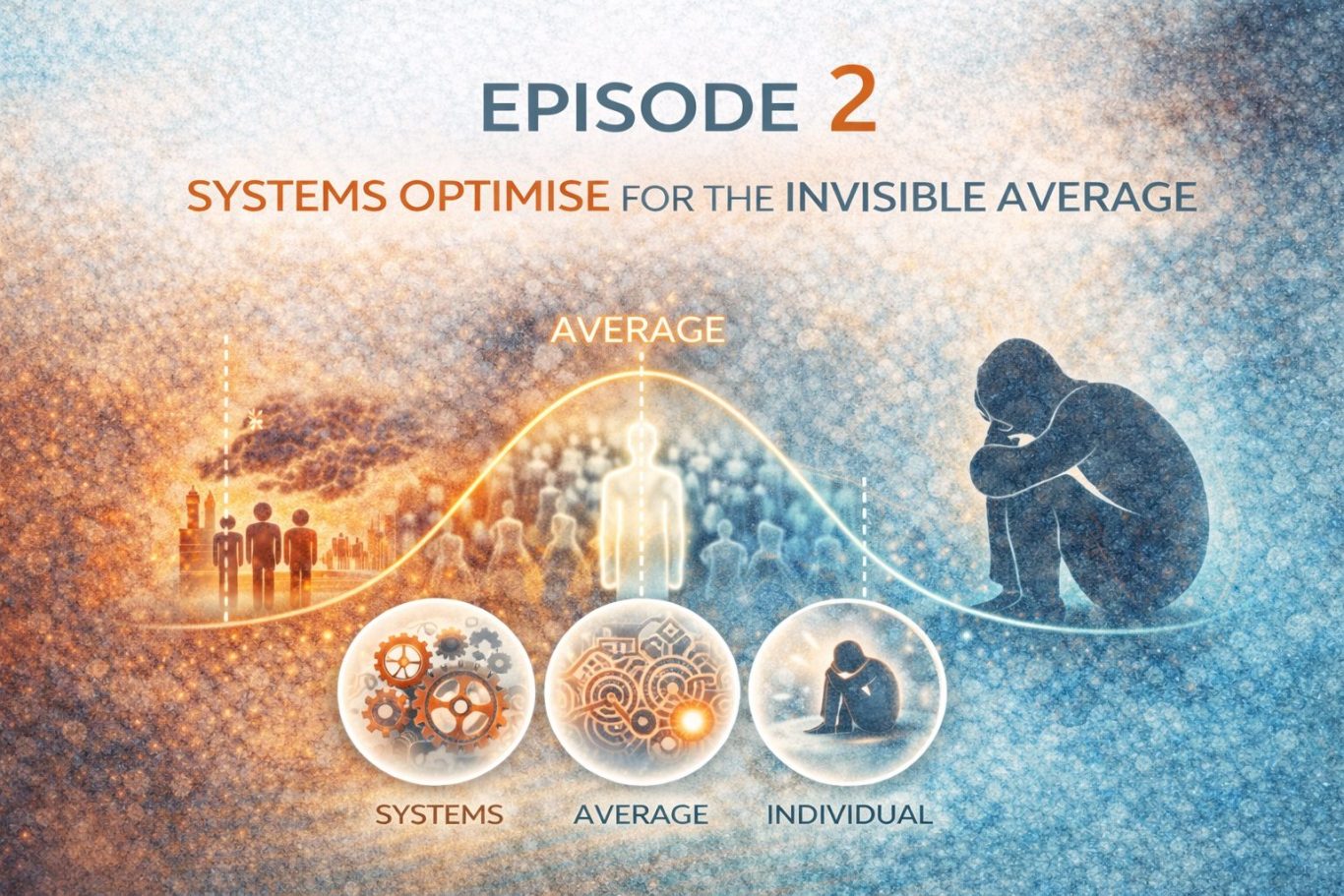
How the “Average Human” Was Invented
There is a person almost every system is quietly built around.
You will never meet them.
They do not exist in real life.
But they shape everything.
They are emotionally regulated.
Cognitively linear.
Consistently available.
Energy-stable.
Socially confident.
Unaffected by illness, trauma, caregiving, poverty, discrimination, or difference.
They respond promptly.
They plan ahead.
They self-motivate.
They tolerate noise, pressure, pace, and ambiguity without visible cost.
They are the invisible average.
And while no one actually lives like this, systems continue to be designed as if most people do.
This is not a minor design quirk.
It is the foundational assumption that governs how demand, time, value, and worth are distributed.
The invisible average is not accidental
The “average human” did not simply appear.
They were constructed.
They emerged at the intersection of:
- industrial productivity models that prized consistency over sustainability
- economic systems built around uninterrupted labour
- organisational hierarchies designed by those with health, security, and social capital
- statistical tools meant to describe populations, not define individuals
Over time, these influences collapsed vast human variation into a single imagined user.
Not because that user exists…
but because designing for one version of humanity feels controllable.
Predictable inputs.
Predictable outputs.
Predictable performance.
Complexity feels risky.
Variance feels inefficient.
Difference feels disruptive.
So systems quietly optimise for sameness… and call it neutrality.
How statistical averages became design targets
In mathematics, an average is descriptive.
It tells you something about a population after the fact.
In systems design, averages become prescriptive.
They tell you what a person should be able to do.
This shift is subtle… and devastating.
What starts as:
“On average, people can sustain X”
Becomes:
“People should be able to sustain X”
From there, it hardens into:
“If you can’t sustain X, the problem is you”
The average stops being a reference point.
It becomes a requirement.
And requirements shape systems.
The danger of designing for the middle of the curve
When systems are designed around the centre of the bell curve, three things happen simultaneously:
- The edges disappear
Extreme fatigue. High sensitivity. Fluctuating capacity. Non-linear cognition. These experiences are smoothed out of relevance. - The centre is over-privileged
Those closest to the average move through systems with less friction… and often mistake that ease for merit. - Everyone else must compensate
The further you are from the centre, the more effort is required just to participate.
This is not because people at the edges are less capable.
It is because the system has decided who it recognises as “normal”.
Time is where the average hides most effectively
If you want to see the invisible average in action, look at how systems treat time.
Most systems assume:
- sustained attention across long, uninterrupted blocks
- consistent daily output
- rapid task switching without cognitive cost
- immediate responsiveness
- early recognition of overload
These assumptions are rarely stated.
They are embedded in:
- meeting culture
- response-time expectations
- productivity metrics
- deadlines
- performance reviews
They privilege certain nervous systems and penalise others.
People who work in bursts are seen as unreliable.
People who need recovery are seen as inefficient.
People whose capacity fluctuates are seen as inconsistent.
Not because they are.
But because the system cannot read rhythm… only consistency.
The myth of the “standard capacity”
Alongside time, systems quietly assume a standard capacity.
A standard amount of:
- emotional regulation
- sensory tolerance
- executive functioning
- social navigation
- cognitive load
This assumed capacity becomes the baseline.
Anything above it is excellence.
Anything below it is deficiency.
What systems rarely acknowledge is that capacity is not fixed.
It fluctuates with:
- health
- stress
- trauma history
- caregiving load
- environmental safety
- sensory conditions
Designing as if capacity is static guarantees that some people will always appear to be failing.
Why the invisible average feels fair (even when it isn’t)
One of the reasons average-based systems persist is that they feel fair.
Everyone is subject to the same rules.
Everyone has the same deadlines.
Everyone is measured by the same standards.
From the outside, this looks like equality.
But equality of rules does not mean equality of cost.
If one person meets a demand using 20% of their available energy
and another meets the same demand using 80%,
the rule may be the same… but the impact is not.
Systems rarely measure cost.
They only measure output.
How “normal” becomes invisible
Once an average is embedded deeply enough, it disappears from view.
It becomes:
- “just how things are done”
- “professional standards”
- “basic expectations”
- “common sense”
At this point, the system no longer recognises itself as designed.
It feels natural.
Inevitable.
Unquestionable.
And anyone who struggles is positioned as the anomaly… rather than the system being recognised as selective.
The quiet sorting function of average-based systems
Average-based systems do not need to exclude people explicitly.
They sort passively.
Those who align with the invisible average progress with minimal friction.
Those who don’t begin to accumulate strain.
Missed deadlines.
Exhaustion.
Overwhelm.
Self-doubt.
Withdrawal.
Eventually, the system points to these outcomes and says:
“See? They couldn’t cope.”
But the sorting happened long before the judgement.
It happened at the level of assumption.
Who benefits from the invisible average
The invisible average benefits those who:
- have stable health
- have predictable energy
- are culturally aligned with dominant norms
- have fewer external demands
- have learned to regulate emotion quietly
Over time, these individuals are more likely to:
- advance
- design systems
- set standards
- define success
Which reinforces the cycle.
The system increasingly reflects those who already fit it.
Why questioning the average feels threatening
Challenging the invisible average feels destabilising because it raises uncomfortable questions.
Questions like:
- Who was this system really built for?
- Whose needs were assumed?
- Whose were ignored?
- Who has been absorbing the cost?
These questions threaten the idea that success is purely merit-based.
They suggest that ease is not always earned…
and struggle is not always failure.
For many systems, that is an intolerable implication.
A crucial reframe
The problem is not that people deviate from the average.
The problem is that systems mistake the average for the human norm.
Variation is not noise.
It is the signal.
And any system that cannot tolerate variance is not neutral…
it is fragile.
The Cost of Average-Based Design (and What It Destroys)
When systems are built for an invisible average, the consequences are not theoretical.
They are lived.
They show up in bodies, relationships, confidence, health, and identity… long before they appear in metrics or reports.
Average-based design doesn’t simply disadvantage some people.
It quietly extracts more from them.
The effort tax no one names
When you do not match the invisible average, participation becomes expensive.
Not in ways the system tracks.
Not in ways managers see.
But in ways your nervous system remembers.
You pay in:
- extra preparation before tasks others can approach casually
- constant self-monitoring to avoid mistakes, missteps, or misunderstanding
- emotional regulation layered on top of cognitive work
- masking differences to appear “professional,” “engaged,” or “capable”
- recovery time that is never built into schedules
This is the effort tax.
It is cumulative.
It is invisible.
And it is not evenly distributed.
Two people can produce the same output.
One finishes with energy intact.
The other finishes depleted, dysregulated, and quietly close to collapse.
The system records identical performance.
The body records something very different.
Why the effort tax stays hidden
Systems are excellent at measuring outcomes.
They are poor at measuring cost.
Effort, strain, and internal load are treated as private matters… not design concerns.
So the system concludes:
“If the work is getting done, everything must be fine.”
This is how hidden overexertion becomes normalised.
And because those paying the highest cost are often the most conscientious, they are the least likely to be believed when they say something is wrong.
When averages turn into moral judgements
Over time, average-based expectations harden into value judgements.
Meeting the standard is framed as evidence of:
- commitment
- professionalism
- reliability
- motivation
Struggling to meet it is reframed as:
- poor organisation
- lack of effort
- weak resilience
- attitude problems
At this point, the system stops seeing a mismatch.
It starts seeing a flaw.
Capacity becomes character.
And once capacity is moralised, shame enters the system.
Shame as a compliance tool
Shame is not an accidental by-product of average-based systems.
It is one of their most effective enforcement mechanisms.
People learn quickly that:
- admitting difficulty invites judgement
- asking for flexibility signals weakness
- naming limits risks exclusion
So they adapt.
They hide the cost.
They suppress signals.
They apologise for needs they didn’t choose.
Shame keeps the system running smoothly… right up until people burn out or leave.
Masking: the quiet price of belonging
One of the most common responses to average-based design is masking.
People learn to:
- dampen emotion
- hide confusion
- over-explain competence
- perform calm while dysregulated
- appear consistent at all costs
From the outside, this looks like success.
From the inside, it is exhausting.
Masking is not a strategy for thriving.
It is a survival response to environments that mistake difference for deficiency.
And it is unsustainable.
Burnout is not sudden… it is delayed recognition
Systems often treat burnout as a personal crisis.
A sudden collapse.
An unexpected breakdown.
An individual failure to cope.
But burnout is rarely sudden.
It is the predictable outcome of prolonged effort without recovery… especially when that effort is invisible and unacknowledged.
Average-based systems create burnout by:
- rewarding over-functioning
- punishing variability
- ignoring early warning signals
- normalising chronic strain
By the time burnout becomes visible, the damage is already done.
How average-based systems destroy feedback
Here is one of the most damaging consequences of designing for the invisible average:
The system loses access to honest information.
People stop giving feedback not because things are fine… but because honesty feels unsafe.
They learn:
- not to flag overload
- not to challenge timelines
- not to question assumptions
- not to disclose difficulty
The system becomes quieter.
Leaders interpret this as stability.
In reality, it is silence born of self-protection.
When people finally leave or collapse, the system is genuinely surprised.
It has been operating without feedback for years.
Rigidity creates fragility
Average-based systems often believe rigidity creates control.
In reality, it creates fragility.
Rigid timelines.
Rigid processes.
Rigid expectations.
These structures cannot absorb shock.
They cannot flex when:
- health fluctuates
- crises emerge
- environments change
- people’s lives become more complex
So strain concentrates.
And concentrated strain always breaks something.
Often, it breaks the people who were holding everything together.
Who adapts… and who pays
When systems refuse to adapt, people do.
They compensate.
They stretch.
They absorb.
Often, these are the same people who:
- notice problems early
- care deeply about outcomes
- hold relational and emotional labour
- spot risks before they escalate
When these people burn out or leave, systems don’t just lose staff.
They lose insight.
They lose early-warning signals.
They lose resilience.
The myth that designing for variance weakens systems
There is a persistent belief that accommodating difference lowers standards.
This is false.
Designing for variance does not remove expectations.
It changes where pressure is placed.
Variance-aware systems:
- distribute load more evenly
- reduce hidden overexertion
- retain people longer
- surface issues earlier
- recover faster under stress
They are not softer.
They are stronger.
Because strength comes from adaptability… not uniformity.
What variance-aware design actually looks like
Designing for variance does not mean infinite flexibility or chaos.
It means intentional choice.
It looks like:
- pacing that allows for fluctuation
- multiple ways to demonstrate engagement or competence
- recovery built into cycles, not treated as failure
- clarity of outcomes with flexibility in process
- safety signals instead of punishment signals
It assumes difference in advance… instead of reacting to it after harm occurs.
From “special cases” to predictable humanity
Average-based systems treat difference as exceptional.
People become:
- adjustments
- accommodations
- edge cases
This framing suggests rarity.
But difference is not rare.
It is the rule.
Any system that treats human variation as an exception is not realistic.
It is aspirational at best… and extractive at worst.
The question systems avoid
Instead of asking:
“Why can’t some people cope with this system?”
A more honest question is:
“What kind of human does this system quietly require?”
And then:
“Who is paying the price for that requirement?”
These questions are uncomfortable.
But they are necessary.
Because systems that refuse to ask them will continue to lose people… and never understand why.
Closing reflection
Burnout is not a personal failure.
It is often the bill for a system that ran on borrowed capacity.
In Episode 3, we will take this one step further…
examining what happens when systems mistake capacity limits for character flaws, and overload for attitude.
How Systems Moralise Load, Limits, and Regulation
There is a moment in almost every system where something subtle… and dangerous… happens.
A person struggles.
They fall behind.
They disengage.
They react emotionally.
They miss something that matters.
And instead of asking what might be limiting capacity, the system makes a different move.
It assigns meaning.
Not logistical meaning.
Not contextual meaning.
Moral meaning.
The question shifts from:
“What’s making this hard?”
To:
“What does this say about them?”
This is the point where systems stop being merely poorly designed
and start becoming quietly harmful.
The most common misinterpretation in human systems
Human systems make one error more than any other.
They confuse capacity with character.
Capacity is situational.
Character is moral.
Capacity fluctuates.
Character is assumed to be stable.
When a system cannot accommodate fluctuating capacity, it defaults to character judgement.
This is how:
- overload becomes laziness
- dysregulation becomes attitude
- shutdown becomes disengagement
- inconsistency becomes unreliability
- withdrawal becomes lack of commitment
What the system experiences as a behavioural problem
is often a nervous system limit.
But systems are rarely designed to recognise that difference.
Why systems reach for moral explanations
Moral explanations are efficient.
They require no redesign.
No redistribution of power.
No structural change.
If the issue is character, the solution is correction.
Performance management.
Discipline.
Motivation strategies.
Resilience training.
All of these place responsibility back on the individual… where it is cheapest for the system to keep it.
Acknowledging capacity, on the other hand, raises uncomfortable questions:
- Is the workload sustainable?
- Are the timelines realistic?
- Is the environment safe?
- Are expectations coherent with human limits?
These questions threaten the architecture of the system itself.
So they are often avoided.
How behaviour becomes a proxy for worth
Once capacity is moralised, behaviour stops being information.
It becomes evidence.
Missing a deadline is no longer a signal of overload…
it becomes proof of poor prioritisation.
Emotional reactivity is no longer a stress response…
it becomes evidence of unprofessionalism.
Needing clarity is no longer a cognitive difference…
it becomes proof of incompetence.
At this point, the system is no longer responding to what is happening.
It is judging who the person is.
The unspoken hierarchy of “good” nervous systems
Most systems quietly reward a specific kind of regulation.
Calm.
Contained.
Predictable.
Emotionally flat under pressure.
This state is treated as maturity, professionalism, leadership potential.
Other nervous system expressions are tolerated… briefly… and then corrected.
Intensity is reframed as volatility.
Sensitivity becomes fragility.
Withdrawal becomes disengagement.
The system does not recognise these as different regulatory strategies.
It recognises them as failures to perform the right one.
Why neurodivergent and traumatised people are hit first
Neurodivergent people, traumatised people, and those with fluctuating capacity are disproportionately affected by this misattribution.
Not because they are less capable.
But because:
- their signals are more visible
- their regulation is more context-dependent
- their capacity is more sensitive to environment
- their stress responses are less easily hidden
They are the first to exceed invisible limits… and the first to be judged for it.
In this way, systems do not merely disadvantage difference.
They actively pathologise it.
The escalation ladder: from support to punishment
Most systems follow a predictable escalation path.
It begins with concern.
Then:
- reminders
- feedback
- informal warnings
When behaviour does not change… because the underlying capacity limit has not changed… the tone shifts.
Concern becomes frustration.
Frustration becomes judgement.
Judgement becomes discipline.
By the time formal action occurs, the system is no longer curious.
It is convinced.
And the person has already internalised the blame.
How shame replaces understanding
Once capacity is reframed as character, shame enters the system.
Not loudly.
Quietly.
People begin to:
- apologise for limits
- hide stress
- downplay difficulty
- override bodily signals
Shame becomes a regulatory tool.
It keeps people compliant.
It keeps problems invisible.
It keeps the system running… until it doesn’t.
Shame is efficient in the short term.
It is catastrophic in the long term.
The internalisation of systemic judgement
One of the most damaging effects of moralised capacity is what people learn about themselves.
They don’t think:
“This system is exceeding my limits.”
They think:
“I’m failing at something others manage.”
So they push harder.
They doubt their perceptions.
They mistrust their body.
They override warning signs.
By the time they realise something is truly wrong, the damage is already entrenched.
Burnout does not begin with collapse.
It begins with self-betrayal.
Why “accountability” is often misused
Systems often defend moral judgements by invoking accountability.
But true accountability requires accurate attribution.
Holding someone accountable for behaviour they cannot sustainably control is not accountability.
It is punishment disguised as fairness.
Real accountability asks:
- What was within this person’s control?
- What exceeded reasonable capacity?
- What conditions shaped this outcome?
Without those questions, accountability becomes a weapon… not a value.
The tragedy of lost signal
When systems moralise capacity, they lose access to critical information.
Early warning signs are silenced.
Honest disclosure disappears.
Feedback becomes filtered.
People stop saying:
“I’m overloaded.”
And start saying:
“I’m fine.”
Until they’re not.
By the time failure becomes undeniable, the system is shocked.
It never saw it coming.
But the signals were there all along… misread as attitude.
A quieter truth
Many people are not failing because they lack discipline, motivation, or character.
They are failing because they are being asked to perform beyond sustainable capacity… repeatedly… in environments that misinterpret limits as flaws.
This is not a personal problem.
It is a systemic misreading of human regulation.
Closing reflection
When systems mistake limits for laziness and overload for attitude,
they don’t create accountability… they create harm.
In the following, we will examine what happens next:
- how punishment replaces support
- how labels stick long after context is gone
- how systems entrench injustice by calling it fairness
- and what it would actually mean to design accountability around capacity, not character
From Misjudgement to Punishment (and How Systems Lock Harm In)
Once a system has mistaken capacity limits for character flaws, the damage does not stop at misunderstanding.
It escalates.
What begins as misinterpretation hardens into process.
What begins as judgement becomes policy.
What begins as “support” quietly turns into punishment.
And by the time anyone realises what has happened, the system has already decided who the person is.
The moment support turns conditional
Most systems do not start out punitive.
They begin with language that sounds supportive:
- “Let’s have a conversation.”
- “We just want to understand what’s going on.”
- “This is about helping you succeed.”
But when the underlying assumption is moral rather than contextual, support is conditional from the start.
Support is offered on the assumption that behaviour will change.
When it doesn’t… because the capacity limit has not changed… the system concludes that the person is unwilling, not unable.
This is the pivot point.
From here on, every interaction is filtered through suspicion.
The escalation pathway systems rarely name
Once capacity is moralised, systems follow a predictable escalation path.
- Informal concern
Gentle reminders. “Check-ins.” Subtle signalling that something is wrong. - Performance framing
Language shifts to output, reliability, engagement, professionalism. - Documentation
Notes are taken. Patterns are “identified.” Context is stripped away. - Formal action
Warnings. Improvement plans. Capability procedures. - Exit
Resignation, dismissal, or quiet disappearance.
At no point does the system return to the original question:
“What is limiting this person’s capacity right now?”
Because once moral judgement has taken root, curiosity feels unnecessary.
How labels outlive context
One of the most dangerous features of moralised systems is how labels stick.
Words like:
- unreliable
- difficult
- resistant
- unmotivated
- emotionally volatile
These labels travel.
They appear in handovers, references, case notes, performance histories.
Long after the original context is gone, the judgement remains.
Future interactions are shaped not by what the person does next… but by what they have been labelled before.
This is how systems create self-fulfilling prophecies.
Why punishment feels justified
From inside the system, punishment often feels reasonable.
After all:
- expectations were made clear
- opportunities were given
- feedback was provided
The system believes it has been fair.
What it does not see is that it has been consistently misattributing cause.
If someone cannot sustainably meet a demand, increasing pressure does not create compliance.
It creates harm.
But because the system reads harm behaviours as further evidence of poor character, punishment escalates rather than pauses.
The disappearance of proportionality
In healthy systems, response is proportional to cause.
In moralised systems, proportionality collapses.
A missed deadline becomes a trust issue.
A shutdown becomes a conduct issue.
An emotional response becomes a professionalism issue.
The original scale of the problem is lost.
Everything is interpreted through the same moral lens:
“This person is the problem.”
Once that conclusion is reached, almost any response feels justified.
How people learn to self-police
Long before formal punishment appears, people adapt.
They learn to self-police.
They:
- censor honest disclosure
- hide early warning signs
- apologise reflexively
- over-explain behaviour
- accept blame to avoid escalation
From the system’s perspective, this looks like improvement.
In reality, it is fear-based compliance.
And fear-based compliance is fragile.
It holds until it doesn’t.
When punishment replaces regulation
Systems that moralise capacity often believe they are enforcing standards.
In reality, they are outsourcing regulation to shame and threat.
Instead of adjusting:
- workload
- pacing
- clarity
- environmental safety
They apply:
- pressure
- surveillance
- consequences
This does not improve regulation.
It overwhelms it.
And overwhelmed nervous systems do not perform better.
They shut down, lash out, or disappear.
The injustice baked into “fairness”
One of the most painful aspects of this process is how often it is defended as fairness.
“Everyone is held to the same standard.”
“We can’t make exceptions.”
“That wouldn’t be fair to others.”
But fairness without context is not fairness.
It is indifference.
When systems apply identical consequences to radically different capacity states, they are not being neutral.
They are being blind.
And blindness is not justice.
Who is most harmed by this process
This escalation disproportionately harms people who already carry load.
Neurodivergent people.
Traumatised people.
Disabled people.
Carers.
Those without power, safety, or advocacy.
Not because they are less capable.
But because their capacity limits are reached sooner… and judged more harshly.
They are the first to be punished for signals the system does not know how to read.
The long tail of moralised failure
Even when someone leaves the system, the impact continues.
People carry:
- damaged confidence
- internalised shame
- mistrust of institutions
- fear of disclosure
- hypervigilance around performance
They don’t just lose a role or a service.
They lose trust in their own perceptions.
This is the long tail of moralised failure.
It doesn’t end at the exit.
What accountability could look like instead
True accountability is not about enforcing sameness.
It is about accurate attribution.
Capacity-aware accountability asks:
- What demands were placed on this person?
- What resources were available?
- What signals were present — and how were they interpreted?
- What was realistically within control?
It distinguishes between:
- unwillingness and overload
- avoidance and shutdown
- resistance and fear
Without this distinction, accountability becomes punishment dressed up as principle.
Designing systems that don’t need shame
Systems that are designed around capacity do not need shame to function.
They build in:
- early signal recognition
- flexible response to fluctuation
- shared responsibility for regulation
- feedback without penalty
- repair instead of escalation
In these systems, difficulty is not a moral event.
It is information.
And information can be worked with.
Why this matters beyond individuals
Moralised systems don’t just harm people.
They undermine themselves.
They:
- lose talent
- silence feedback
- misinterpret risk
- escalate preventable crises
- repeat the same failures with new people
Calling this accountability does not make it so.
It simply makes the harm harder to challenge.
A necessary reframe
Many people are not failing because they lack discipline, motivation, or integrity.
They are failing because they are being judged for limits they did not choose… inside systems that refuse to see them.
This is not a leadership issue.
It is not a resilience issue.
It is a design issue.
Closing reflection
When punishment replaces curiosity, systems stop learning.
And when systems stop learning, they start repeating harm.
In Episode 4, we will turn to what people do in response to all of this…
the cost of constant self-translation, masking, and performing “fit” inside systems that were never built for them.
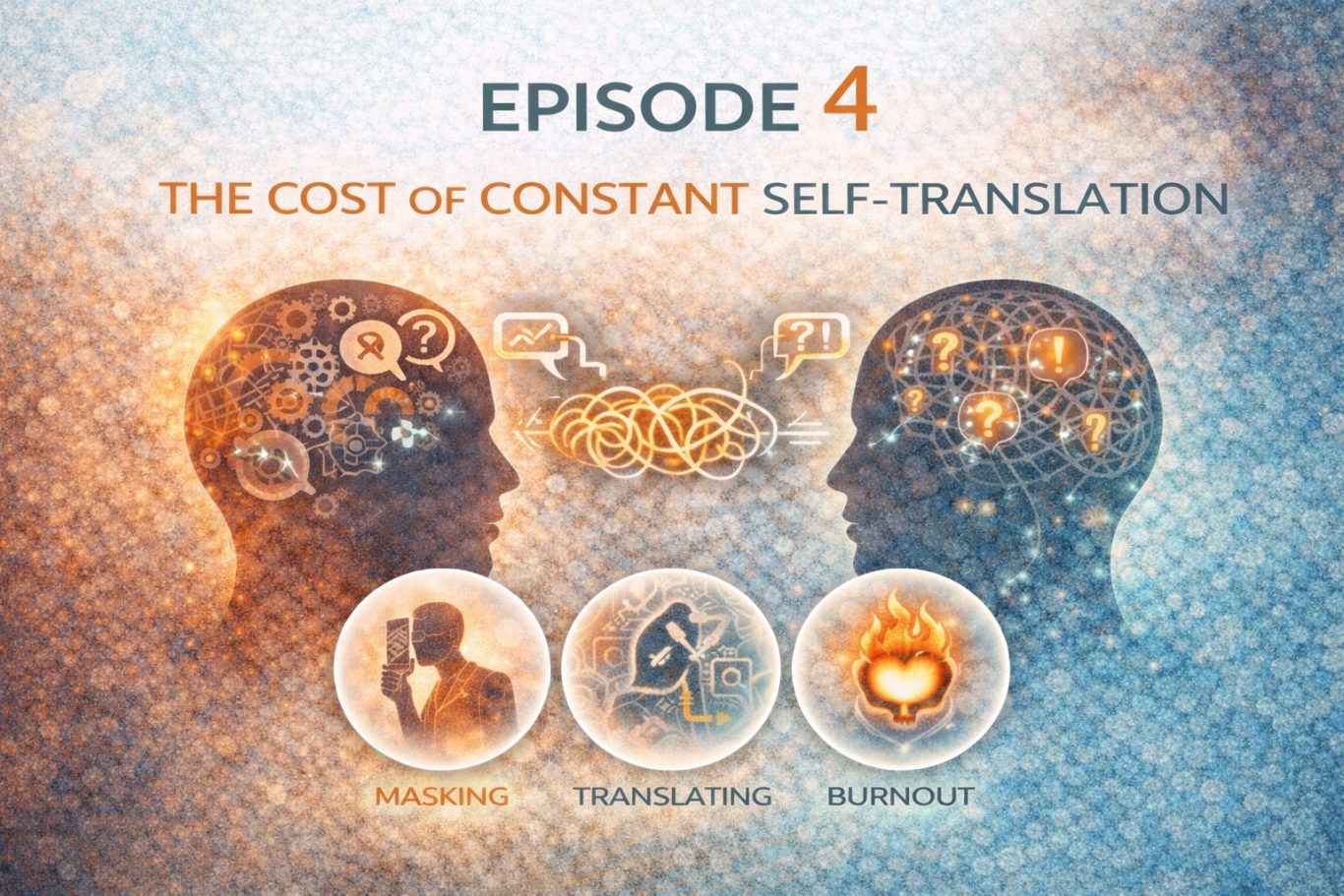
Living in Translation
There is a form of labour that almost never appears in system design, job descriptions, care pathways, performance frameworks, or outcome measures.
It is not logged.
It is not audited.
It is not rewarded.
But for many people, it is the most demanding work they do.
This is the work of constant self-translation.
What self-translation actually is
Self-translation is the ongoing effort of converting your natural way of thinking, feeling, processing, communicating, and responding into a version that a system can tolerate.
It is not self-reflection.
It is not emotional intelligence.
It is not “professional development.”
It is survival labour.
It sounds like an internal monologue that never switches off:
- How do I phrase this so it doesn’t sound confrontational?
- How much of my reaction is safe to show here?
- What part of myself needs editing in this context?
- How do I explain this without being labelled difficult, emotional, or incompetent?
- What version of me will be understood… or at least not punished?
For many people, this work is continuous.
It runs underneath every interaction, every meeting, every appointment, every email, every decision.
And because it is invisible, it is routinely mistaken for ease.
Why systems require translation at all
Self-translation does not emerge because people lack confidence or clarity.
It emerges because systems are not built to read difference.
Systems that optimise for the invisible average assume:
- narrow communication styles
- specific emotional expressions
- linear reasoning
- predictable pacing
- contained, non-disruptive reactions
Anything outside that bandwidth is treated as noise.
Not always punished… but misread.
Intensity becomes volatility.
Processing time becomes incompetence.
Directness becomes rudeness.
Emotional honesty becomes unprofessionalism.
So people adapt.
They translate intensity into neutrality.
They translate uncertainty into false confidence.
They translate regulation needs into politeness.
They translate distress into silence.
Not because it is authentic…
but because it is safer.
The illusion of “high functioning”
Systems often reward people who translate themselves well.
They are described as:
- articulate
- emotionally intelligent
- self-aware
- resilient
- “high functioning”
But this language misdiagnoses what is actually happening.
What looks like functioning is often compensation.
What looks like resilience is often suppression.
What looks like engagement is often performance.
The system rewards the appearance of fit… not the cost of achieving it.
And because the cost is internal, it disappears from the system’s field of vision entirely.
The invisible labour beneath competence
For someone constantly self-translating, even simple tasks carry hidden layers of effort.
A meeting is not just a meeting.
It is tone-monitoring, expression-management, word-choice filtering, timing calculations, body-language regulation.
A deadline is not just a task.
It is managing executive load, anxiety, sensory impact, emotional containment, and recovery… often simultaneously.
A request for help is not just communication.
It is a risk assessment:
- Will this be believed?
- Will it be used against me later?
- Will it change how I’m seen?
All of this labour happens before the visible work even begins.
And because the output looks “normal,” the labour is erased.
Why people don’t simply stop translating
From the outside, self-translation can look like a choice.
Why don’t they just be themselves?
Why don’t they say what they need?
Why don’t they speak up sooner?
But self-translation is rarely voluntary.
It is learned.
People translate themselves because past honesty has been punished.
Because emotional expression has been pathologised.
Because needs have been minimised or dismissed.
Because visibility has led to exclusion, discipline, or harm.
Translation becomes a protective strategy.
Not a preference.
Not a personality trait.
A survival response.
The early lesson: “be less”
Most people who self-translate learned the lesson early.
They were told… explicitly or implicitly… that they were:
- too intense
- too sensitive
- too slow
- too emotional
- too much
So they learned to shrink.
To soften their language.
To flatten their affect.
To pre-empt rejection.
To dilute themselves into something more acceptable.
The system did not need to enforce conformity.
People learned to supply it themselves.
Masking is not deception… it is safety
Masking is often framed as inauthenticity.
In reality, it is risk management.
People mask when:
- the cost of being misunderstood is high
- the consequences of emotional honesty are severe
- the system lacks repair, curiosity, or accountability
Masking is not about hiding who you are.
It is about staying safe where you are.
And safety strategies always come with a cost.
The cumulative weight of translation
Self-translation is rarely exhausting at the beginning.
It becomes exhausting through accumulation.
Each adjustment feels manageable on its own:
- a softened email
- an unexpressed reaction
- an unmet need quietly swallowed
But over time, these micro-adaptations stack.
Energy is spent not only on what you are doing,
but on how you are allowed to exist while doing it.
Eventually, there is very little left.
When translation reshapes identity
One of the quietest… and most damaging… effects of constant self-translation is how it reshapes a person’s relationship with themselves.
People stop asking:
- What do I think?
- What do I feel?
- What do I need?
And start asking:
- What is acceptable here?
- What will keep me safe?
- What response will avoid consequence?
Over time, internal experience loses authority.
Not through dramatic trauma alone…
but through constant adaptation.
A system that never sees the work
Perhaps the cruelest aspect of self-translation is that systems rarely know it is happening.
They see:
- competence
- composure
- reliability
- professionalism
They do not see:
- vigilance
- suppression
- exhaustion
- cost
The system assumes sustainability because it has never been shown otherwise.
And the person has learned that showing otherwise is dangerous.
Closing reflection
If a system only works when people constantly edit themselves,
that system is not neutral.
It is extractive.
When Translation Becomes Erosion
Self-translation does not usually fail loudly.
It works.
People cope.
They adapt.
They hold it together.
And because it works, it is often misunderstood as sustainability.
But translation that is required constantly does not remain neutral.
Over time, it becomes corrosive.
What begins as adaptation becomes erosion.
The slow loss of self-trust
One of the earliest… and least visible… consequences of constant self-translation is the erosion of trust in one’s own internal signals.
When someone must routinely override their instincts to remain acceptable, they learn a dangerous lesson:
My internal experience is less reliable than the system’s expectations.
Discomfort is reframed as weakness.
Fatigue is reframed as lack of discipline.
Emotional response is reframed as overreaction.
Over time, people stop listening to themselves.
They no longer ask:
- What am I feeling?
- What do I need right now?
They ask instead:
- What is expected here?
- What will keep me out of trouble?
- What response will preserve my standing?
This is not a dramatic rupture.
It is a quiet recalibration… repeated thousands of times… until the internal compass is no longer trusted to guide action.
Why burnout feels confusing and disorienting
When burnout arrives in people who self-translate, it rarely looks the way systems expect.
There is often no obvious overload event.
No single crisis.
No dramatic breaking point.
Instead, people describe:
- emotional flattening
- cognitive fog
- sudden intolerance for things they once managed
- loss of motivation without loss of care
- inability to “pull off” the translation anymore
The mask fails.
Not because the person has changed…
but because the cost has finally exceeded capacity.
This is why burnout can feel so confusing.
People are often told:
But you weren’t doing that much.
What they were doing was carrying far more than was visible.
The myth of the “sudden collapse”
Systems often describe burnout as unexpected.
We had no idea.
They never said anything.
They always seemed fine.
This narrative protects the system from accountability.
Because the truth is rarely that signals were absent.
It is that signals were:
- subtle
- coded
- filtered
- strategically softened
- intentionally withheld
The system taught people that signalling distress was unsafe.
So when collapse finally becomes visible, it is described as sudden.
It isn’t.
It is delayed recognition.
How systems train people not to signal early
In environments optimised for the invisible average, early signals are liabilities.
People quickly learn that:
- naming difficulty slows processes down
- emotional honesty complicates decision-making
- requesting adjustment invites scrutiny
- disclosure alters how you are perceived
So they stop signalling.
They learn to wait until things are undeniable… or leave before that point arrives.
By the time distress becomes visible, it is already severe.
And the system calls it an individual crisis rather than a predictable outcome.
The compounding cost of invisible labour
Self-translation is not a one-off effort.
It compounds.
Each day requires:
- monitoring tone
- filtering language
- suppressing reactions
- repairing micro-misunderstandings
- anticipating judgement
This constant vigilance drains energy that could otherwise support:
- creativity
- learning
- connection
- joy
- growth
Life becomes maintenance.
And maintenance, without recovery, eventually exhausts everything.
This is why people often report that burnout feels like emptiness rather than exhaustion.
There is nothing left to draw from.
When leaving doesn’t end the harm
One of the most misunderstood aspects of institutional harm is that it does not end when someone exits the system.
Self-translation often persists long after the context has changed.
People remain:
- hyper-vigilant
- overly apologetic
- reluctant to disclose needs
- quick to self-blame
- fearful of being “too much”
The system may be gone…
but the adaptations remain.
This is how systems export harm forward in time.
The cost is paid even in safer environments.
What systems mistake for resilience
Systems frequently praise those who endure self-translation the longest.
They call it:
- grit
- professionalism
- emotional intelligence
- leadership potential
But endurance is not wellbeing.
And the ability to erase yourself should never be mistaken for strength.
What looks like resilience is often capacity being consumed quietly.
When that capacity runs out, the system is surprised… and the person is blamed.
Why self-translation props up bad design
Constant self-translation allows poorly designed systems to appear functional.
It absorbs damage internally.
People smooth over incoherence.
They patch gaps with personal effort.
They compensate for structural failures with emotional labour.
As long as enough people do this, the system looks stable.
But stability achieved through self-erasure is an illusion.
It delays reform.
It hides risk.
It guarantees future collapse.
What safety actually looks like
In systems that are genuinely inclusive, translation is optional.
People do not have to constantly calculate:
- tone
- expression
- pacing
- emotional containment
Difference is expected… not managed after harm occurs.
In these systems:
- signals are treated as information
- intensity is contextualised, not punished
- pauses are allowed
- repair is normalised
People do not need to disappear in order to belong.
From translation to coherence
The opposite of constant self-translation is not defiance.
It is coherence.
Coherence is when:
- internal experience and external expression align
- effort is proportional to outcome
- safety does not require performance
- feedback does not carry threat
Coherent systems do not demand self-erasure.
They adapt to humans… rather than requiring humans to adapt endlessly to them.
Why this matters beyond individuals
When systems rely on self-translation to function, they hollow themselves out.
They:
- lose honest feedback
- misread emerging risk
- burn through people quietly
- repeat the same failures with new faces
Self-translation masks dysfunction.
It makes harm look like competence.
And competence, when misread this way, becomes dangerous.
The question systems avoid
The real question is not:
Why do people disengage, burn out, or withdraw?
It is:
How much translation did this system require before it noticed anything was wrong?
Because when survival depends on invisibility, harm is not accidental.
It is inevitable.
Closing reflection
If a system only works when people hide parts of themselves,
the problem is not the people.
It is the system.
In Episode 5, we will examine one of the most seductive ways systems avoid confronting this reality…
how “resilience” is used to cover design debt, and why coping is not the same as repair.
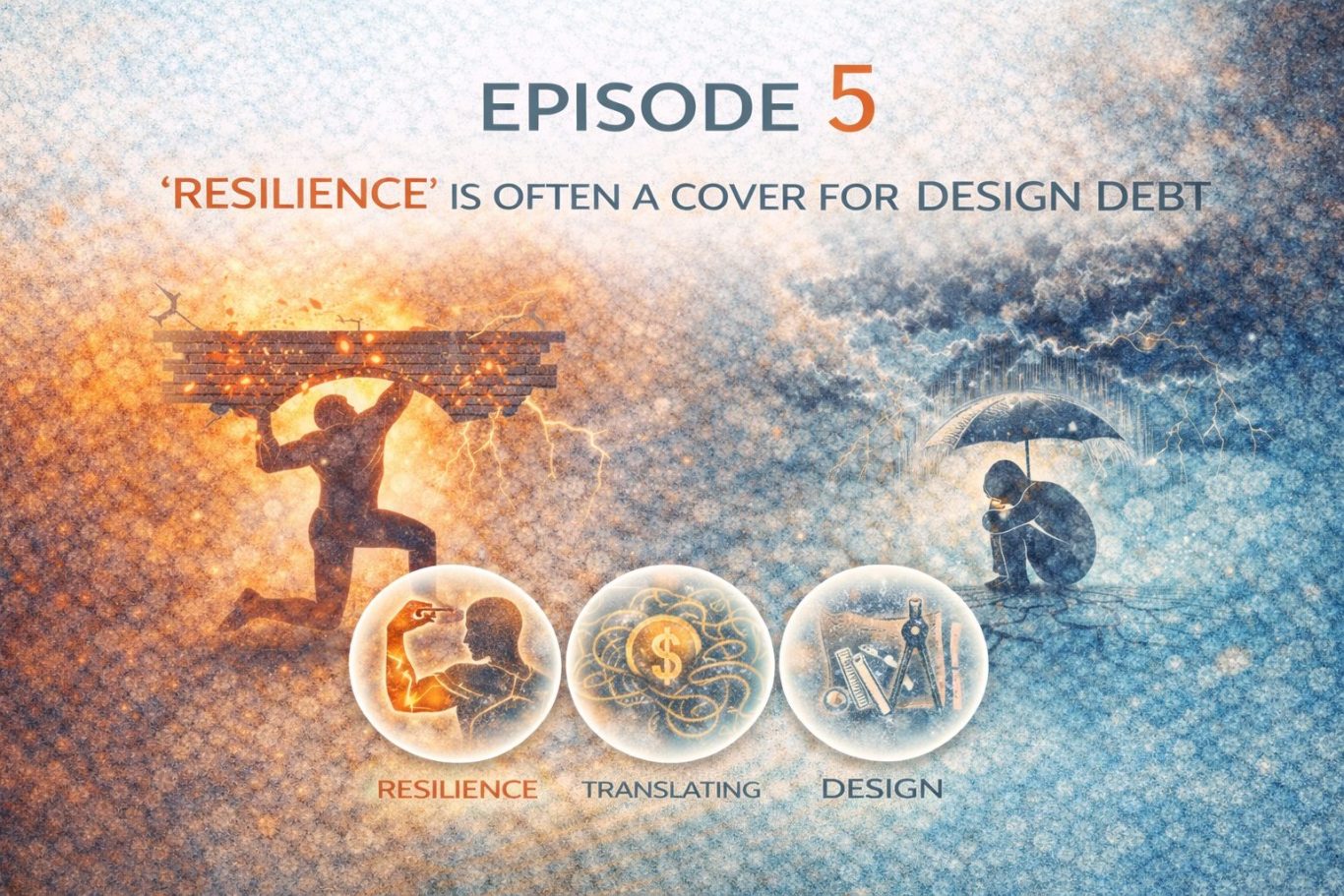
How Systems Shift Harm Onto People
There is a moment in most failing systems where the conversation quietly changes.
Not outwardly.
Not explicitly.
But structurally.
The system starts to struggle.
People begin to burn out.
Errors increase.
Disengagement spreads.
And instead of asking what in the system is causing this, the focus shifts somewhere else.
It shifts onto the people.
This is where the language of resilience enters.
When “support” appears at exactly the wrong moment
Resilience is rarely introduced when systems are healthy.
It arrives when:
- workloads are unsustainable
- pace has outstripped capacity
- safety has eroded
- feedback is being ignored
At precisely the moment structural change is needed, the system offers something else instead.
Workshops.
Webinars.
Toolkits.
Mindfulness sessions.
Wellbeing emails.
All framed as support.
But look closely at the timing.
Resilience is most often introduced after harm has already been caused… and just before accountability would otherwise be required.
What resilience language actually does
Resilience language sounds compassionate.
It speaks about:
- coping
- adaptability
- strength
- grit
- bouncing back
But embedded within it is a subtle message:
The system is fixed.
You need to adapt.
This reframes harm as a personal challenge rather than a structural problem.
If you are struggling, it is not because the demands are unreasonable.
It is because you need better tools to endure them.
Design debt: the cost systems refuse to pay
In engineering, design debt refers to the accumulated cost of shortcuts.
When a system is built quickly, cheaply, or without considering real-world use, problems stack up.
Eventually, the system becomes fragile.
Human systems are no different.
Design debt accumulates when:
- workloads exceed human limits
- timelines ignore recovery
- variation is treated as inconvenience
- regulation is assumed rather than supported
- safety is optional
Instead of paying this debt through redesign, systems often defer it.
They pass the cost onto people.
Resilience becomes the payment plan.
How coping replaces repair
There is a critical distinction systems often collapse:
Coping is not repair.
Coping helps people survive damage.
Repair removes the source of damage.
But repair is expensive.
It requires:
- redesigning workflows
- redistributing power
- slowing pace
- changing incentives
- tolerating short-term disruption
Coping, by contrast, is cheap.
It keeps output flowing.
It maintains appearances.
It avoids structural reckoning.
So systems invest heavily in coping… and call it care.
Why resilience narratives feel reasonable
Resilience narratives persist because they feel morally satisfying.
They align with cultural values:
- self-reliance
- perseverance
- personal responsibility
They allow leaders to feel supportive without relinquishing control.
And they offer individuals something seductive:
A way to survive without challenging the system.
For people already under strain, resilience can feel like the only available option.
Which is exactly why it is so effective.
The quiet moralisation of suffering
Once resilience becomes the dominant frame, suffering is subtly moralised.
Those who cope are praised:
- “They handle pressure so well.”
- “They’re incredibly resilient.”
- “They always find a way.”
Those who don’t are questioned:
- “They’re struggling with resilience.”
- “They need more support.”
- “They’re not managing stress well.”
The system never asks:
Why is this level of stress normalised?
It asks:
Why can’t this person handle it?
How resilience hides inequality
Resilience narratives are not applied evenly.
They fall hardest on those who already carry load:
- neurodivergent people
- traumatised people
- disabled people
- carers
- those without power or security
These groups are told to be more resilient in environments that were never designed for them.
The more misaligned the system, the more resilience is demanded.
This is not empowerment.
It is extraction.
“Wellbeing” as a distraction
Many systems respond to burnout with visible wellbeing initiatives.
Yoga sessions.
Meditation apps.
Mental health awareness days.
Posters about self-care.
These interventions are not inherently bad.
But when they are offered instead of structural change, they become a distraction.
They shift attention away from:
- workload
- pace
- safety
- coherence
And toward individual behaviour.
This is sometimes called wellbeing washing… the appearance of care without the substance of change.
The cruelty of unsupported coping
Perhaps the most harmful aspect of resilience culture is what it teaches people to do next.
They learn to:
- absorb harm quietly
- blame themselves for struggle
- hide early warning signs
- push through signals of overload
They are praised for endurance.
Until they break.
And when they do, the system responds with surprise:
We offered so much support.
But support that requires people to endure harm is not support.
It is containment.
Why systems prefer resilient people
Resilient people are convenient.
They:
- compensate for poor design
- absorb instability
- maintain output under strain
- require fewer changes
From a system perspective, resilient people are assets.
From a human perspective, they are being consumed.
And because resilience looks like strength, this consumption often goes unnoticed… even by the person experiencing it.
The hidden message resilience sends
At its core, resilience messaging carries an unspoken instruction:
Endure quietly.
Adapt endlessly.
Don’t ask the system to change.
For a while, people comply.
Because they have to.
But endurance without repair always ends the same way.
In burnout.
In disengagement.
In exit.
A necessary pause
Before moving further, it’s worth asking a harder question:
If a system requires extraordinary resilience to survive it…
what does that say about the system?
Because healthy systems do not rely on people being exceptional just to get through the day.
They rely on design that fits human limits.
Closing reflection
Resilience is not a virtue when it is required to survive harm.
It is a signal that harm has been normalised.
Why Coping Silences Systems (and Repair Changes Everything)
Resilience culture does more than shift harm onto individuals.
It quietly breaks the system’s ability to learn.
When people are taught to cope instead of speak, endure instead of signal, adapt instead of question, the system loses access to its most important data.
Not performance data.
Not output metrics.
Human feedback.
And without feedback, systems don’t improve.
They repeat.
How resilience silences early warning signals
In healthy systems, struggle is information.
It tells you:
- where load is accumulating
- where pace exceeds capacity
- where safety is eroding
- where assumptions are wrong
In resilience-based systems, struggle is reframed as a personal issue.
People are taught that if something feels unsustainable, the solution is:
- better coping
- stronger boundaries
- improved mindset
- more self-care
So they stop reporting strain.
Not because strain has disappeared…
but because naming it feels pointless, risky, or self-incriminating.
The system becomes quieter.
And quiet systems often mistake silence for stability.
Why coping delays system learning
Every time a person copes with poor design, the system is protected from feedback.
Deadlines are met… just barely.
Mistakes are corrected quietly.
Confusion is smoothed over.
Overload is absorbed internally.
From the system’s perspective, everything still works.
This is the paradox of resilience:
The better people cope, the longer bad design survives.
Coping acts like shock absorption.
It prevents the system from feeling the impact of its own choices.
And because it never feels that impact, it never learns.
When learning is outsourced to burnout
Eventually, coping fails.
No one can absorb design debt indefinitely.
When resilience runs out, the system finally experiences consequences… but in the most expensive way possible.
Through:
- burnout
- attrition
- long-term sickness
- disengagement
- reputational damage
At this point, the system often describes the problem as sudden.
But nothing about it is sudden.
It is deferred learning finally arriving with interest.
Why systems misinterpret resilience as strength
From inside the system, resilience looks like a desirable trait.
Resilient people:
- keep things moving
- absorb disruption
- don’t complain
- require fewer changes
They are labelled:
- reliable
- adaptable
- professional
But resilience in these contexts is not strength.
It is uncompensated labour.
And systems that rely on it are not robust…
they are fragile and propped up by human overextension.
The collapse of proportional response
One of the most damaging effects of resilience culture is how it distorts proportionality.
When systems expect people to cope, they stop adjusting demand in response to strain.
Instead of:
- reducing load
- slowing pace
- reallocating resources
They offer:
- stress management tools
- wellbeing sessions
- encouragement to “take care of yourself”
This creates a mismatch.
The intervention is small.
The harm is structural.
And the gap between the two widens over time.
What repair actually requires
Repair is fundamentally different from coping.
Coping asks:
How can people endure this?
Repair asks:
Why does this cause harm at all?
Repair requires systems to examine:
- workload design
- pacing and recovery cycles
- decision density
- emotional and cognitive load
- threat and safety signals
It requires acknowledging that harm is not an unfortunate side effect…
it is a predictable outcome of specific design choices.
And that means those choices must change.
Why repair feels threatening
Repair is disruptive.
It challenges:
- productivity myths
- efficiency narratives
- control structures
- power distribution
It may temporarily slow output.
It may require uncomfortable conversations.
It may expose past mistakes.
Resilience culture avoids all of this.
It allows systems to feel caring without changing.
Supportive without relinquishing control.
Progressive without redesign.
This is why resilience is so attractive…
and so dangerous.
The difference between humane systems and resilient people
Humane systems do not require extraordinary resilience to function.
They assume:
- fluctuating capacity
- emotional variability
- periods of low output
- the need for recovery
They are designed so that ordinary humans can participate without self-erasure.
In humane systems:
- stress is an anomaly, not a baseline
- recovery is built in, not earned
- feedback is safe, not penalised
- adaptation is shared, not outsourced
These systems still require effort.
They simply do not require harm.
When redesign reduces burnout… without resilience training
One of the clearest indicators that resilience has been used as a cover for design debt is this:
When systems are redesigned, burnout reduces without additional coping interventions.
When:
- pacing becomes humane
- expectations become coherent
- safety increases
- decision-making becomes clearer
People don’t need to be more resilient.
They need to be less harmed.
Resilience training becomes redundant when systems stop injuring the people inside them.
The myth that repair is unrealistic
Systems often argue that redesign is impractical.
Too complex.
Too expensive.
Too disruptive.
But what is rarely acknowledged is the cost of not repairing.
Burnout.
Attrition.
Litigation.
Recruitment churn.
Loss of trust.
Loss of expertise.
Design debt is paid either way.
The only question is who pays it…
the system, or the people inside it.
Why resilience culture creates brittle systems
Systems that rely on resilience appear stable until they encounter shock.
A crisis.
A staffing shortage.
A surge in demand.
A cultural shift.
Because they have offloaded regulation onto individuals, they have very little slack.
When people can no longer cope, the system has nothing left to absorb strain.
This is brittleness.
Not strength.
A reframe systems rarely allow
Instead of asking:
How can we make people more resilient?
A better question is:
Why does this system require resilience at all?
Because resilience should be a response to occasional adversity…
not a permanent condition for participation.
The invitation resilience culture avoids
Repair requires humility.
It requires systems to say:
- We underestimated human cost
- We normalised harm
- We confused endurance with success
This is not failure.
It is learning.
But learning is impossible in systems that silence feedback through coping.
Closing reflection
When resilience is mandatory, something is wrong.
And when coping replaces repair, harm becomes policy.
In Episode 6, we will turn to the final shift…
what redesign actually looks like when systems anticipate difference instead of reacting to damage.
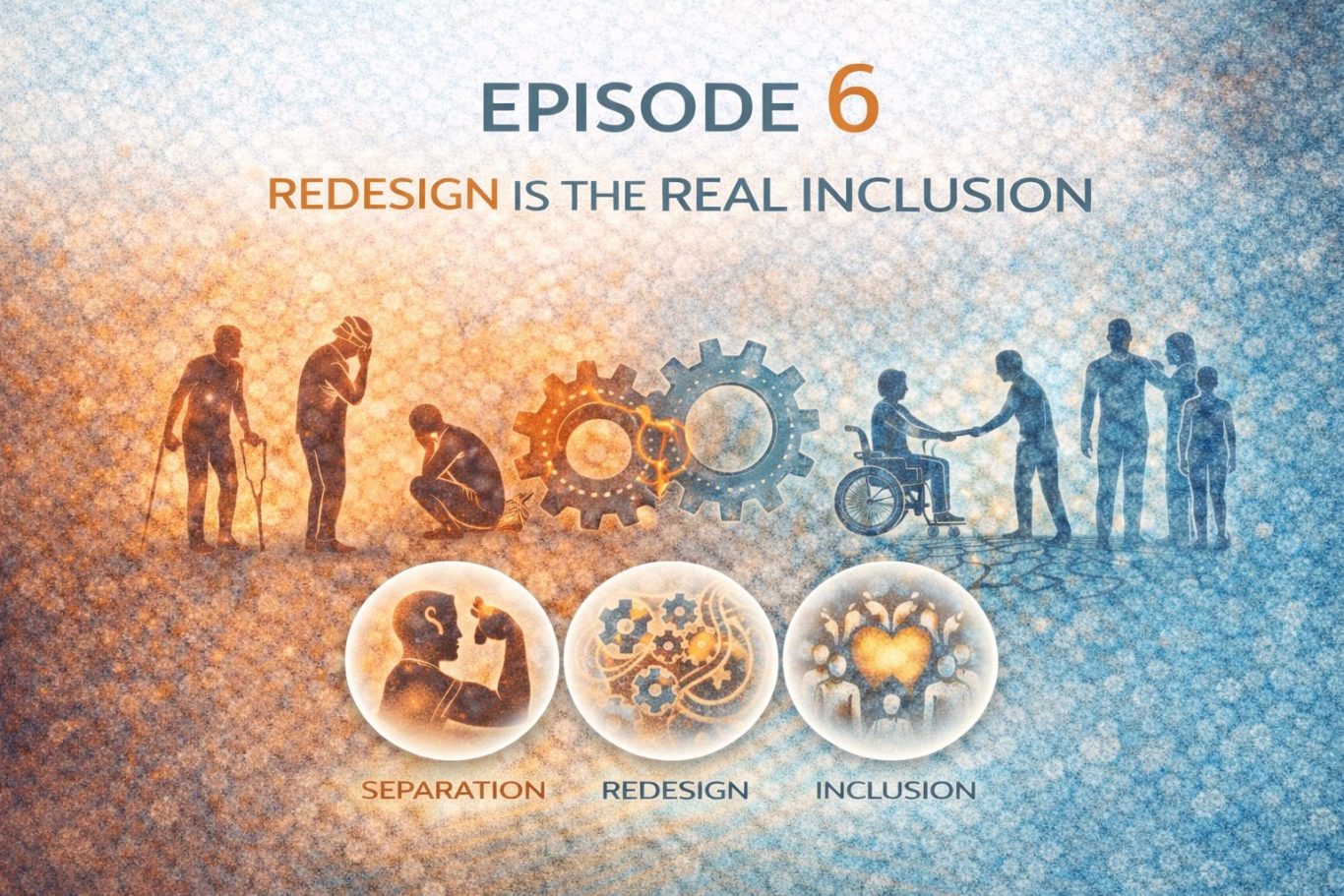
From Accommodation to Anticipation
Every system that harms people eventually reaches the same rhetorical moment.
It says:
“We’re inclusive.”
“We make adjustments.”
“We accommodate difference.”
And on the surface, this can sound like progress.
But accommodation is not the same as inclusion.
And it is certainly not redesign.
Accommodation happens after harm.
Redesign prevents it.
The limits of accommodation culture
Accommodation culture treats difference as an exception.
Someone struggles.
A request is made.
An adjustment is considered.
The system remains unchanged.
This approach assumes:
- difference is rare
- need is individual
- harm is accidental
- the system itself is fundamentally sound
But when the same adjustments are requested repeatedly… by the same kinds of people, in the same kinds of ways… the problem is not individual.
It is architectural.
Accommodation is what systems offer when they are unwilling to examine their own design.
Why accommodation still centres power
Accommodation places the burden on the person experiencing harm.
They must:
- recognise the problem
- name their need
- disclose vulnerability
- justify the request
- tolerate scrutiny
This is not neutral.
It privileges those who:
- feel safe disclosing
- can articulate needs clearly
- are believed when they do
- have enough power to ask
Those without these protections are left to cope quietly… or leave.
A system that requires self-advocacy to be safe is not inclusive.
It is selective.
Redesign starts with a different assumption
Redesign begins by changing the question.
Instead of:
“How do we respond when people struggle?”
It asks:
“What kinds of humans will interact with this system… and what will they predictably need?”
This is anticipatory design.
It assumes:
- variable energy
- fluctuating capacity
- emotional intensity
- non-linear processing
- periods of vulnerability
- diverse communication styles
Not as edge cases.
As the baseline.
Difference is not unpredictable… it is patterned
One of the most persistent myths in system design is that difference is chaotic.
It isn’t.
Human variation follows patterns:
- stress reduces capacity
- uncertainty increases load
- threat impairs regulation
- safety improves cognition
- recovery restores function
These patterns are well understood.
What systems often lack is not knowledge…
but willingness to design around it.
Redesign means treating difference as expected, not disruptive.
From compliance to coherence
Many systems are built around compliance.
They ask:
- Are you following the process?
- Are you meeting the standard?
- Are you behaving correctly?
Redesigned systems shift the goal.
They ask:
- Does this make sense to a human nervous system?
- Is effort proportional to outcome?
- Is regulation supported or undermined here?
- Does this environment create safety or threat?
This shift… from compliance to coherence… is foundational.
People do not need to be controlled into functioning.
They need conditions that allow functioning to emerge.
Designing for nervous systems, not ideals
One of the most radical moves in redesign is this:
Stop designing for the ideal human.
Start designing for the actual nervous system.
Actual nervous systems:
- fatigue
- overload
- dysregulate
- recover
- need rhythm
- respond to safety
Systems that ignore this reality will always require:
- masking
- resilience
- self-translation
- over-functioning
Systems that design with it in mind reduce harm automatically.
Not through training.
Through structure.
What anticipatory design changes immediately
When systems anticipate difference, several things shift:
- Pacing slows where it needs to… not everywhere
- Recovery is built into cycles, not treated as failure
- Multiple modes of engagement are normalised
- Signals are read early, before crisis
- Flexibility is structural, not discretionary
This is not chaos.
It is intelligent load distribution.
Why redesign is often mischaracterised
Redesign is frequently dismissed as:
- unrealistic
- inefficient
- too complex
- too expensive
But this framing ignores a crucial truth:
Systems are already paying the cost of poor design.
They just pay it indirectly.
Through:
- burnout
- turnover
- disengagement
- lost trust
- repeated failure
Redesign does not create cost.
It moves cost back where it belongs… into the system, instead of onto people.
Inclusion without redesign is theatre
Many systems celebrate inclusion while leaving core structures untouched.
They change language.
They add policies.
They create roles and committees.
But if:
- pace remains inhumane
- capacity is moralised
- safety is conditional
- difference requires permission
Nothing fundamental has changed.
Inclusion without redesign is optics.
It soothes discomfort without preventing harm.
Redesign is a responsibility, not a favour
True inclusion is not something systems offer.
It is something systems owe.
Because if a structure systematically disadvantages predictable groups of people, that is not an unfortunate side effect.
It is a design failure.
And design failures require redesign… not gratitude for accommodations.
A shift in accountability
Redesign moves accountability to the right place.
Instead of asking:
Why can’t people cope with this system?
It asks:
Why was this system built in a way that requires coping at all?
This is not an attack.
It is maturity.
Closing reflection
Inclusion is not about fixing people so they fit systems.
It is about fixing systems so people do not have to disappear inside them.
What Redesign Actually Looks Like (and Why It Works)
If redesign is the real inclusion, the next question is unavoidable:
What does redesign actually mean in practice?
Not in slogans.
Not in policy language.
Not in aspirational frameworks.
But in the day-to-day mechanics of how systems function… and how humans move through them.
Redesign starts where harm shows up first
One of the most important shifts in redesign is where attention is placed.
Traditional systems start with:
- outputs
- targets
- compliance metrics
- performance indicators
Redesigned systems start somewhere else.
They start with:
- points of friction
- moments of overload
- early withdrawal
- repeated misunderstandings
- predictable drop-out points
These are not failures to be managed.
They are design signals.
Redesign treats friction as information… not inconvenience.
Variance-aware systems do not aim for sameness
A defining feature of redesigned systems is that they abandon the pursuit of uniform behaviour.
They no longer aim for:
- identical productivity
- consistent emotional expression
- fixed pacing
- standardised capacity
Instead, they design for range.
They assume:
- energy fluctuates
- attention varies
- capacity changes with context
- stress alters performance
- safety improves regulation
Variance-aware systems do not ask people to flatten themselves.
They adjust structure so difference does not become a problem in the first place.
Principles of variance-aware redesign
While redesigned systems look different across sectors, they tend to share core principles.
1. Pacing is structural, not individual
Instead of asking individuals to manage unsustainable speed, redesigned systems:
- vary intensity across cycles
- build in recovery by default
- reduce continuous urgency
- protect slower processing without penalty
Pace becomes a property of the system… not a personal failing.
2. Flexibility is built in, not requested
Redesigned systems do not rely on disclosure or self-advocacy for safety.
They normalise:
- multiple modes of engagement
- optional formats
- asynchronous participation
- varied communication styles
This removes the burden of asking… and the risk of being refused.
3. Signals are welcomed early
In redesigned systems, early signs of strain are treated as valuable.
Not disruptive.
Not inconvenient.
They are acted on before escalation occurs.
This prevents:
- crisis-driven responses
- punitive interventions
- burnout-based learning
Redesign replaces punishment with calibration
One of the clearest markers of redesign is what happens when someone struggles.
In old systems:
- difficulty triggers correction
- non-compliance triggers discipline
- difference triggers scrutiny
In redesigned systems:
- difficulty triggers calibration
- strain triggers adjustment
- difference triggers curiosity
This is not leniency.
It is accuracy.
Punishment assumes defiance.
Calibration assumes mismatch.
And mismatch can be redesigned.
Feedback loops are the backbone of inclusive systems
Redesigned systems restore what resilience culture silences: feedback.
But not just any feedback.
They create:
- safe channels
- low-stakes signalling
- frequent micro-adjustments
- visible response to input
People do not need to escalate distress to be heard.
They do not need to break down to prompt change.
The system learns continuously… not catastrophically.
Psychological safety is structural, not cultural
Many systems attempt to create safety through messaging:
“Speak up.”
“We value honesty.”
Redesigned systems understand something deeper.
Psychological safety is not created by encouragement.
It is created by consequence patterns.
When people see that:
- honesty does not lead to punishment
- feedback does not harm reputation
- difficulty does not reduce opportunity
They speak.
When they see the opposite, they don’t.
Redesign changes consequences… not slogans.
Redesign reduces burnout without asking for resilience
One of the most reliable outcomes of redesign is this:
Burnout decreases without additional coping interventions.
Not because people have changed…
but because the system has.
When:
- pace is humane
- expectations are coherent
- recovery is normalised
- regulation is supported
People no longer need extraordinary resilience to survive.
Ordinary humans can function.
And that is the point.
Why redesigned systems outperform “resilient” ones
Systems that rely on resilience look strong… until they fail.
Redesigned systems look slower… until they endure.
They:
- retain people longer
- surface problems earlier
- adapt under stress
- maintain trust
- avoid catastrophic collapse
They do not require heroics.
They require design maturity.
And over time, they outperform systems that consume their people quietly.
The role of leadership in redesign
Redesign is not a delegation task.
It is a leadership responsibility.
Because redesign requires leaders to:
- question inherited assumptions
- tolerate short-term discomfort
- redistribute power
- listen without defensiveness
- accept that past design caused harm
This is not about blame.
It is about ownership.
Leaders do not need to be perfect.
They need to be willing to change the structure… not just the language.
Redesign is not about infinite flexibility
A common fear is that redesign means chaos.
It does not.
Redesigned systems still have:
- standards
- accountability
- boundaries
- expectations
What changes is where flexibility lives.
Instead of forcing humans to flex endlessly, the system does.
This creates clarity without cruelty.
Inclusion as infrastructure
At its most fundamental level, redesign treats inclusion as infrastructure.
Not:
- a policy
- a value statement
- a training module
But the physical, temporal, emotional, and procedural architecture of the system itself.
Infrastructure shapes behaviour without demanding effort.
That is why redesign works.
The future-proof question
Every system that wants to endure must eventually ask a hard question:
Can ordinary humans participate here without harming themselves?
If the answer is no, the system is not future-proof.
Because resilience is finite.
Humans are not infinitely adaptable.
And systems that demand otherwise will continue to break people… and eventually themselves.
A final reframe
Inclusion is not generosity.
It is competence.
It is the ability to design systems that fit the reality of human variation rather than forcing people to contort themselves to survive.
Redesign is not radical.
It is overdue.
Closing reflection
When systems are redesigned to anticipate difference,
people no longer need to be resilient just to belong.
This completes Episode 6… and the full series:
“The System Doesn’t Fail People Randomly.”
Not because people are broken.
But because systems have been designed as if only one kind of human exists.
And that, finally, is changing.