
By Neal Glendenning
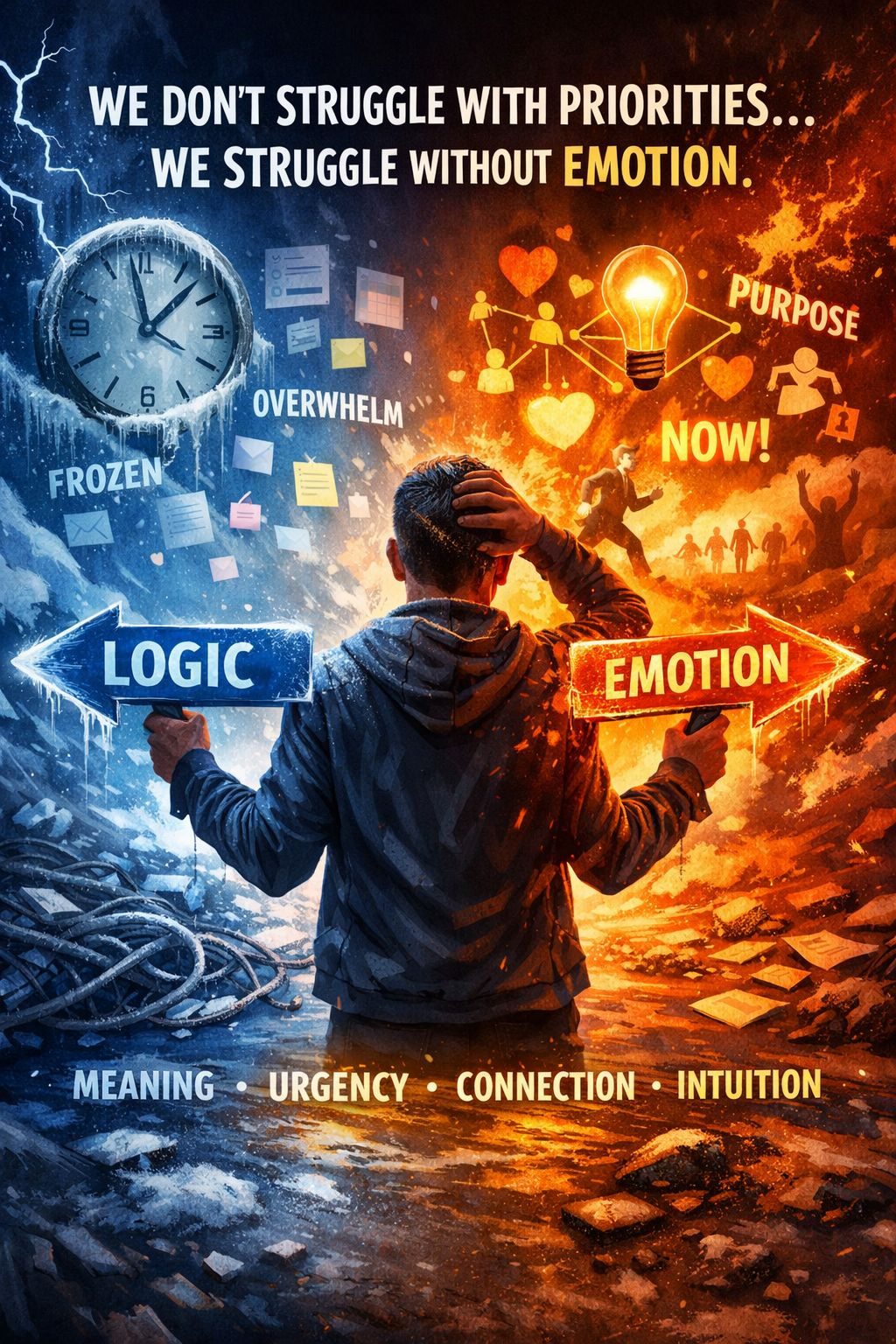
Ask an ADHD brain to prioritise logically
and it freezes.
Ask it to prioritise emotionally
and it flies.
This is where so many misunderstandings begin.
Because most systems assume that priority is a cognitive skill...
a neat hierarchy of importance, deadlines, lists, and labels.
But ADHD brains don’t sort the world that way.
We don’t ask, “What’s most important?”
We ask... often unconsciously...
“What matters right now?”
And those are not the same question.
Our brains sort by:
meaning... does this connect to something I care about?
urgency... does this feel alive, present, pressing?
connection... does this involve people, impact, or purpose?
intuition... does something in me say now?
Not by abstract priority matrices.
Not by colour-coded to-do lists.
Not by someone else’s definition of “should.”
So when people say,
“You just need to prioritise better,”
what they’re really saying is,
“Detach your nervous system from relevance and perform anyway.”
That’s not a skills gap.
That’s a biology mismatch.
When tasks arrive stripped of emotion, context, and meaning,
our nervous system doesn’t engage...
it stalls.
Not because we’re lazy.
Not because we don’t care.
But because activation requires felt significance.
This is why ADHD can look like procrastination on the outside
and feel like paralysis on the inside.
We don’t fail to prioritise.
We fail to feel the priority.
And here’s the part most people miss:
When meaning lands, action follows... fast.
When a task connects to values, curiosity, people, or purpose,
we don’t need pushing.
We don’t need pressure.
We don’t need threats or shame.
We move.
With intensity.
With creativity.
With momentum that surprises everyone... including ourselves.
This is why ADHD motivation is so often misread.
It’s not inconsistent.
It’s context-dependent.
Change the framing.
Restore the meaning.
Anchor the task to something that matters.
And suddenly the same brain that “couldn’t prioritise”
is executing at speed.
So instead of asking ADHD people to work harder,
design better.
Make it meaningful.
Make it human.
Make it emotionally real.
And we won’t just prioritise it...
we’ll make it happen.