
By Neal Glendenning
ADHD is not a deficit of attention.
It’s a difference in regulation.
Attention, emotion, energy, motivation...
all move in response to interest, meaning, urgency.
That’s why pressure sometimes “works.”
It creates stimulation where none existed.
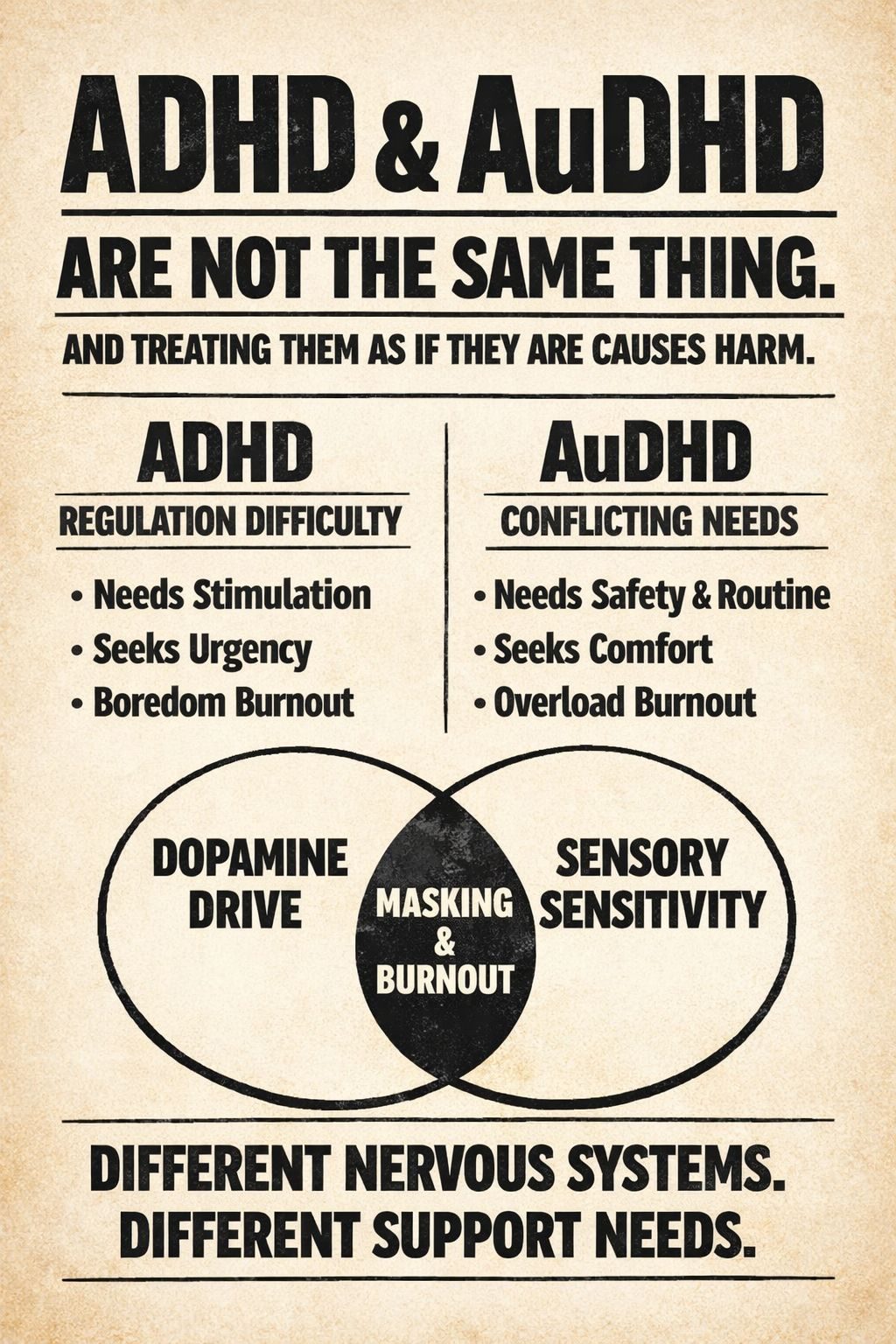
But AuDHD is different.
AuDHD is not “stronger ADHD.”
It’s not ADHD with extra traits.
It’s two nervous systems operating at once.
One part seeks novelty, movement, stimulation.
The other seeks predictability, safety, sameness.
One part wants freedom.
The other needs structure.
One part burns out from boredom.
The other burns out from overload.
So the AuDHD nervous system lives in constant negotiation.
Pressure might activate the ADHD side
while simultaneously overwhelming the autistic side.
Routine might soothe the autistic side
while suffocating the ADHD side.
This is why so many AuDHD adults feel like they’re “never quite okay.”
Too much structure → shutdown.
Too much flexibility → chaos.
Too much stimulation → overload.
Too little → collapse.
And because these needs contradict each other,
AuDHD people learn to mask both.
They become:
• highly competent
• highly insightful
• highly exhausted
Often diagnosed late.
Often mislabelled as anxious, depressed, difficult, inconsistent.
But nothing is “wrong.”
This nervous system isn’t broken...
it’s complex.
ADHD struggles with activation.
AuDHD struggles with conflicting regulation signals.
That distinction matters.
Because advice designed for ADHD alone... “just add urgency” “gamify it” “raise the stakes”... can push an AuDHD nervous system into meltdown or shutdown.
AuDHD doesn’t need more pressure.
It needs:
• safety before productivity
• flexibility with predictability
• sensory regulation before expectations
• meaning instead of threat
This isn’t fragility. It’s biology.
If we want neurodivergent people to thrive, we have to stop forcing one nervous system blueprint onto another.
Not everything that looks like resistance is defiance. Not everything that looks like inconsistency is lack of effort.
Sometimes it’s a nervous system doing its best
to survive a world that wasn’t built for contradiction.
Understanding the difference between ADHD and AuDHD
isn’t academic.
It’s the difference between support
and silent harm.
And it’s long overdue.