
By Neal Glendenning
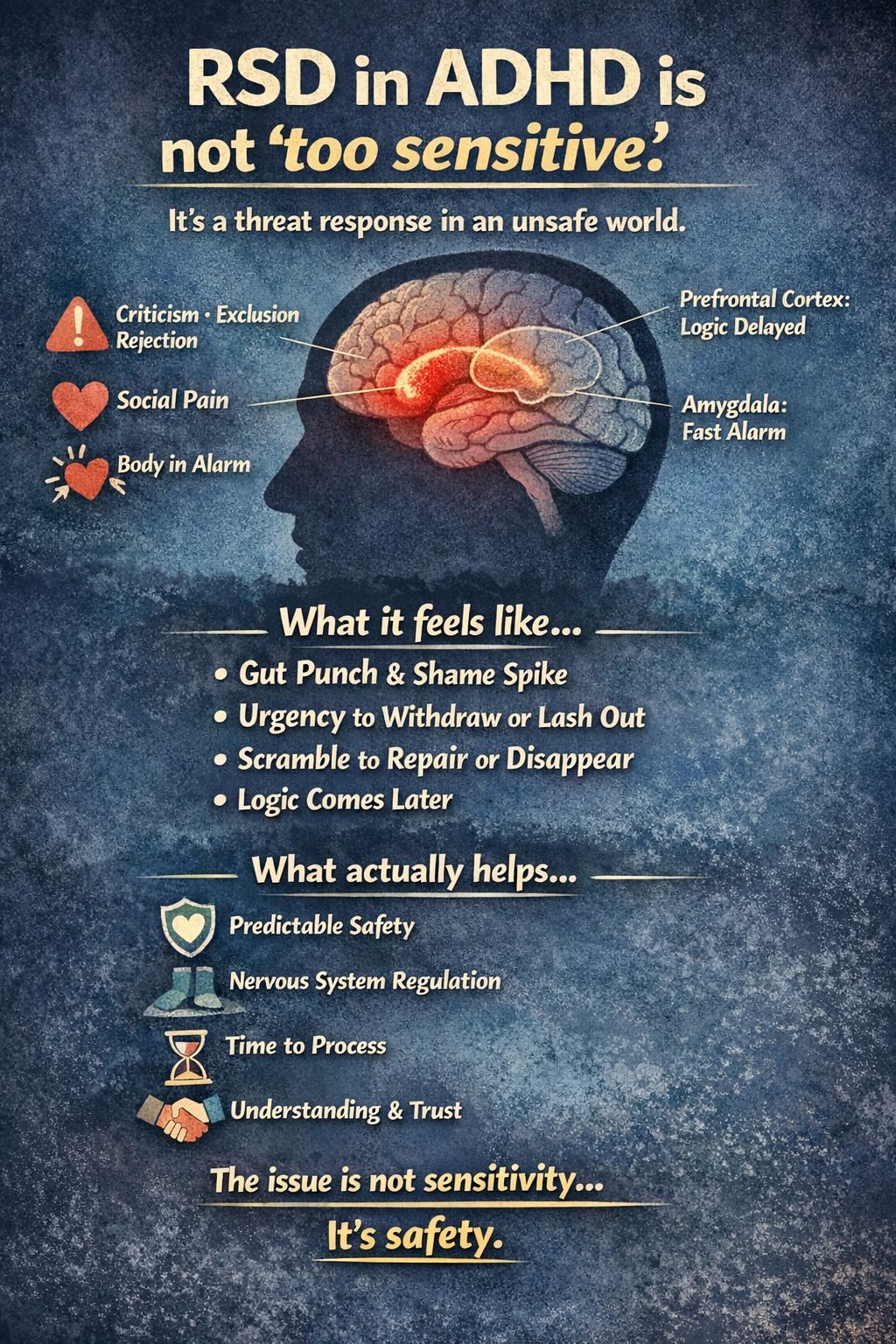
Rejection Sensitivity Dysphoria (RSD) in ADHD isn’t fragility.
It’s a nervous system doing its job too well in a world that isn’t safe enough.
RSD gets framed as “overreacting.”
As being “too sensitive.”
As something to toughen up, rationalise away, or stop taking personally.
But that framing misses the point entirely.
RSD isn’t a personality flaw.
It isn’t emotional immaturity.
And it isn’t a failure of logic.
It’s a threat response.
For many ADHD nervous systems, social signals are not neutral data.
They’re weighted.
Amplified.
Processed with urgency.
A raised eyebrow.
A delayed reply.
A piece of feedback without warmth.
A subtle shift in tone.
The body reacts before the mind has time to interpret.
Heart rate spikes.
Heat floods the chest.
Shame hits like impact.
Thoughts scramble to repair, explain, withdraw, or disappear.
Not because the person is weak.
But because their system has learned... often correctly... that rejection carries real cost.
This is what people miss:
ADHD is not just a condition of attention.
It’s a condition of emotional regulation and nervous system timing.
The alarm goes off fast.
Context arrives late.
So when someone says,
“Don’t take it personally,”
what they’re really saying is,
“Override a body-level survival response with logic.”
That’s not how nervous systems work.
You cannot think your way out of an alarm.
You regulate your way out of it.
And here’s the part that rarely gets said:
RSD is not constant.
It is context-sensitive.
Put the same person in an environment that is: – predictable
– kind
– emotionally literate
– clear about expectations
– safe enough to make mistakes
…and RSD often softens dramatically.
Not because the person changed.
But because the threat load dropped.
Which tells us something important.
The question isn’t: “What’s wrong with you?”
It’s: “What does your nervous system not feel safe enough to tolerate?”
RSD is not a defect.
It’s an alarm calibrated for a world that has demanded too much emotional self-policing for too long.
And when we stop moralising that alarm...
when we design systems, relationships, workplaces, and feedback cultures that reduce unnecessary threat...
we don’t get “less sensitive” people.
We get regulated, creative, deeply loyal humans
who no longer have to live in emotional defence.
RSD isn’t the problem.
Unsafe systems are.