
By Neal Glendenning
I think I’ve found a missing piece in emotional dysregulation in ADHD / AuDHD.
And it’s not motivation.
Not mindset.
Not emotional “immaturity”.
It’s interoception... our ability to sense what’s happening inside the body.
A paper I was recently pointed toward reframed emotion regulation in a way that stopped me in my tracks:
Regulation isn’t about controlling emotion.
It’s about effective communication between body, mind, and feeling.
When that communication works, regulation happens early.
When it doesn’t, everything arrives late and loud.
And that, suddenly, explains a lot about ADHD and AuDHD.
Many ADHD/AuDHD nervous systems don’t lack emotion regulation capacity... they lack early internal signal access.
The body reacts first:
• heart rate shifts
• breath changes
• muscles tighten
• heat rises
• energy spikes or drops
But if those signals aren’t noticed or interpretable in real time, the brain only gets involved once the system is already overwhelmed.
That’s when people say:
“I don’t know what came over me.”
“I went from fine to flooded.”
“I didn’t realise how stressed I was until I crashed.”
That isn’t poor insight.
It’s delayed data.
Chronic stress, trauma, masking, sensory overload, and constant adaptation can all teach the nervous system to either:
• amplify signals (hyper-arousal, RSD, emotional volatility), or
• mute signals (shutdown, numbness, dissociation, burnout).
Both are protective.
Both break regulation.
This also explains why so many ADHD/AuDHD people say:
“Mindfulness doesn’t work for me.”
If you can’t reliably access internal sensation... or if sensation itself feels unsafe... then “just notice your breath” isn’t regulation.
It’s a dead end.
The insight that landed for me is this:
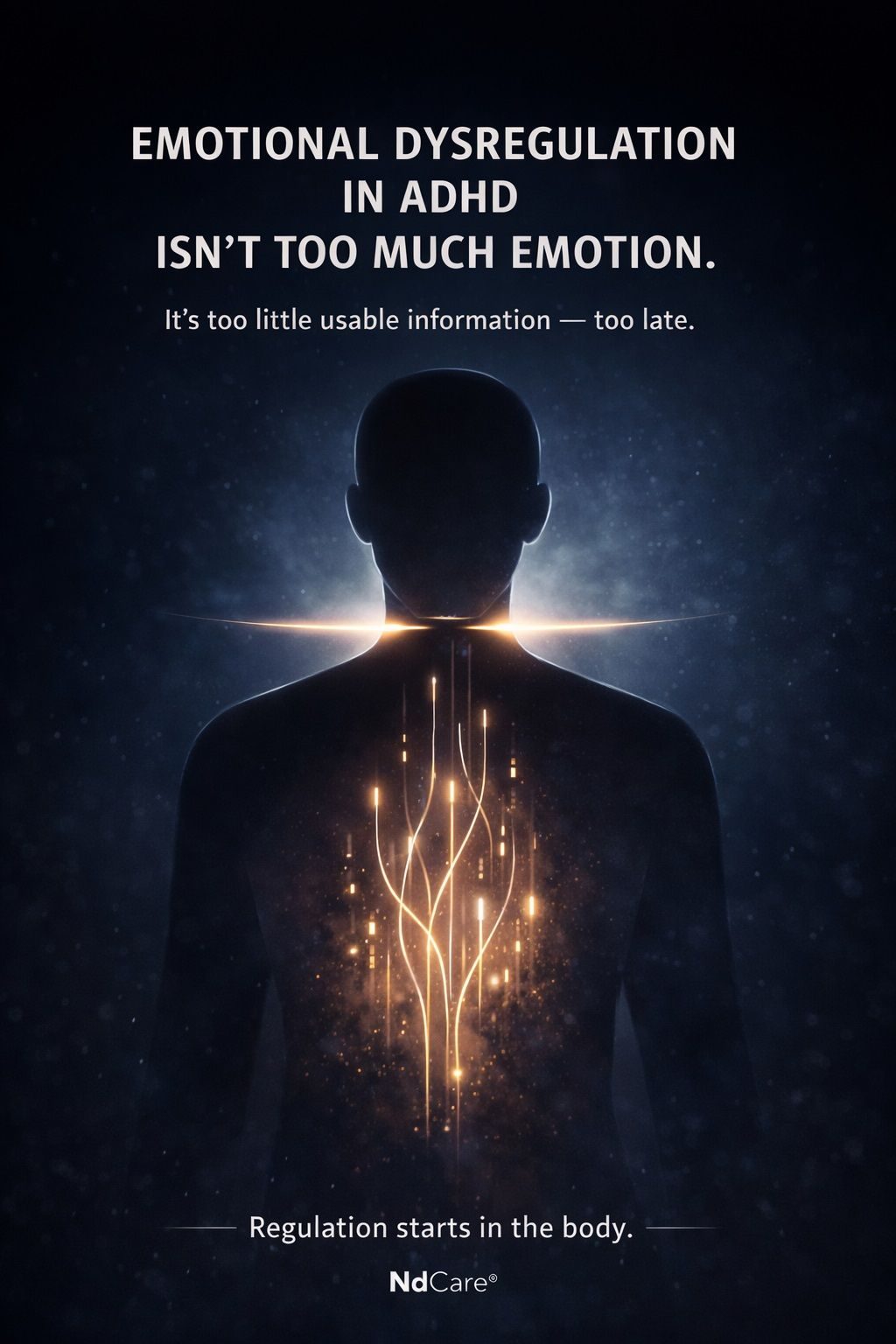
Emotional dysregulation in ADHD is often not ‘too much emotion’.
It’s too little usable information, too late.
Which means the solution isn’t tougher coping strategies.
It’s not more discipline.
It’s not emotional suppression.
It’s restoring signal clarity.
Teaching the nervous system to:
• notice earlier
• stay present longer
• interpret sensations accurately
• and respond before escalation or collapse
That’s regulation.
And it reframes ADHD/AuDHD not as emotionally unstable...
but as running on a different sensory timeline.
This discovery is already reshaping how we think about regulation, burnout, RSD, shutdown, and “overreactions” at NdCare.
Because once you understand that regulation starts in the body...
you stop blaming the person
and start redesigning the system.
More on this soon.