
By Neal Glendenning
People hear “my brain won’t stop” and assume chaos.
But what they’re hearing isn’t chaos... it’s capacity without containment.
ADHD minds don’t simply think fast.
They absorb fast.
They interpret fast.
They make connections faster than the world expects them to.
We take in:
more ideas
more emotions
more patterns
more questions
more possibilities
more atmosphere
more nuance
more unspoken signals
And when that much data is running through a nervous system that was never designed to filter in linear order, it doesn’t present as calm productivity... it presents as noise, velocity, overwhelm, and what people label “racing thoughts.”
But here’s the truth:
What feels like racing isn’t speed.
It’s width.
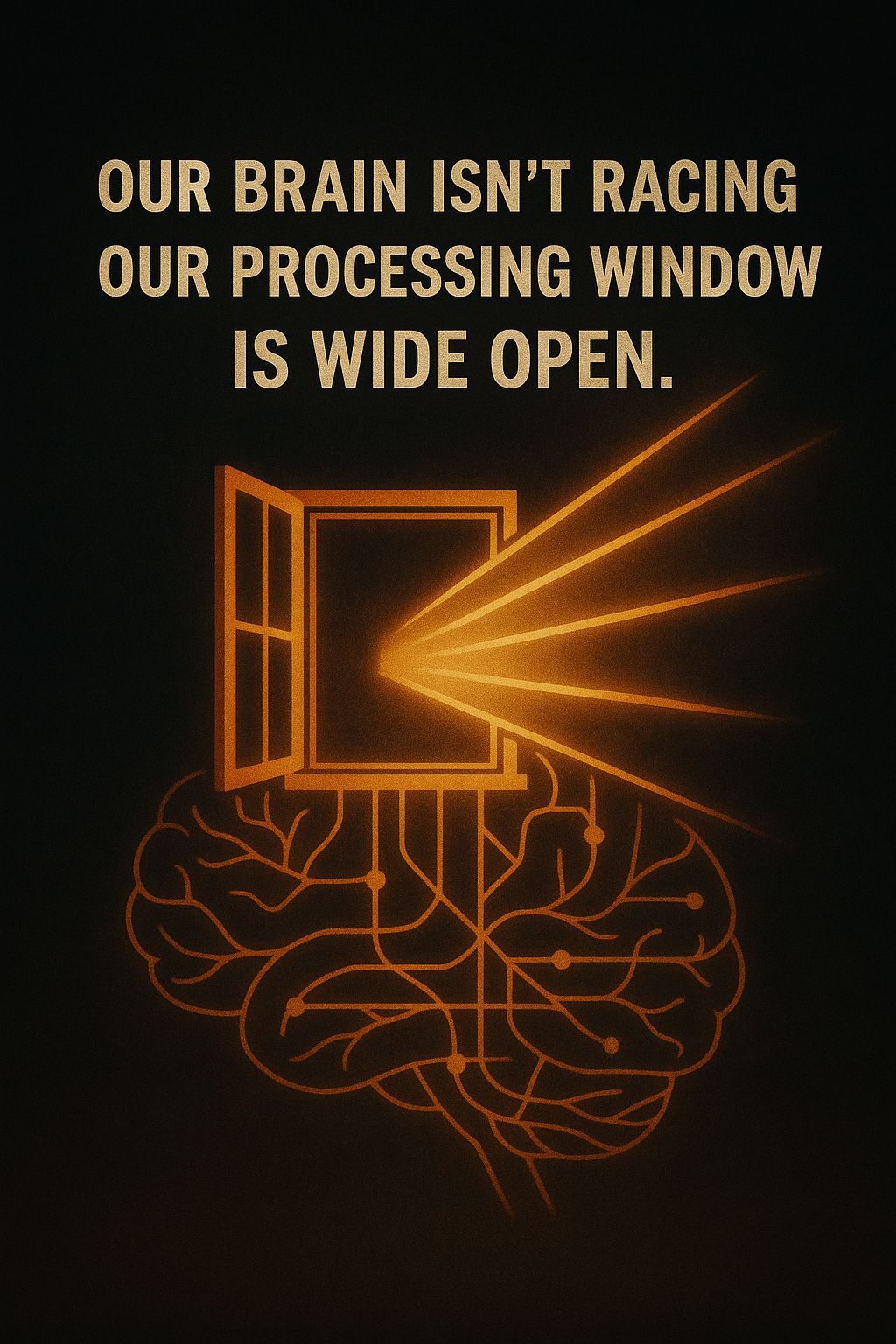
Our processing window is wide open.
We’re not running faster... we’re running on more lanes at once.
When that width has no direction, no outlet, no structure that honours how we work, the mind spirals. Thoughts collide. Ideas stack. Emotions amplify. Everything becomes “all at once,” and the world calls it dysregulation.
But when that same width finds alignment...
when ideas have a pathway,
when emotions have context,
when curiosity has permission,
when meaning drops in...
something else happens entirely.
The same brain that was drowning becomes a channel.
A conduit.
A force.
It doesn’t feel like racing anymore.
It feels like coherence.
It feels like flow.
It feels like genius.
That’s the paradox of ADHD cognition:
We don’t need fewer thoughts.
We need somewhere to put them.
We don’t need to quiet the mind.
We need systems that can hold what the mind creates.
Because the issue was never overthinking...
it was under-channelling.
Purpose becomes the nervous system’s traffic light:
green when something matters,
amber when something’s emerging,
red when something misaligns.
Give us a reason, and our brain organises itself.
Give us meaning, and the noise becomes pattern.
Give us direction, and the velocity becomes precision.
Our mind isn’t malfunctioning.
It’s multi-tracking.
And once the world stops trying to slow us down
and starts helping us channel what we carry,
they’ll stop asking, “Why is your brain racing?”
and start saying,
“I finally see what your brain is capable of.”