
By Neal Glendenning
ADHD “time blindness” gets framed as irresponsibility, chaos, or carelessness.
But look closely... it isn’t about not valuing time.
It’s about experiencing time differently.
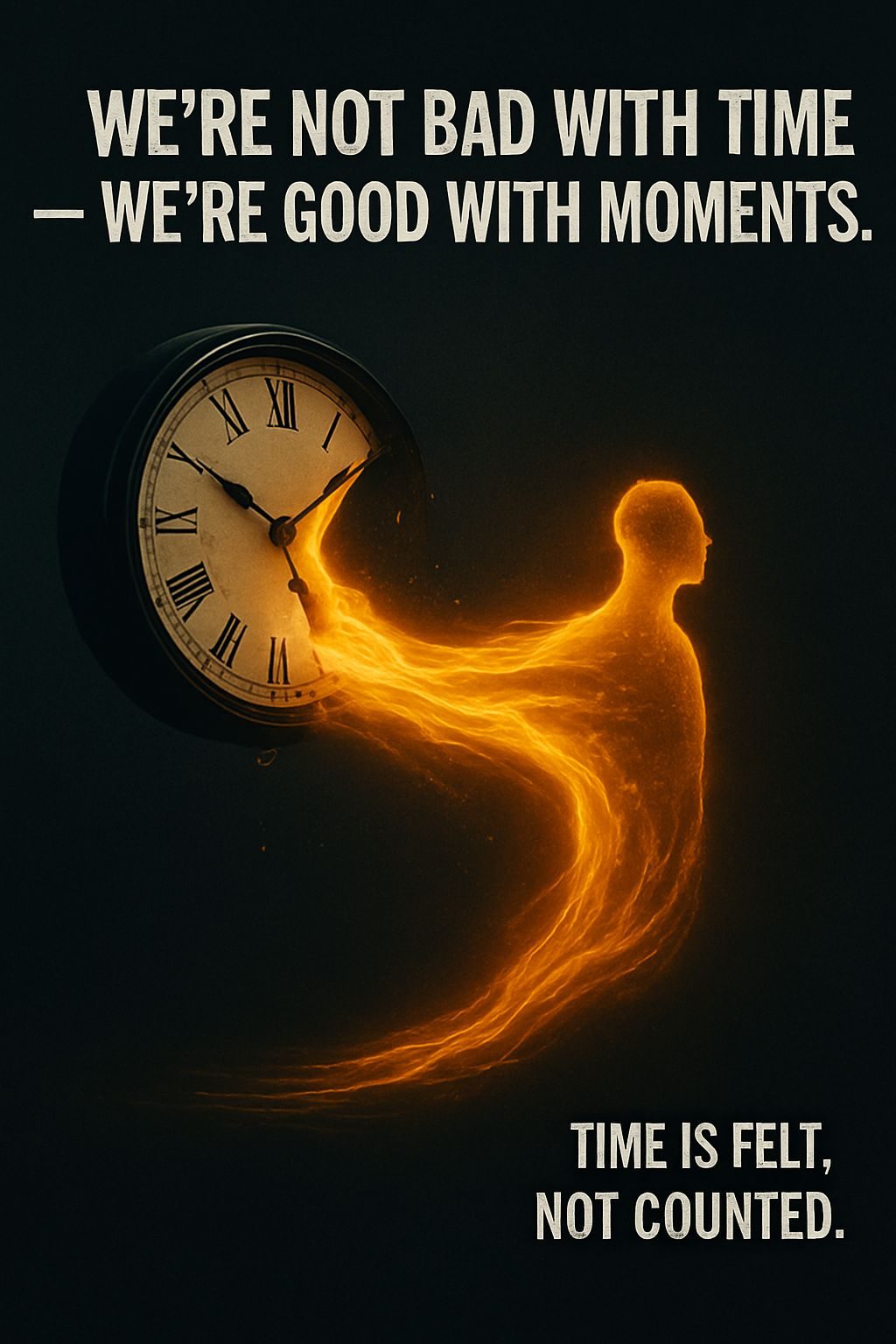
Most people live in clock time: minutes, hours, tidy boxes.
But we live in felt time: meaning, momentum, emotional gravity.
We don’t navigate by the ticking second.
We navigate by the internal shift... the spark, the pull, the signal that says: this matters now.
We feel the present with intensity.
We feel the future only when it becomes emotionally embodied... when it stops being an abstract concept and starts being a lived experience in the nervous system.
That’s why deadlines hit all at once.
Why routine tasks slip.
Why an afternoon can disappear into a hyperfocus vortex or evaporate into avoidance without us noticing the transition.
It’s not that we’re late because we don’t care.
We’re late because time, for us, is alive... not linear. It stretches, contracts, shapeshifts. It moves with mood, energy, meaning. It bends itself around emotion, not minutes.
And instead of pathologising that, we need environments that understand it.
We need design, not discipline.
We need tools that meet our brain where it actually lives:
• Emotional anchors, not just alarms.
Tie the task to a feeling, a purpose, a reason that actually lights the system up.
• Visual timelines, not verbal reminders.
We need to see time to believe time... to map the invisible into something tangible.
• Momentum cues, not moral judgment.
A gentle nudge that says, “start here,” not a lecture that says, “why didn’t you.”
• Bridges between states, not abrupt switches.
Our brain needs a warm-up, a landing, a transition... not a demand to teleport attention.
People say, “Just manage your time better.”
But time isn’t what we manage.
What we manage is energy, meaning, nervous system load, emotional resonance, and the internal physics of engagement.
Clock time is a construct... useful, yes, but not universal.
Presence, depth, immersion... those are our native languages.
We’re not built to chop life into identical units.
We’re built to pour ourselves into the moments that matter, the moments that move something in us.
And when we stop treating that as a flaw and start treating it as a form of intelligence, everything shifts.
We don’t need to become masters of minutes.
We need systems that translate time into something we can feel... something that syncs with how our brains actually work.
Because we’re not bad with time.
We’re brilliant with moments.
And if the world learned to design for that, we wouldn’t be “late” — we’d be aligned.